







 Customer Dispute Resolution Page
 Help Center
 Affiliate Program
In this article
Welcome to WPT Global
Welcome to WPT Global, the online home of the World Poker Tour®. Let us guide you through setting up your account and get you to the tables in no time.Social Media


How To Play
World Leading Tournaments
A huge player pool and everything from freerolls to high rollers – plus regular special events!Ambassadors
Get to know our ambassadors - world-class players from across the globe who embody the spirit of the game. Discover their stories and become part of the community.Your Hub for News
Explore stories, tips, and updates from the world of poker and casino. Learn from pros, discover new trends, and stay in the loop with everything happening at WPTGlobal.What are you looking for?
Close




Poker Blinds Explained: Small Blind & Big Blind Guide
Share




Poker blinds, the small blind and big blind, are the forced bets that help run every poker game. It doesn't matter if you're playing online or in live poker rooms, blinds are the foundation of every game you play.
So, if you're learning to play poker, here's why blinds add structure to poker and define your overall strategy. Understanding poker blinds helps you plan preflop decisions and manage stack sizes in cash games and poker tournaments, while protecting your chips.
What Are Poker Blinds?
Poker blinds are forced bets that are made before a new round of action begins. They're known as forced bets because they have a fixed value and players can't opt out of making them.
Before we talk more about poker blinds, we need to separate them from antes, as both blinds and antes are types of forced bets. It's best to define blinds and antes in the following ways:
Blinds come in pairs (the small blind/big blind). They're always positioned to the left of the button and move clockwise around the table.
Antes are a mandatory bet placed by each player at the table before any cards are dealt. In stud variants they're accompanied by a secondary ante, known as the bring-in. Antes don't move around the table. Similarly, the bring-in doesn't move in a structured way. Instead, the player with the highest or lowest face-up card (depending on the game) pays it.
To further complicate things, you can have blinds and antes in the same game. In tournament play, for example, there may come a point when antes have to be posted along with the blinds, but we'll talk about this more later.
The main point to remember is that two players post blinds, and everyone at the table posts antes.
Why Do Blinds Exist?
Blinds exist to create action. They do that by forcing you to put money into the pot twice per orbit. This forces you to play hands because, if you didn't, your stack would slowly dwindle.
Given that the blinds play such an important role in the game and, in turn, your strategy, let's take a closer look at the small and big blinds.
The Small Blind and Big Blind
The two blinds in a standard poker game each play a distinct role.
The Small Blind
The small blind is a forced bet made by the player to the left of the button. The small blind costs 50% of the big blind. For example, if the big blind costs $10, the small blind costs $5.
The Big Blind
The big blind is a forced bet made by the player to the left of the small blind. The big blind defines the table stakes. For example, if sitting at a $1/$2 poker table, the big blind will be $2. The big blind also determines the amount players can sit down with in cash games.
Generally, the maximum buy-in will be 100x the big blind. Similarly, the minimum buy-in will typically be 40x the big blind. So, in our fictional $1/$2 cash game, the maximum buy-in would be $200, and the minimum buy-in would be $80.
How Blinds Work in Poker Games?
Here's an example of how the blinds work in poker. We'll go back to the fictional $1/$2 cash game. It's a Texas Hold'em game, and there are six players at the table.
Before any cards are dealt, the dealer button is given to the player in seat 6. That means the player in seat 1 posts the small blind ($1), and the player in seat 2 posts the big blind ($2).
Who Acts After the Blinds Have Been Posted?
Once the blinds have been posted, the hand begins with everyone getting two hole cards. Then, as per the rules of poker, the player sitting to the left of the big blind acts first.
We call this position "under the gun" because the first player to act doesn't have any information. All the pressure is on them, so they're said to be staring down the barrel of a gun.
Pre-Flop vs. Post-Flop
After the under-the-gun player has made their move, play moves clockwise around the table. Before the flop (aka pre-flop), the last player to act is the big blind.
After the flop (post-flop), the player closest to or on the dealer button acts last, and the small blind (or the player closest to it) acts first.
This process is replicated every betting round. Once the dealer button returns to its initial starting point, it's said to have completed one orbit of the poker table.
Example Hand
Here's an example poker hand from our fictional $1/$2 cash game, so you can see how the blinds work. We won't complicate things by adding hole cards and community cards. Instead, we'll hide everyone's cards and focus on the blinds.
The Set-Up
Six players sit down in a $1/$2 cash game. The player in seat number 6 has the button, which means players 1 and 2 are in the blinds.
Player 6 has the button and receives two hole cards.
Player 1 posts the small blind ($1) and receives two hole cards.
Player 2 posts the big blind ($2) and receives two hole cards.
Player 3 receives two hole cards.
Player 4 receives two hole cards.
Player 5 receives two hole cards.
Pre-Flop Betting Round
With Player 2 sitting in the big blind, the action starts with Player 3. This player has the ability to call the big blind, raise, or fold.
Player 3 acts first and folds.
Player 4 raises to $6.
Player 5 folds.
Player 6 folds.
Player 1 folds.
Player 2 calls.
Post-Flop Betting Round
There are only two players in the hand when the flop is dealt. If the small blind isn't active, the closest player to their left must act first. In this hand, Player 2 (the big blind) still has cards, which means they're first to act.
Player 2 acts first and checks.
Player 3 bets $10.
Player 2 folds.
Player 3 wins the pot.
That's how the blinds work in Texas Hold'em cash games, but what about other variants? Mandatory bets vary depending on the game you're playing, as we'll explain in the next section.
Blinds in Different Poker Variants
The mandatory bet in Hold'em is different from Seven Card Stud. There are also differences between cash games and tournaments. As a player, you need to know the structure before you start.
In the first instance, you have blinds vs. antes, as we've already discussed. The structure used depends on the variant you're playing:
Poker variants that have small and big blinds: Texas Hold'em, Pot Limit Omaha, Omaha Hi/Lo, 2-7 Triple Draw, Five Card Draw, Pineapple, and Badugi.
Poker variants that have antes and bring-ins: Seven Card Stud, Razz, and Short Deck (aka 6+ Hold'em).
Once you know the way mandatory bets are made, you can look at the format:
Cash Games: The blinds are fixed, which means they always cost the same amount. For example, if you're sitting in a $5/$10 cash game, the small blind will always be $5 and the big blind will always be $10.
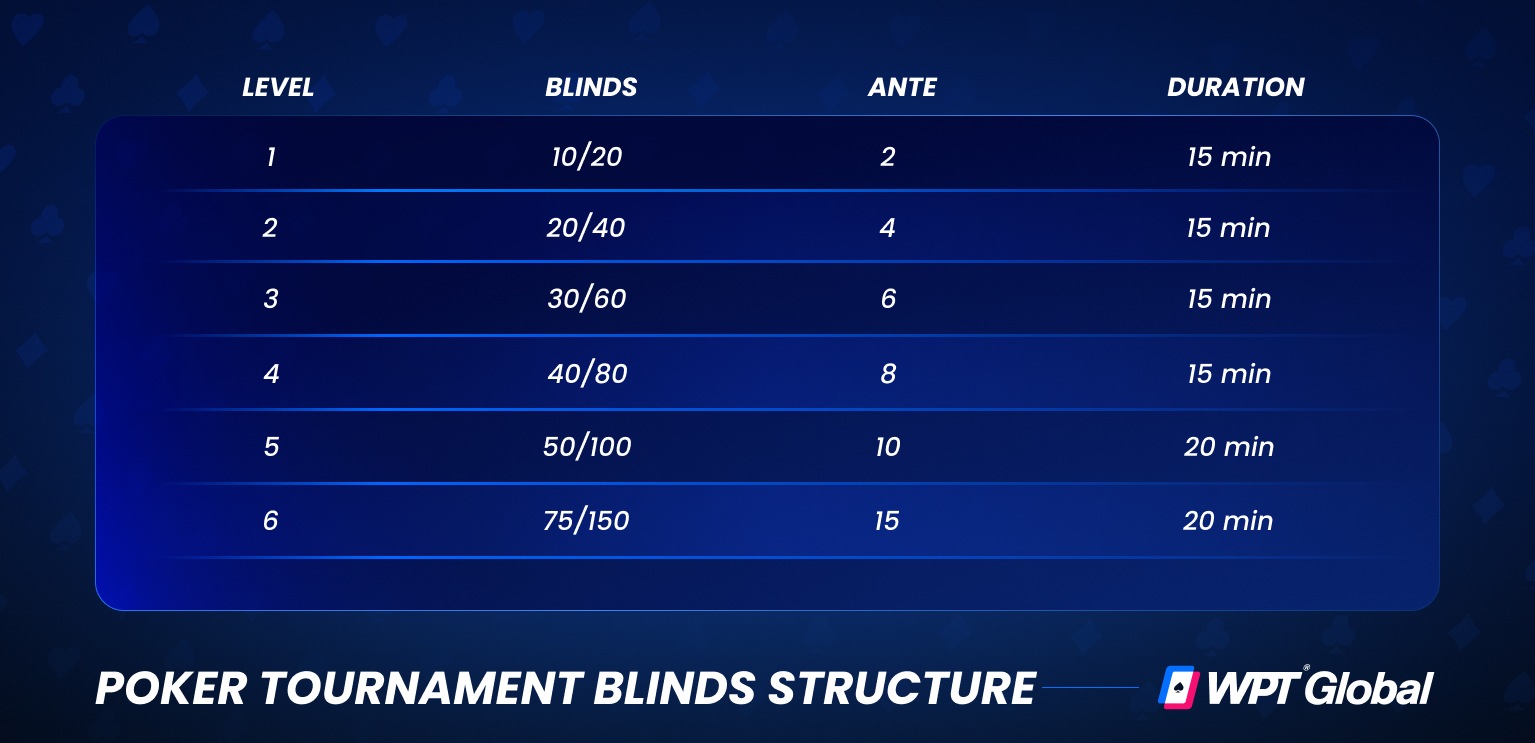
Poker Tournaments: Blind levels increase at predetermined intervals (the blind structure). For example, a tournament might start at 10/20, but then move up to 20/40 after 5–15 minutes. Blind levels keep escalating throughout tournament play.
Supplementary Bets
The final thing to consider when it comes to blinds in cash games and tournaments is supplementary bets.
Antes
As we explained earlier, antes can also be used in conjunction with blinds. In these situations, the blinds and antes are posted simultaneously. That means everyone puts in the ante, and two players put in the blinds + the ante.
Antes are used in the latter stages of certain tournaments to create more action. In cash games, antes are an optional extra used in live games and for certain online poker tables.
Straddles
Straddles are optional bets used in cash games. They're posted at the same time as the blinds by the player to the left of the big blind.
The straddle amount varies depending on the game you're playing. However, in most cases, it's twice the cost of the big blind. So, if the big blind is $4, a player who wants to straddle must put $8 into the pot before any cards are dealt.
When the under-the-gun player straddles, they get to act last pre-flop. That means the player next to the straddle has to act first. Finally, the straddle replaces the big blind as the minimum amount players have to pay to stay in the hand.
Blind Levels in Poker Tournaments
Managing the escalating blinds is a skill that all tournament players have to master. To master the art of tournament play, you need to consider the blind structure. Each tournament has a distinct structure, both in terms of the number of starting chips each player receives and the frequency of blind increases.
Stacks are measured in relation to the big blind when it comes to structures. For example, let's say each player starts with 2,000 chips and the initial blinds are 10/20. That means the big blind is 20. In this situation, the player has 100 big blinds, i.e. 2,000/20 = 100.
Poker tournaments typically have one of three structures:
Short Stack: A short-stack tournament is one in which players start with 50 big blinds or less.
Regular: A regular tournament is one in which players start with 100 big blinds.
Deep Stack: A deep-stack tournament is one in which players start with 200 big blinds or more.
Alongside the structure, you need to consider how quickly the blinds increase. There are four main speeds when it comes to tournament blinds:
Slow: The blinds increase every 20-60 minutes in slow online poker tournaments and 90-120 minutes in live poker tournaments.
Regular: The blinds increase every 10-15 minutes in regular speed tournaments and 30-60 minutes in live tournaments.
Turbo: The blinds increase every 5 minutes in turbo poker tournaments and 15 minutes in live tournaments.
Hyper Turbo: The blinds increase every 2-3 minutes in hyper turbo tournaments. The hyper-turbo format isn't used in live poker tournaments.
The structure and speed of a poker tournament impact how you play. For example, in a deep-stack tournament with a slow clock, you can afford to be patient. In a short-stack turbo tournament, you need to have a wide opening range from the start.
Something else to consider is your chip count in relation to the blinds and how it changes over time. You might have a big stack in relation to the blinds if you win a lot of hands, or you may be short-stacked. What's more, the definition of big and short stacks changes as a tournament progresses.
At the start of play, 100 big blinds would be average, so anything over that would be a big stack. However, as the blinds increase relative to the average chip count, a big stack might be more like 50 big blinds.
As before, your chip count determines how you play. You can be aggressive with a big stack, but not with a short stack. Understanding your position and how to adapt is an important skill in poker, as is learning how to play from the blinds.
Strategy for Playing from the Blinds
The final strategy concept to master when it comes to poker blinds is defence. Specifically, you need to defend your big blind.
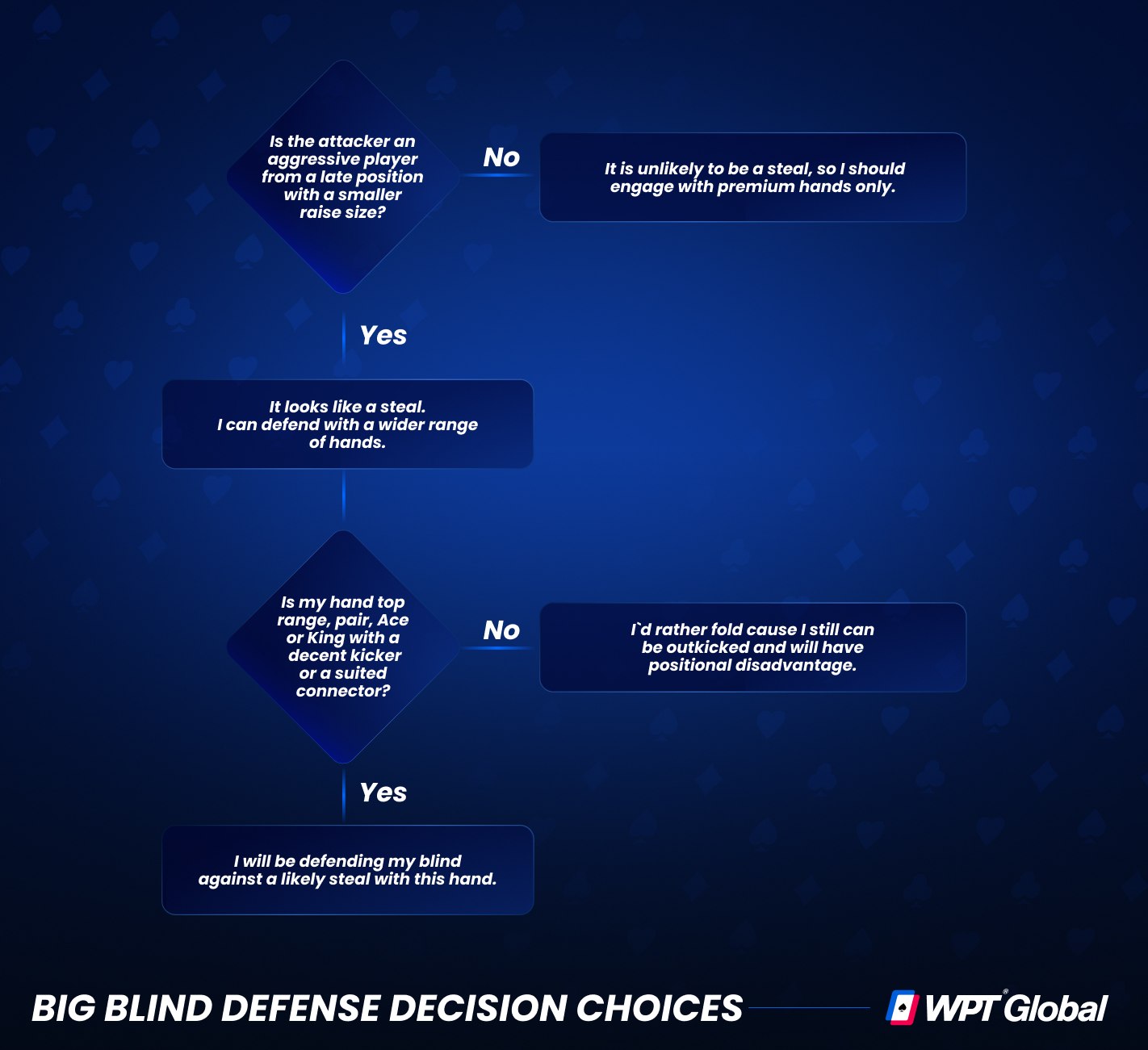
In preflop you should widen your defending range versus frequent stealers, but tighten versus large raises. And from the small blind position make sure to defend selectively with hands that play well out of position, and avoid dominated offsuit aces and kings.
Skilled poker players know that the blinds are dead money. The players were forced to post them before receiving any cards, so there's a high probability that they don't have hands they're willing to play.
Because of this, smart players attack the blinds in an effort to win easy chips. You can't let these players steal your blinds with impunity. That doesn't mean calling every time someone raises. However, you should be more willing to call or raise with less-than-premium hands if an aggressive player is constantly attacking your big blind.
You'll be playing out of position, so there are right and wrong hands to defend with. Aces with a weak kicker are rarely hands you should defend with. The same goes for kings with weak kickers and pure bluffs. Aces with a jack or better can be good hands to defend with.
You could also consider adding suited connectors to your range because they're fairly easy to play post-flop: either you hit something worth playing or you fold. Master this while simultaneously being aware of your stack in relation to the blinds, and you'll be a much stronger poker player.

FAQs
Who bets first in poker with blinds?

The player to the left of the big blind is first to act in a traditional poker game. The first player to act, aka the under-the-gun player, can fold and pass the action onto the next player. If they wish to continue, they must call an amount equal to the big blind or raise.
What does 100 big blinds mean?
100 big blinds (aka 100 bbs) means your chips in play are equal to 100x the big blind. For example, if the big blind is 20 and you have 2,000 chips, you've got a 100 bb stack.
When should you increase blinds?
The blinds only increase in poker tournaments. The intervals between each increase are determined before the start of play. There isn't a perfect structure because tournament organisers have different goals.
What is a blind check in poker?
A blind check in poker is when a player exercises their right to check before the next community card is dealt. Phil Hellmuth famously uses this move to confuse his opponents.
Can the big blind raise pre-flop?
Yes, the player in the big blind can raise pre-flop. If they do, the action moves to the first player sitting to their left. If no one calls, the big blind takes the pot uncontested, and the betting round is over.



Promotions
For Customers
Safety & Security
Stay Connected
Follow us on social media to stay updated with the latest news, updates, and exclusive offers!


Promotions
For Customers
Safety & Security
Stay Connected
Follow us on social media to stay updated with the latest news, updates, and exclusive offers!
 Local Payment Methods
 Cards
Cards Crypto
 E-Wallets
 Apple Pay
 Google Pay
 Instant Bank Payments
*
Some methods may not be available in your region. Please contact support if you experience any issues.
This website is operated by Everstronglink Limited a company incorporated under the laws of Costa Rica having its registered address at Province 01 San Jose, Canton 02 Escazu, San Rafael, On La Ceiba Street, House No. 400, Costa Rica, and is licensed by the Tobique Gaming Commission under License Number 0000005. Kashxa Limited, a Cyprus company with registration number 427606, having its registered office at Strovolou, 12 Aigyptou, Nicosia, 1097, Cyprus, is acting as a payment agent on behalf of the license holder entity Everstronglink Limited.
Gambling can be addictive. Play responsibly. Everstronglink Limited only accepts customers over 18 years of age.
Copyright © 2026 WPT Global. All rights reserved