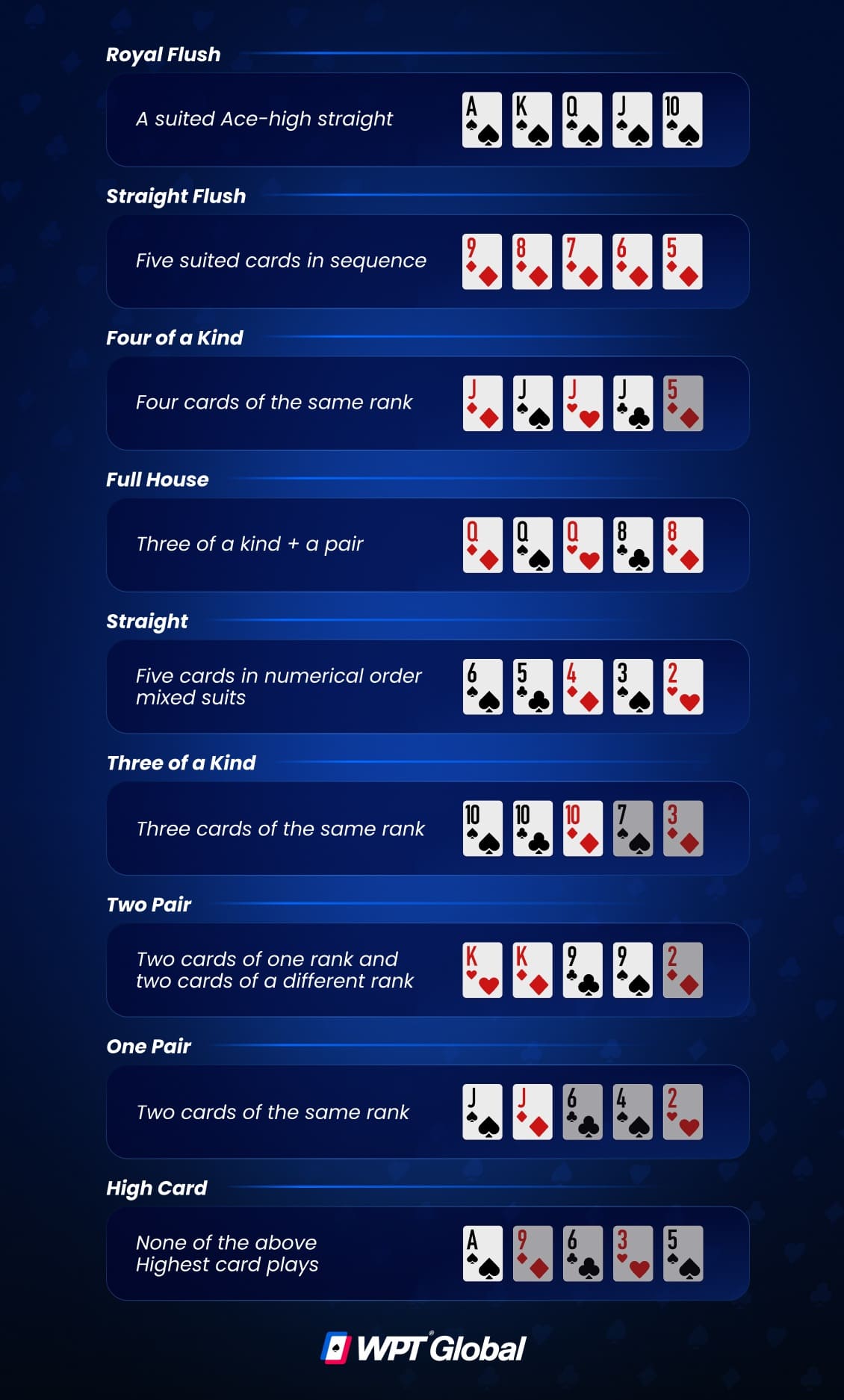
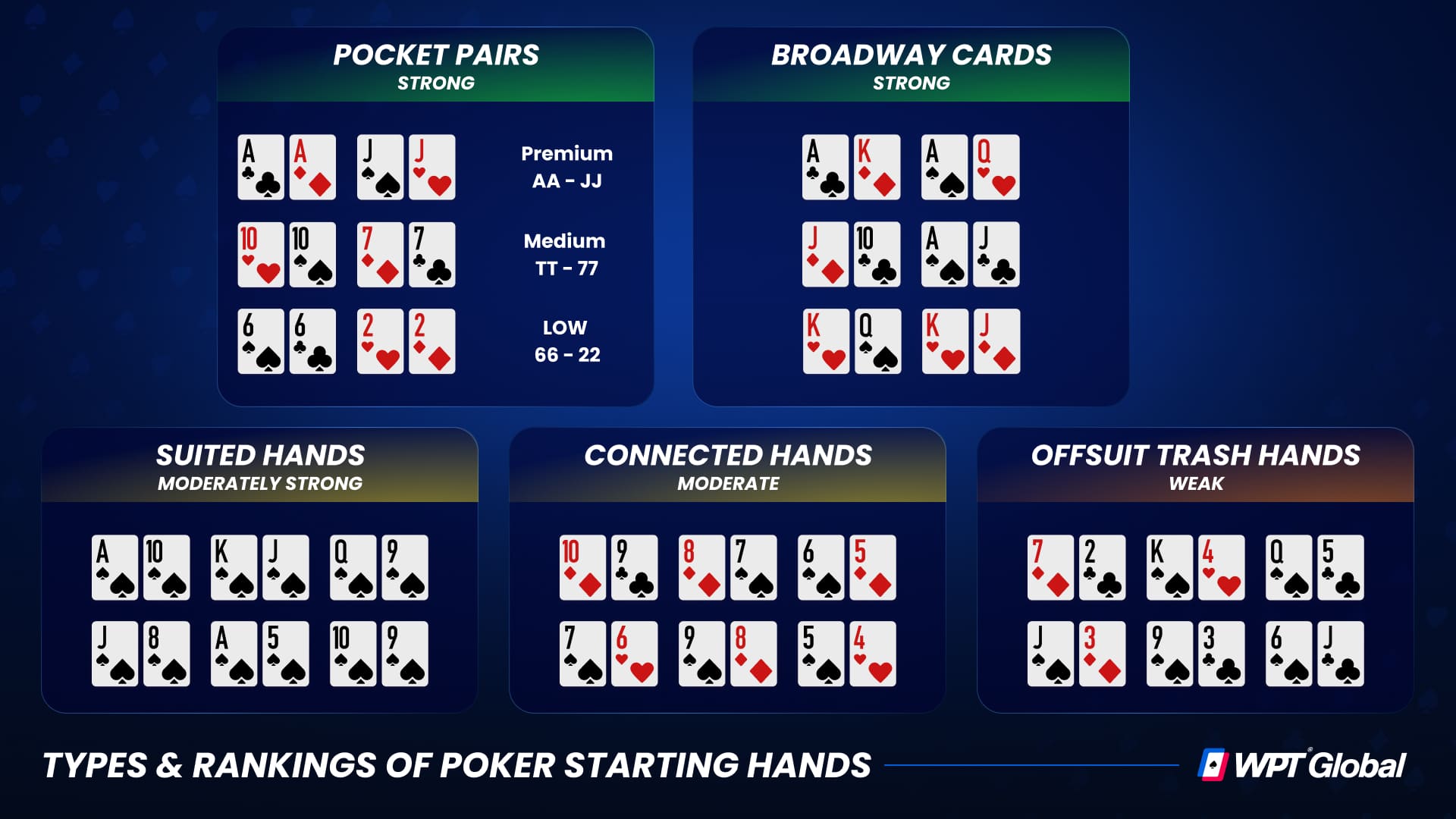
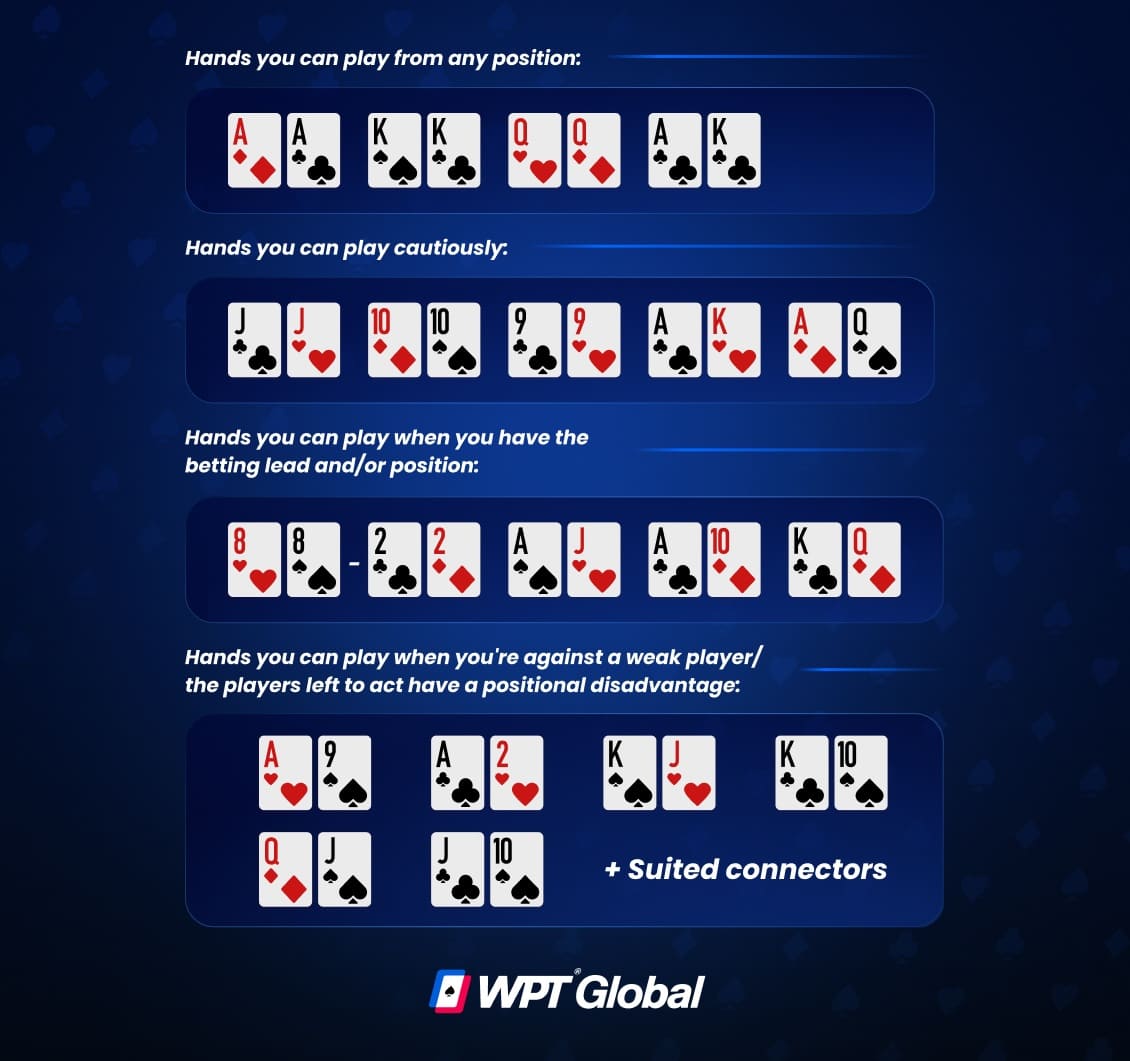
Once you've added rankings and starting hands to your cheat sheet, the next strategy concept to consider is position.
Again, we've got an in-depth article on poker positions that you can read. For the purposes of this guide, we'll touch on the most important concepts.
Position is defined in terms of your proximity to the button. We use the button as an anchor point because the player with it (or closest to it) closes the action after the flop in Texas Hold'em and Omaha.
Closing the action is an advantage because you get to see what other people have done and, in turn, dictate the betting.
As per the rules of poker, the button moves around clockwise after the end of a hand. That means you'll be on the button once every orbit of the table. Here's a general overview of the strategies you should use in different positions:
Under-the-gun (the first player to act) = only play if you've got a very strong hand
Early positions = only play if you've got strong hands
Middle positions = play high-value pairs and aces with strong kickers
Late positions (and the button) = play most pairs, most aces, and broadway hands such as K-Q
The blinds = play a tight range because you'll have a positional disadvantage after the flop
Odds and equities are the next thing to go on our poker cheat sheet. Below, you'll find the poker odds of hitting ranked hands on the flop, as well as the equity you need to chase draws and call river bets.
Knowing the numbers in common situations is the difference between making profitable and unprofitable moves.
By profitable and unprofitable, we mean in terms of long-term expected value. In other words, if you made the same move thousands of times, would it yield a profit or a loss, based on the numbers?
What are the chances of landing a dream flop? These are the odds of hitting common made hands when the first three community cards hit the board in Texas Hold’em.
These odds assume you play a large sample of hands, outcomes may vary greatly in the short term but will tend to align with these probabilities over time.
Hand equity refers to your chance of winning a pot based on the current cards you have versus your opponent’s possible range. Knowing your equity lets you make smarter bets, especially when chasing draws!
The final section of our ultimate poker cheat sheet focuses on betting. Every poker game you play takes place across multiple streets. You need to know how to play profitably on every street.
Too many newbies make the mistake of thinking they can win hands before the flop. The truth is that world-class poker players will go to the flop and beyond as much as possible against newbies.
They do that because it's where they have the biggest edge. Therefore, if you want to become a better poker player, you need to have a general understanding of how to play hands across multiple streets.
Learn all about pre-flop strategy in our dedicated guide. TL;DR:
Have a tight raising range in early positions and gradually increase your range as you move into later positions.
Bet in position when you have a strong pre-flop hand (J-J or better + A-K) or when you're against a weak player and you have position.
Continuation Betting is the act of betting on the flop after raising pre-flop. In general, you should be continuation betting more than 60% of the time when any or all of these conditions are met:
It's a dry board (aka flop). A dry board consists of cards that aren't close in value or suit, e.g., 4♥ 8♠ Q♦.
When you're against one opponent.
When the board consists of at least one broadway card. Why? Because a broadway card is likely to hit your perceived range (i.e., people will assume you've raised pre-flop with a range that contains broadway cards).
When you're seen as a tight player. In these situations, people are more likely to assume you've hit something because you only seem to bet when you've got strong hands.
You should be less inclined to make a continuation bet on wet boards. Wet boards contain a lot of connected cards and, therefore, draws. The risk of continuation betting on these boards is that someone could easily raise with a strong draw.
If that happens, you'll not only have to fold bluffs but also consider folding hands that might currently be winning but aren't strong enough to play a big pot with. Conversely, if you've got a strong draw and want to put more pressure on an opponent, you can elect to check-raise.
This means you're not continuation betting but checking instead. Then, if your opponent bets, you can raise. For this to be an effective move, you need to have a strong straight draw or flush draw. You also need to be relatively certain your opponent will bet when you check.
Your turn strategy should be a continuation of what you did on the flop. Essentially, the decision you make on the flop should govern what you do for the rest of the hand.
For example, if you continuation bet as a bluff on a dry flop and the turn is a blank (i.e., a seemingly innocuous card), you should bet again if you believe your opponent will fold. If, of course, the turn changes the board's dynamics, you can slow down and check.
The point here is that the story you tell on the flop should continue onto the turn. Poker players who tell the most convincing stories typically win the most pots.
Therefore, your aim on the turn should be to continue telling a consistent story, unless the board's dynamics change in your favour or against you. If that happens, it's time to reassess what the optimal move is based on your opponent's possible range and the story you've started telling.
The river completes your story and your opponent's story. It's the point in a hand when a final decision has to be made. If you're betting, you need to know if you're doing it for value or as a bluff.
Betting the River for Value
If you're betting for value, choose an amount relative to the size of the pot and your opponent's stack that's attractive.
For example, if there's $100 in the pot and your opponent has $100 in their stack, $60 is an attractive bet size for two reasons: 1. They'll still have chips if they call and lose. 2. They can win almost double their stack.
Bluffing on the River
Suppose you're betting as a bluff, the same principle applies but in reverse. The amount you bet needs to be scary enough in relation to someone's stack that they can't call unless they've got a monster hand.
Calling on the River
If you're the person calling, you need to decide whether your hand is winning on balance. By that, we mean that your hand needs to be ahead of your opponent's betting range.
Let's say you've got a set, but there's a possible flush on the board. You assume that your opponent's range contains a flush, a pair, and some bluffs.
On balance, you figure that a flush represents the smallest percentage of their range. If that's the case, you should call. This is how you need to think when you're facing bets on the river.
River Cheat Sheet Summary:
Bet big for value with strong hands
Bluff big only if opponent is likely to fold
Call when your hand beats most of their range
Let's bring this poker cheat sheet to a conclusion with four important do's and four important don'ts. Keep these in mind when you're playing cash games or a poker tournament, and you won't go far wrong:
Do's
Always play in position when possible
Be aggressive whenever you can
Observe opponents
Steal blinds at any opportunity
Don'ts
Proper bankroll management means only playing at stakes where you can comfortably handle big swings. Many pros recommend never risking more than 5% of your bankroll on a single game.
That's everything you need to get started. Screenshot this guide, print it out, or commit it to memory. Whichever way you do it, keep this cheat sheet handy when you're playing poker, and you'll be on the way to developing a winning strategy.







 Customer Dispute Resolution Page
 Help Center
 Affiliate Program