





 Customer Dispute Resolution Page
 Help Center
 Affiliate Program
In this article
Welcome to WPT Global
Welcome to WPT Global, the online home of the World Poker Tour®. Let us guide you through setting up your account and get you to the tables in no time.Social Media


How To Play
World Leading Tournaments
A huge player pool and everything from freerolls to high rollers – plus regular special events!Ambassadors
Get to know our ambassadors - world-class players from across the globe who embody the spirit of the game. Discover their stories and become part of the community.Your Hub for News
Explore stories, tips, and updates from the world of poker and casino. Learn from pros, discover new trends, and stay in the loop with everything happening at WPTGlobal.What are you looking for?
Close




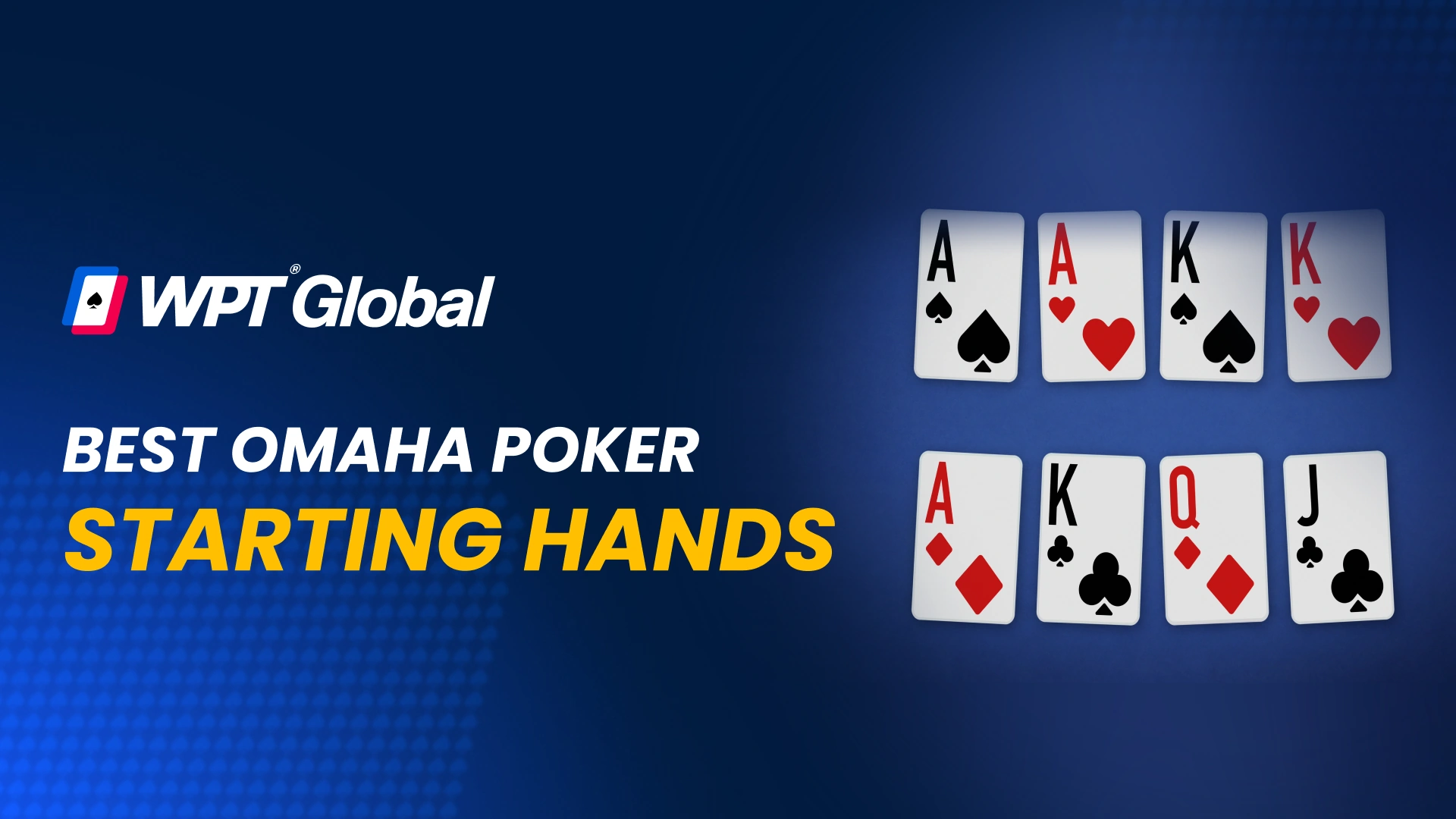
Best Omaha Poker Starting Hands: A Complete Strategy Guide
Share




Key Takeaways
Omaha starting hands are more complex than Texas Hold’em due to four hole cards.
The best hands are coordinated, connected, and capable of making the nuts.
Double-suited and connected high-card hands dominate most situations.
Even strong-looking hands like AA can be weak without support.
Position and hand coordination are critical to long-term success in Omaha.
At first glance, Omaha looks similar to Texas Hold’em. The same community cards, the same betting rounds, and the same goal of making the best five-card hand. But the moment you are dealt four cards instead of two, everything changes.
In Omaha, starting hand selection becomes significantly more important and far more complex. Many beginners make the mistake of overvaluing hands that look strong in Hold’em, only to find themselves consistently second-best.
This guide breaks down omaha poker starting hands in a practical way. You will learn what makes a strong hand, how to identify profitable combinations, and how to avoid the most common traps that cost players money.
What Makes a Good Starting Hand in Omaha?
The biggest difference between Omaha and Hold’em is simple. You must use exactly two of your four hole cards, combined with three community cards. This rule alone dramatically changes how hands are evaluated and played.
Because of this, the probability of strong hands at showdown is much higher than in Hold’em. Marginal holdings that might be good in other formats lose value quickly, as opponents are far more likely to have strong draws or made hands.
In Omaha, hand strength is not about individual cards but how well all four cards work together. Connected hands, such as JT98, have strong straight potential and can form multiple combinations. Suitedness also plays a major role, especially with double-suited hands, which provide more opportunities to make flushes. Nut potential is critical, as winning hands are often the absolute best possible combination, meaning second-best hands frequently lose money over time.
High card strength still matters, particularly with cards like A, K, Q, and J, which help form strong top pairs and premium draws. However, coordination is the most important factor. All four cards should contribute to potential straights, flushes, or strong combinations. Disconnected hands with gaps or mismatched suits tend to perform poorly.
This is why hands like AA are not always as strong as they appear. In Hold’em, pocket aces are dominant, but in Omaha, AAxx without support can be overrated. A hand like AA72 rainbow looks strong but lacks connectivity and suitedness, making it difficult to realise its value. In contrast, a hand like AAJT double-suited is considered premium because it offers multiple ways to make strong hands.
Understanding this shift is essential, as Omaha rewards coordinated, multi-way potential rather than just raw card strength. This difference is one of the biggest adjustments players must make when transitioning from traditional poker games.
Top 30 Starting Hands in Pot Limit Omaha
Understanding which hands perform best in Pot Limit Omaha is essential because the game heavily rewards coordination, suitedness, and nut potential. Unlike Hold’em, where high cards dominate, Omaha hands must work together to create multiple strong possibilities across different board textures.
The following table outlines the top 30 starting hands in Omaha based on real-world playability, with emphasis on double-suited and highly connected combinations:
Rank | Starting Hand |
|---|---|
1 | AAKK double-suited |
2 | AAQQ double-suited |
3 | AAJJ double-suited |
4 | AAKK single-suited |
5 | AAJT double-suited |
6 | AAQQ single-suited |
7 | KKQQ double-suited |
8 | KKJJ double-suited |
9 | QQJJ double-suited |
10 | JT98 double-suited |
11 | T987 double-suited |
12 | 9876 double-suited |
13 | AKQJ double-suited |
14 | KQJT double-suited |
15 | QJT9 double-suited |
16 | AAJT single-suited |
17 | AATT double-suited |
18 | KKTT double-suited |
19 | QQTT double-suited |
20 | AKQT double-suited |
21 | AKQJ single-suited |
22 | KQJT single-suited |
23 | QJT9 single-suited |
24 | JT98 single-suited |
25 | T987 single-suited |
26 | 9987 double-suited |
27 | 8876 double-suited |
28 | A987 double-suited |
29 | K987 double-suited |
30 | Q987 double-suited |
These hands rank highly because they can make nut straights, strong flushes, and multiple redraws. The strongest Omaha hands are not just good preflop but retain equity across many different board runouts.
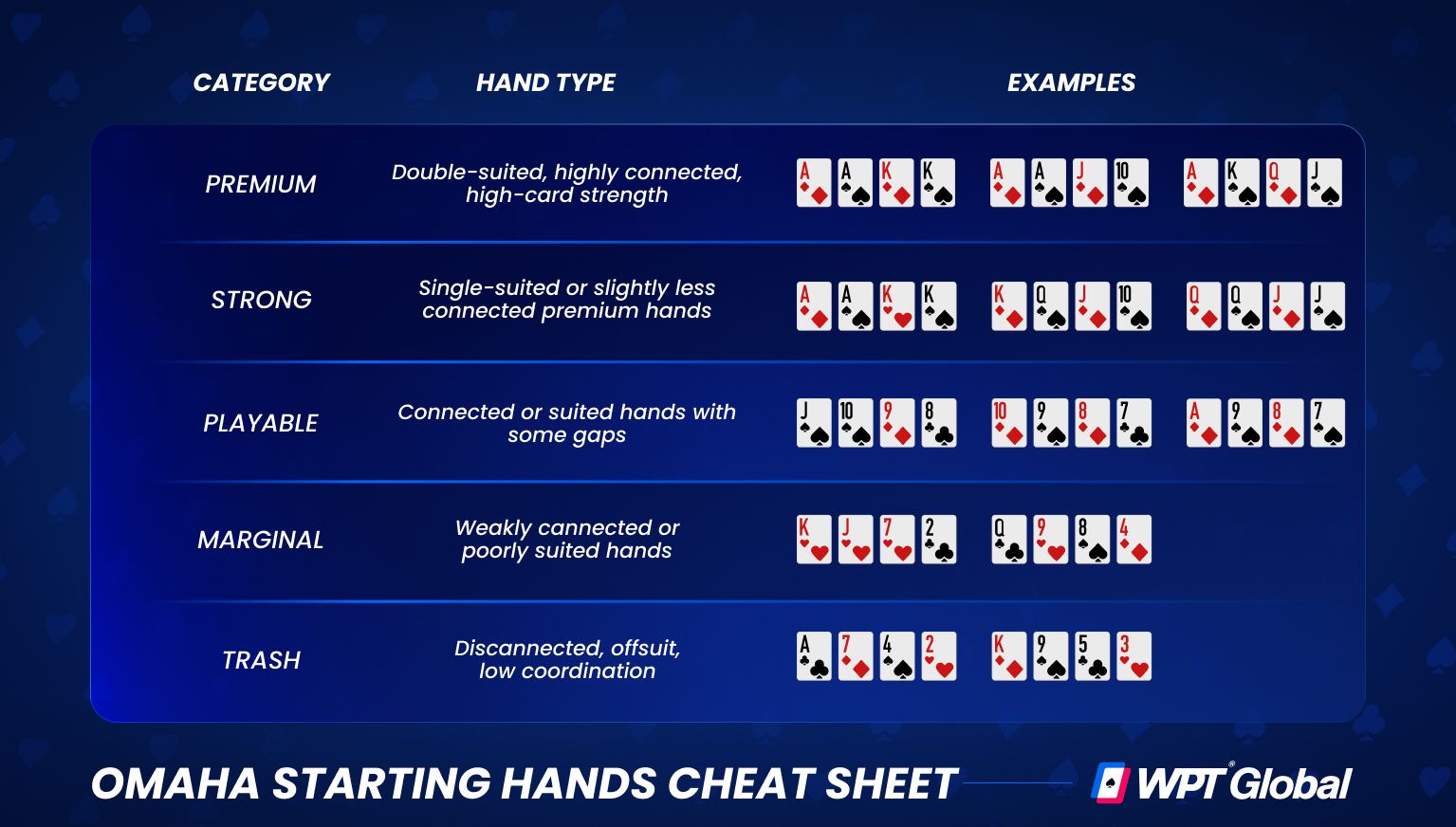
To make hand selection more practical, Omaha hands are often grouped into categories based on strength and structure:
Category | Hand Type | Examples |
|---|---|---|
Premium | Double-suited, highly connected, high-card strength | AAKK ds, AAJT ds, AKQJ ds |
Strong | Single-suited or slightly less connected premium hands | AAKK ss, KQJT ds, QQJJ ds |
Playable | Connected or suited hands with some gaps | JT98 ss, T987 ss, A987 ds |
Marginal | Weakly connected or poorly suited hands | KJ72 ss, Q984 rainbow |
Trash | Disconnected, offsuit, low coordination | A742 rainbow, K953 offsuit |
This chart helps simplify decisions by focusing on structure rather than memorising exact rankings. Strong Omaha play comes from choosing hands that can make the nuts and avoiding those that create second-best situations.
Types of Strong Omaha Starting Hands
Understanding hand categories is more useful than memorising rankings because Omaha is driven by how hands perform across multiple streets, not just their preflop strength.
Double-Suited Hands
These are the most powerful starting hands in Omaha because they offer two independent flush possibilities. Example: A♠K♠Q♥J♥. This structure significantly increases equity, as you can make strong flushes in two different suits while also having straight potential. Double-suited hands also benefit from redraws, meaning even when you make a strong hand, you often have additional ways to improve further.
Connected High Cards
Hands like AKQJ and KQJT are highly valuable because they can form multiple straight combinations across a wide range of boards. Their strength comes from flexibility and coverage, allowing them to interact with many flops. When combined with suitedness, these hands become even more powerful, often producing both straight and flush draws simultaneously.
Paired Hands (AAxx, KKxx)
Pairs still matter in Omaha, but they are far less dominant than in Hold’em. The key is support. A hand like AAJT double-suited is strong because it combines a high pair with connectivity and flush potential. In contrast, a hand like AA83 rainbow lacks coordination, making it difficult to improve beyond a single pair. Without additional structure, even premium pairs can become vulnerable.
Nut Potential Hands
The goal in Omaha is to make the nuts, not just a strong-looking hand. Hands that can make nut straights, nut flushes, and strong redraws are significantly more valuable because they avoid costly second-best situations. Players who consistently prioritise nut potential are more likely to win large pots while minimising losses in marginal spots.
Worst Omaha Starting Hands - Hands to Avoid
Some hands consistently underperform because they fail to meet the core requirements of strong Omaha play: coordination, suitedness, and nut potential. Examples include 9872 rainbow, KK72 unsuited, AQ83 disconnected, and J742 mixed suits.
The main issue with these hands is poor coordination. The cards do not work together to form straights or strong combinations, which means they rarely connect well with the board. Even when they do, they often produce weak or incomplete draws that are difficult to continue with.
Low nut potential is another major problem. In Omaha, winning hands are usually the nuts or close to it. Hands like AQ83 may make top pair, but that is rarely strong enough at showdown. Similarly, weak connected hands like 9872 may form straights, but often not the highest possible straight, leaving you vulnerable to better holdings.
These hands also suffer from weak redraw capability. Strong Omaha hands often have backup equity, meaning they can improve further even after hitting a draw. Poor starting hands lack this feature, so when they make a hand, they are often “stuck” with it and unable to improve if behind.
This leads to one of the biggest leaks in Omaha: second-best hands. Unlike Hold’em, where top pair can sometimes be enough, Omaha frequently punishes hands that are strong but not the strongest. Over time, playing these types of holdings results in losing larger pots when dominated and winning only small ones when ahead, making them consistently unprofitable.
Preflop Strategy Based on Position
Position is even more important in Omaha than in Hold’em because hands run closer in equity and post-flop play is more complex. Acting later gives you a significant advantage in managing pot size and making better decisions with incomplete information.
Early Position Starting Hand Selection
In early position, you should play tight and focus on premium, well-structured hands such as AAxx double-suited and high connected double-suited combinations. These hands perform well against strong ranges and retain equity across multiple streets. Marginal holdings should be avoided, as being out of position makes it much harder to realise equity and control the hand.
Middle & Late Position Strategy
In middle and especially late position, you can widen your range to include suited connectors, single-suited high cards, and coordinated mid-range hands. These hands benefit from having more information and the ability to apply pressure. Late position allows you to control pot size, take advantage of weaker ranges, and play more hands profitably.
Blind Defense Considerations
Defending the blinds in Omaha is challenging because you will be out of position for the rest of the hand. Weak and disconnected hands should generally be avoided, as they perform poorly without initiative. Instead, focus on hands with strong draw potential and good coordination, while remaining cautious about committing too many chips in marginal situations.
Common Mistakes Omaha Players Make With Starting Hands
Overvaluing Aces
AA without support often leads to trouble. Unlike Hold’em, aces alone are not enough. Without suitedness or connectivity, they struggle to improve and are vulnerable on coordinated boards where opponents can make stronger hands.
Playing Too Many Hands
Four cards can create the illusion of strength, but most combinations are still unplayable. Hands that look decent often lack coordination or nut potential, leading to difficult post-flop situations and long-term losses.
Ignoring Nut Potential
Second-best hands lose large pots in Omaha. Winning consistently requires aiming for the nuts or strong redraws, rather than settling for hands that can easily be dominated.
Misunderstanding Equity
Even strong hands rarely dominate in Omaha. Equity runs much closer between ranges, which means preflop advantages are smaller and more hands remain competitive through the flop and beyond.
Players transitioning from Hold’em often underestimate how different Omaha strategy really is, especially when it comes to hand selection and post-flop play.

FAQs
What are the best starting hands in Omaha?

The best hands are double-suited, highly connected combinations like AAKK double-suited or AKQJ double-suited.
Is AA a good hand in Omaha?
Yes, but only when supported by connected or suited cards. AA alone is not enough.
How many starting hands are possible in Omaha?
There are over 270,000 possible starting hand combinations, making selection more complex than Hold’em.
What is a wrap hand in Omaha?
A wrap is a straight draw with multiple outs, often involving 13 or more possible cards to complete a straight.
Should I always play double-suited hands?
Not always, but they are among the strongest types of starting hands and should usually be played in most situations.



Promotions
For Customers
Safety & Security
Stay Connected
Follow us on social media to stay updated with the latest news, updates, and exclusive offers!


Promotions
For Customers
Safety & Security
Stay Connected
Follow us on social media to stay updated with the latest news, updates, and exclusive offers!
 Local Payment Methods
 Cards
 Crypto
 E-Wallets
 Apple Pay
 Google Pay
 Instant Bank Payments
*
Some methods may not be available in your region. Please contact support if you experience any issues.
This website is operated by Everstronglink Limited a company incorporated under the laws of Costa Rica having its registered address at Province 01 San Jose, Canton 02 Escazu, San Rafael, On La Ceiba Street, House No. 400, Costa Rica, and is licensed by the Tobique Gaming Commission under License Number 0000005. Kashxa Limited, a Cyprus company with registration number 427606, having its registered office at Strovolou, 12 Aigyptou, Nicosia, 1097, Cyprus, is acting as a payment agent on behalf of the license holder entity Everstronglink Limited.
Gambling can be addictive. Play responsibly. Everstronglink Limited only accepts customers over 18 years of age.
Copyright © 2026 WPT Global. All rights reserved