





 Customer Dispute Resolution Page
 Help Center
 Affiliate Program
In this article
Welcome to WPT Global
Welcome to WPT Global, the online home of the World Poker Tour®. Let us guide you through setting up your account and get you to the tables in no time.Social Media


How To Play
World Leading Tournaments
A huge player pool and everything from freerolls to high rollers – plus regular special events!Ambassadors
Get to know our ambassadors - world-class players from across the globe who embody the spirit of the game. Discover their stories and become part of the community.Your Hub for News
Explore stories, tips, and updates from the world of poker and casino. Learn from pros, discover new trends, and stay in the loop with everything happening at WPTGlobal.What are you looking for?
Close




How to Semi-Bluff in Poker Like a Pro
Share




Semi-bluffing in poker is one of the most powerful and satisfying moves because it gives you two ways to win: immediate fold equity or value when your draw completes. This is why the pros use it frequently in cash games and tournaments.
As effective as this move can be, there are times to use it and times not to. So, if you want to become a tougher player and, potentially, win more money at the poker table, here's how to semi-bluff like a pro.
In this guide, you’ll learn the poker theory behind semi-bluffs, when to use them, and how to balance aggression with solid decision-making.
What is a Semi-Bluff in Poker?
Semi-bluffing is the act of playing a drawing hand aggressively. You aim to either win the pot immediately or increase its value so you can win more money when your draw hits.
When people first learn how to play poker, they often assume that bluffing and semi-bluffing are the same, however there are some important differences between the two.
In poker theory, a pure bluff happens when your hand has no outs or showdown value, essentially a total bluff relying solely on fold equity.
A semi-bluff is when your hand's equity is sufficiently strong to justify a raise. That means you've got strong draws, such as a straight flush draw, rather than weak flush draws.
The best semi-bluffs come from combo draws which are hands with multiple ways to improve, such as open-ended straight draws combined with flush draws.
That's the theory. Let's put this to the test by looking at a scenario when you might semi-bluff and, in turn, the factors you need to consider before making this move.
When Should I Semi-Bluff?
The optimal time to semi-bluff is when you hold a strong drawing hand and you believe there’s a decent chance your opponent folds to your raise or continuation bet.
Here's an example of when you might use a semi-bluff poker strategy:
Your Hand: 5♦ 6♦
Opponent's Hand: A♠ A♣
The board: A♥ 7♦ 8♦
In this scenario, you've flopped a straight flush draw, a flush draw, and a straight draw. Your opponent has a set and makes the first move by betting 60% of the pot. This bet size gives you excellent pot odds to raise as a semi-bluff because of the strength of your combo draw.
You raise. In this spot, you'd be happy if your opponent folds, but you don't mind moving all-in (if required) because you've got plenty of outs.
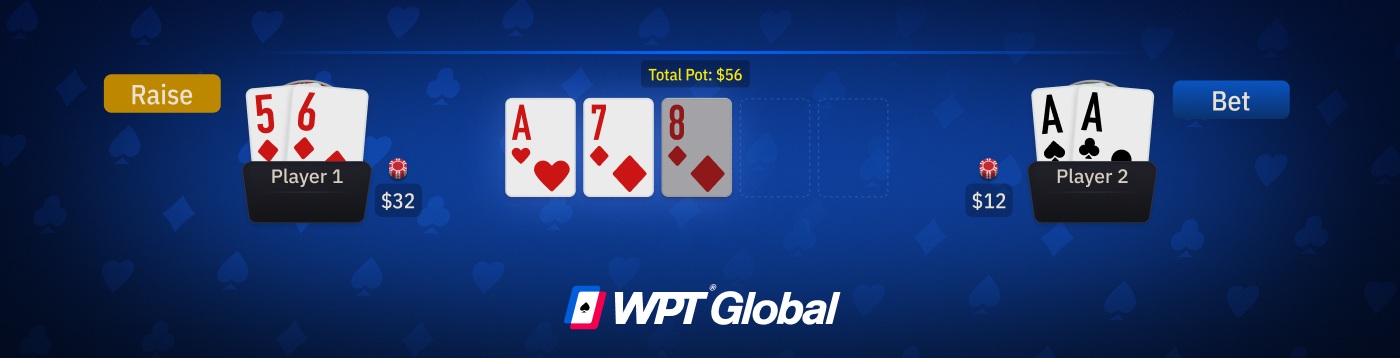
Running the numbers through a poker hand calculator, your hand's equity in this spot is 42%. This alone might not be enough to justify a raise. However, in addition to your own hand's equity, you need to consider something known as fold equity.
The Importance of Fold Equity and Ranges
Calculating fold equity can be tricky because you rarely know an opponent’s exact holding; instead, you can estimate how often your semi-bluff forces folds across their range. Additionally, you don't know if your opponent is going to fold. This is where you need to use your reading skills.
You need to consider your opponent's range based on previous hand histories. You also need to consider their tendencies. Are they loose and aggressive? Are they tight and passive? The tighter someone is, the more likely they are to fold.
The combination of your hand and the potential fold equity in a given scenario is how you determine whether or not semi-bluffing is a good move.
In our scenario, the opponent has a set, so they won't fold. However, when we make reads in poker, the aim isn't to put someone on a single hand because that's almost impossible. What we do, instead, is put them on a range of hands.
To put someone on a range, you need to think about previous moves you've seen them make, any hand histories you have, and the way things played out in the current hand.
In our scenario, we know the opponent bet 60% of the pot on an ace-high board. Based on this, we can assume the following:
They could have a pair of aces.
They could have a flush draw.
They could have a straight draw.
They could have a high pocket pair, such as K-K or Q-Q.
They could be bluffing.
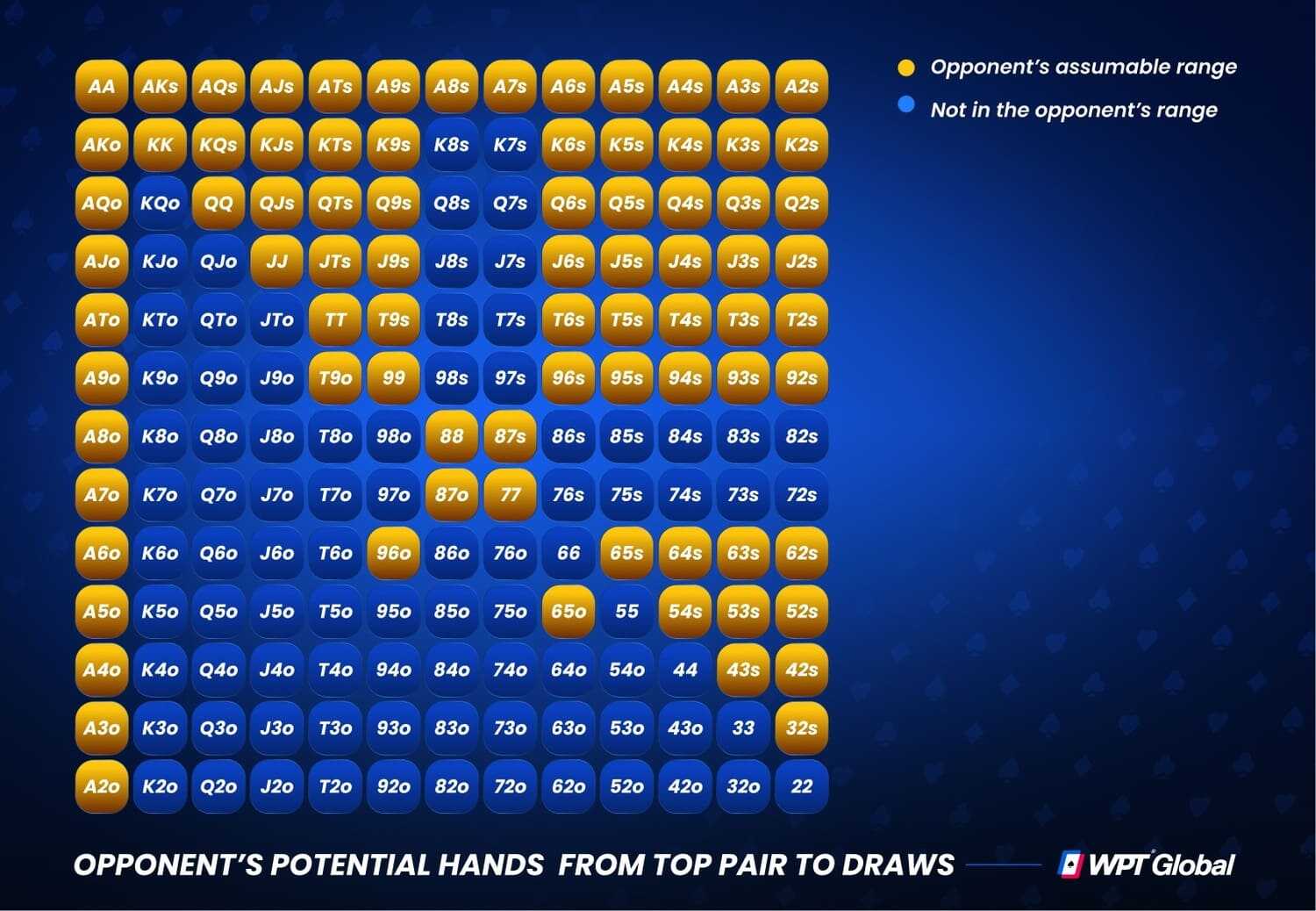
Understanding these possible holdings helps you assign weighted ranges and decide whether your semi-bluff generates enough expected value to justify aggression.
And Factoring in these possibilities, 5♦ 6♦ has more equity than the opponent's range. Therefore, it's fine to raise as a semi-bluff in this spot. We can add further justification to this by looking at the factors you need to consider before making a semi-bluff.
Semi-Bluff Strategy
A well-timed semi-bluff can help you win the pot immediately or build a larger pot to capture more money when your draw hits. This tells us that the first thing to consider before making a semi-bluff is your hand.
Basically, you need a drawing hand with enough equity to warrant raising and, if necessary, calling an all-in bet.
There is also a school of thought that advocates semi-bluffing with hands that have no showdown value. However, this takes us into a discussion about blockers and turning made hands into bluffs.
So, for the purposes of this introduction to semi-bluffing, we're going to stick with strong drawing hands. In this context, strong draws are those with at least 40% showdown equity, i.e., you've got at least a 40% chance of winning if the hand goes to the river.
Let's look at an example in which you'd have over 40% equity. For the purposes of this example, we'll assume we know our opponent's exact hand.
In reality, you need to consider your hand and its outs vs. an opponent's possible range. Tracking your outs and comparing them to pot odds helps determine if a semi-bluff is mathematically profitable.
However, working through specific scenarios gives you a better idea of when drawing hands are strong and not so strong.
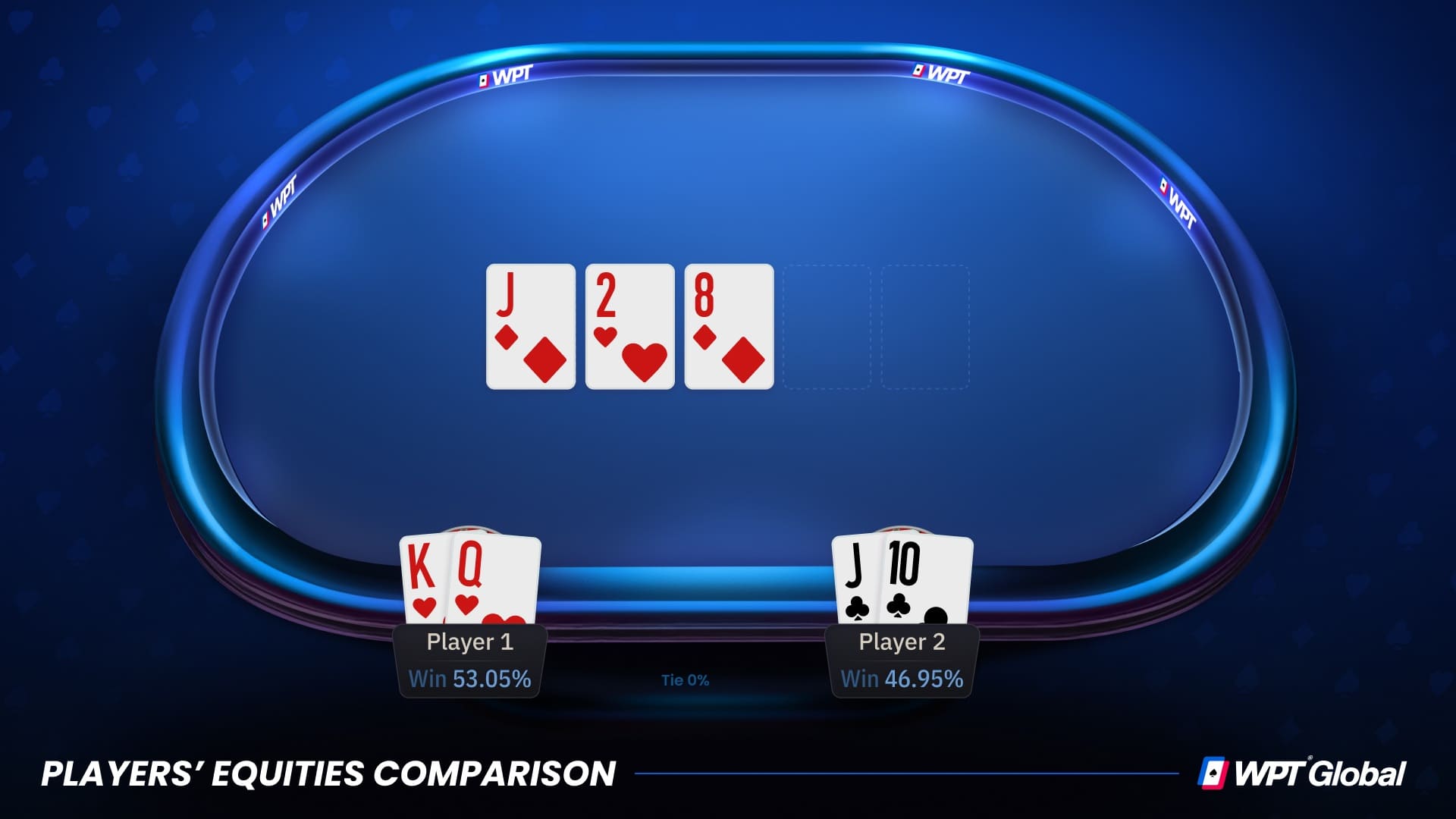
Your hand: K♥ Q♥
Opponent's hand: J♣ 10♣
The board: J♥ 2♥ 8♦
Putting this hand into a poker calculator shows us that K♥ Q♥ has 53% equity on account of the fact that you can hit a flush or a better pair to win the pot.
Once you've factored in the strength of your draw, you need to consider your position and your opponent's tendencies. As we've said, you may or may not want an opponent to fold when you semi-bluff.
If you're facing a tight opponent, it may be best to check when you're out of position and call the flop. If you're in position, it might be best to call a bet on the flop. After this, you can reassess the hand and, possibly, raise the turn.
If your opponent is aggressive, you can lead out when out of position and, if you're raised, you can shove or re-raise to maximize fold equity while still having draw equity. Alternatively, if you're in position, raise their bet and react accordingly based on their move.
When Not to Semi-Bluff?
There is a temptation to semi-bluff all of your very strong draws. We're not saying it's always wrong to bluff with very strong draws. But, in practice, there are spots where you shouldn't do it as often as you might think.
Here's an example of a hand you might consider semi-bluffing:
Your Hand: A♦ K♦
Opponent's Hand: XX
The board: J♦ 10♦ 2♥
We raised pre-flop, and our opponent (who is on the button) called. We don't know what our opponent's hand is at this stage. However, based on their position, the action, and what we know from previous hands, we can assume their range hits part of this flop.
That means they could have top pair, second pair, straight draws, and flush draws. They may even have an overpair to the board, such as Q-Q.
We don't have a made hand at this point, so it's tempting to make a continuation bet. The justification for continuation betting is that we raised pre-flop, we don't have a made hand, but we have a very strong draw (straight flush, flush, straight, and overcards).
Should You Semi-Bluff in this Spot?
If you run this scenario through a solver, such as GTO Wizard, the game theory optimal (GTO) move is to check. The reason for checking here is that you don't actually want your opponent to fold.
Of course, there's a chance you bet and the opponent calls or raises. However, if there's a chance they'll fold, it's better to check. By checking, you preserve your equity and keep weaker hands in the pot, allowing you to realize more value on later streets. The theory here is that you're actually losing equity if they fold.
Put another way, if you bet and they fold, you win a small pot. If, however, you check and let your opponent dictate the action, you could win more money by hitting your draw on later streets. Therefore, while semi-bluffing strong draws can be powerful, game texture and opponent type should also dictate when to apply pressure.
Start Slow and Get Comfortable with Semi-Bluffing
Our final tip for semi-bluffing is to wait for strong draws in low-stakes cash games and poker tournaments.
Then, once you're comfortable with making these moves with your strongest draws, increase your range slightly.
Gradually add semi-bluffs with backdoor flush draws or open-ended straight draws to balance your betting ranges and stay unpredictable against savvy opponents.
This should give you a good foundation to build on as you move up the stakes and come across better players.

FAQs
What is the difference between a bluff and a semi-bluff?

A pure bluff is when you raise with a hand that has very few or no outs and can't win a showdown. A semi-bluff is when you raise with a strong hand, such as a straight flush draw. The poker theory behind semi-bluffing is that your hand has sufficient equity to justify a raise and, if necessary, go all-in.
When is the best time to semi-bluff?
The best time to semi-bluff is when you've got a strong drawing hand and plenty of fold equity. A combo draw, such as a flush + straight, is an example of a strong drawing hand. Fold equity is based on your opponent's tendencies and the types of hands in their possible range.
What are “outs” in relation to semi-bluffing?
Outs are the cards you can hit to complete your draw. For example, if you've got two hearts and there are two hearts on the flop, you've got nine outs, i.e., nine hearts left in the deck. More outs give you more equity in a hand, which is what you need if you're going to semi-bluff.

Promotions
For Customers
Safety & Security
Stay Connected
Follow us on social media to stay updated with the latest news, updates, and exclusive offers!


Promotions
For Customers
Safety & Security
Stay Connected
Follow us on social media to stay updated with the latest news, updates, and exclusive offers!
 Local Payment Methods
 Cards
Cards Crypto
 E-Wallets
 Apple Pay
 Google Pay
 Instant Bank Payments
*
Some methods may not be available in your region. Please contact support if you experience any issues.
This website is operated by Everstronglink Limited a company incorporated under the laws of Costa Rica having its registered address at Province 01 San Jose, Canton 02 Escazu, San Rafael, On La Ceiba Street, House No. 400, Costa Rica, and is licensed by the Tobique Gaming Commission under License Number 0000005. Kashxa Limited, a Cyprus company with registration number 427606, having its registered office at Strovolou, 12 Aigyptou, Nicosia, 1097, Cyprus, is acting as a payment agent on behalf of the license holder entity Everstronglink Limited.
Gambling can be addictive. Play responsibly. Everstronglink Limited only accepts customers over 18 years of age.
Copyright © 2026 WPT Global. All rights reserved