






 Customer Dispute Resolution Page
 Help Center
 Affiliate Program
In this article
Welcome to WPT Global
Welcome to WPT Global, the online home of the World Poker Tour®. Let us guide you through setting up your account and get you to the tables in no time.Social Media


How To Play
World Leading Tournaments
A huge player pool and everything from freerolls to high rollers – plus regular special events!Ambassadors
Get to know our ambassadors - world-class players from across the globe who embody the spirit of the game. Discover their stories and become part of the community.Your Hub for News
Explore stories, tips, and updates from the world of poker and casino. Learn from pros, discover new trends, and stay in the loop with everything happening at WPTGlobal.What are you looking for?
Close




Understanding Poker Equity
Share




In poker, equity is the percentage of the pot a player can expect to win if the hand goes to showdown, so mastering it is essential.
Like all poker strategy fundamentals, equity applies to all poker games. So, once you've mastered how to play poker, turning your attention to equity is a must.
In this guide, you’ll learn pot equity (showdown equity), fold equity, and implied odds, plus quick formulas to calculate equity at the table. So here's everything you need to know about poker equity and how winning online poker players use it to make better decisions.
What is Poker Equity?
Poker equity is your hand’s expected share of the pot. In practice we use three related concepts: pot equity (your showdown equity versus a hand or range), fold equity (how often a bet or raise makes an opponent fold), and implied odds (future value you expect to win when a draw completes).
We'll define the three types of poker equity in a moment. Before that, let's think about why equity matters. It matters because, if you remove the psychological element of poker, equity underpins every decision you make.
That's because poker strategy is largely based on probability theory. For example, you can use your hand's equity against an opponent's assumed range to determine whether a call is profitable or not.
Poker Equity Example Hand
Let's say you've got K♥ J♣ and the board is J♥ A♠ 4♦ 3♦ 7♥. Based on their betting pattern, you believe that your opponent has something strong.
You estimate that 60% of your opponent's range gives them a better hand than yours. If you're correct, that means you beat 40% of their range. There's $100 in the pot, and you're facing a bet of $50.
We can use this information to determine how much equity you need to make a profitable call. Here's how to calculate equity quickly:
Call amount/total amount you'll win X 100 = minimum equity required to call
In this example, there's $100 in the pot + your opponent's $50 bet. If you call, the total amount in the pot will be $200. This is also known as your pot odds.
So, in this scenario, the pot odds are 3:1 because you have to pay $50 to win $150 (i.e., 50:150 reduces down to 3:1 because 50 goes into 150 three times).
Plugging these numbers into the above formula, we get:
$50/$200 = 0.25 X 100 = 25%
This tells us you need 25% equity or better to make a profitable call based on your opponent's assumed range. Given that you believe your hand's equity is 40% against the opponent's range, calling is the right move.
That's why equity matters. Now that's clear, let's define the main types of equity in poker.
Types of Poker Equity
Equity is a general term that refers to our chances of winning based on one or more factors. As we've said, this means we need to categorise poker equity into three categories: pot, fold, and implied.
Here's a detailed overview of each type of poker equity, along with how to calculate equity and some examples:
Pot Equity
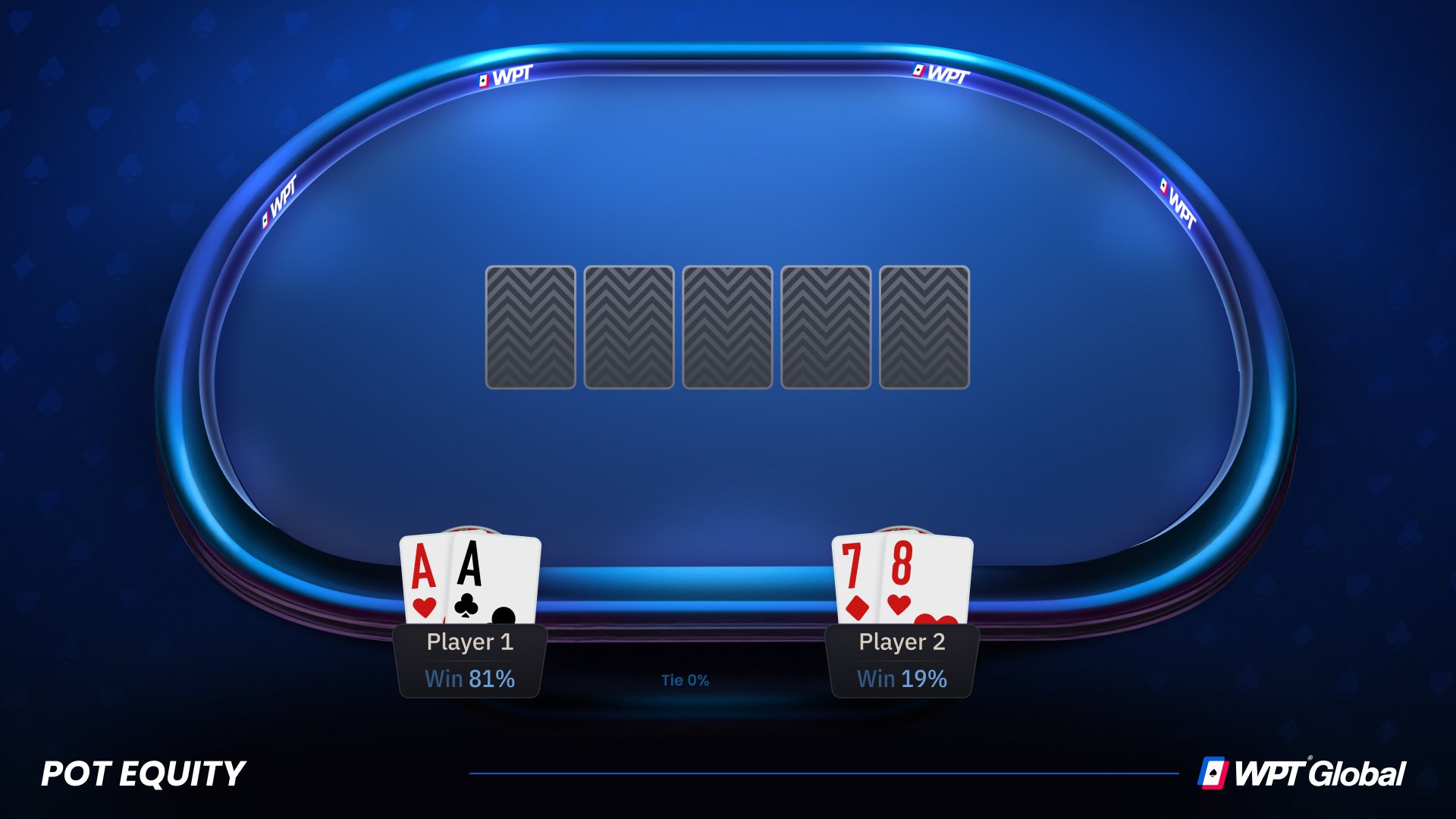
Pot equity refers to your theoretical share of the pot based on your hand and your opponent's hand or range. For example, a poker equity calculator A♥ A♣ has 81.19% equity against 7♦ 8♥. We also call this showdown value because it's the amount you stand to win when the hand reaches a showdown.
In this example, if you put A♥ A♣ vs. 7♦ 8♥ into a poker calculator, you'll see that the former wins 81% of the time. This figure is based on the result of A♥ A♣ vs. 7♦ 8♥ over thousands of hands.
We then need to look at the showdown value of A♥ A♣ in relation to the pot. If there's $100 in the pot, we can say that Ah Ac has $81 worth of pot equity.
Obviously, we don't know someone's exact hand, unless it's an all-in situation. Therefore, we can also calculate equity based on the range of hands we think an opponent has. This is slightly trickier, which is why you should use a poker equity calculator to perform equity calculations away from the table.
Fold Equity
Fold equity is the probability that an opponent folds to your bet or raise. For example, if there's $100 in the pot and you believe your opponent folds 20% of the time when you bet, your fold equity is $20.
You can use fold equity in conjunction with your hand's equity against an opponent's assumed range to determine the breakeven bet. For example, if you believe your opponent folds 10% of the time and you bet 3/4 of the pot, your hand needs 36% equity against their assumed range for it to be a breakeven bet.
Another way to think about fold equity and breakeven bet sizing is the risk-to-reward ratio. For that, you can use this formula when you believe your hand has zero chance of winning a showdown (i.e., 0% equity):
[Bet size / (bet size + pot size before the bet)] X 100
Here's an example where you bet $40 into a $100 pot:
40 / (40 + 100) = 0.285 x 100 = 28.5
Risk-to-reward ratio = 28.5%
In this example, you need your opponent to fold more than 28.5% of the time to a $40 bet if you have 0% of winning a showdown. If we don't know for certain that $40 will be enough to elicit a fold 28.5% of the time, we could bet slightly more. That's where reads come into play.
Fold equity isn't an exact science because you never know how often someone will fold. However, these calculations give us a starting point, e.g., you know that an opponent needs to fold more than 28.5% of the time when you bet 40% of the pot, and your hand has 0% equity.
Bluffing with Equity
There will be situations when you elect to bluff with some showdown equity. In these spots, you have two ways to win the pot in these situations: your opponent folds to your bet, or you have the best hand. You don't need as much fold equity in these situations.
Let's adapt our previous example. Instead of 0% showdown equity, we'll assume you've got 10%. You don't necessarily have to be precise in these situations. You can simply tell yourself that you don't need as much fold equity.
Going back to our example. If the target is >28.5% when your hand's equity is 0%, it will be something more like 24.5% when your hand has 10% equity. To summarise, the more equity your hand has against an opponent's assumed range, the less fold equity you need.
Pot Odds, Drawing Odds, and Implied Odds
Pot odds and implied odds are related, but they are not the same thing. Pot odds compare the cost of a call to the pot you can win right now. Implied odds estimate how much extra money you may win on later streets if you complete your draw.
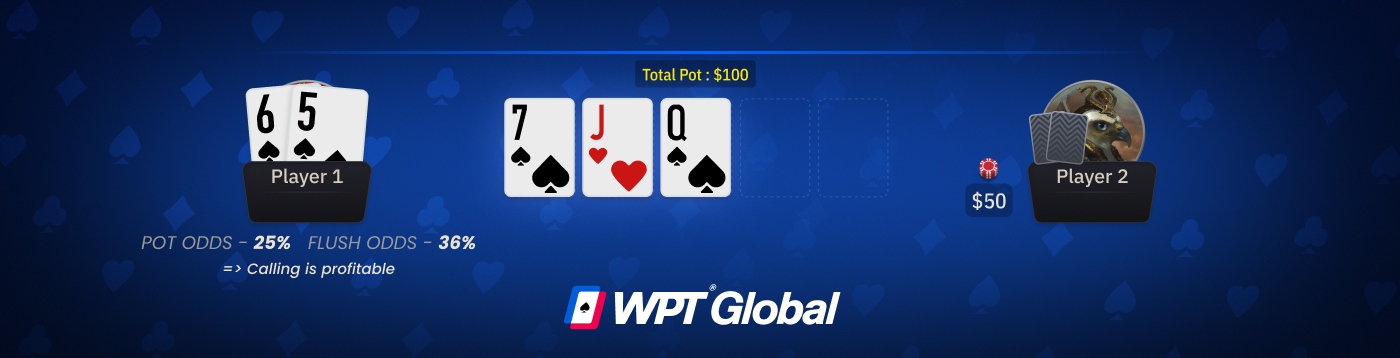
For example, let’s say you’re playing Texas Hold’em and you have a flush draw on the flop. There is $100 in the pot, and your opponent bets $50.
Step 1: Calculate Your Outs
A flush draw usually gives you nine outs.
Step 2: Calculate Your Pot Odds
We calculate pot odds by comparing the amount we have to call with the total pot after we call:
Call / (pot + bet + call) x 100
In this example:
$50 / ($100 + $50 + $50) = 25%
This means that you need at least 25% equity for the call to break even against this single bet.
Step 3: Compare Pot Odds to Your Immediate Drawing Odds
Because this is a flop decision and you're only facing one bet right now, the correct comparison is to your chance of improving on the next card, not over two cards to come.
With nine outs, your chance of hitting the flush on the turn is approximately:
9 x 2 = 18%
That is less than the 25% required by your pot odds, so this call is not profitable on direct odds alone.
If you expect to win additional money on later streets when you hit, that extra future value is called implied odds. Implied odds may make a call worthwhile, but they should be treated separately from your direct pot-odds calculation.
Only when all the money is already going in and no further betting remains does it make sense to compare your equity over two cards to come directly against the price you are getting.
That's the poker theory when it comes to equity. Now, let's put everything we've discussed into practice with some useful strategy tips.
Using Poker Equity Strategically
The main reason we want to know our equities is so we can profitably bet, call, raise, or fold. By profitably, we mean that your decision yields a profit over time. In other words, you win more times than you lose.
For example, if you move all-in with pocket aces against pocket deuces, it's a profitable move because you'll win approximately 82% of the time (i.e., 82 times out of 100). Notice here that you won't win every time. You can lose 18 times. However, in the long run, you'll win more than you lose, which makes it a profitable play.
Calculating Equity Makes You a Better Player
Learning how to calculate equity quickly gives you the power to know when moves are more or less likely to be profitable. For example, if you're planning to run a bluff, you need to calculate your fold equity. Once you know that, you can decide whether you've got a realistic probability of winning the pot with a bluff.
The same is true when it comes to calling with a made hand or draw. If you've got a two-pair, you can calculate your pot equity (aka showdown value) against an opponent's range. Similarly, if you're chasing a straight draw, you can use implied equity (odds) to determine whether it's mathematically correct to call bets.
There are plenty of poker tools you can use to calculate equity, such as PocketSolver. Use them while you're studying and reviewing hands to build up a general idea of the equities required for common spots.
Use Poker Equity Wisely
It's important to remember that equity calculations aren't always 100% accurate. That's because you have limited information in certain spots. For instance, if you don't know an opponent's hand, you need to assign them a range.
Despite that, equity calculations are still incredibly useful because they give you a statistical basis for making decisions.
Final Thoughts
Poker equities should be seen as statistical markers that tell you what's required to make a profitable move. When you're calling, you want better equity than the current pot odds.
When you're betting or raising as a bluff, you want your fold equity to be better than the risk-to-reward ratio. Get these two things right, and it will improve your ROI.

FAQs
How does equity affect my poker strategy?

Poker equity tells how often an action needs to occur for it to be profitable, which allows you to decide if it's better to call, bet/raise, or fold. If you have a lot of equity, it makes sense to bet or raise. If you don't have much equity, it's often better to fold.
Does having a high equity guarantee that I will win?
Having high equity in a poker hand doesn't guarantee you'll win. Poker equity is simply your hand's theoretical share of the pot based on your opponent's assumed range.
Can my equity change during a hand?
Yes, your equity changes throughout a hand based on the community cards and the size of the pot. Therefore, you need to calculate equity based on the current dynamics so you know what the most theoretically profitable move is.
What is the difference between stake and equity?
Your stake in poker refers to the amount you sit down with in a cash game or the amount you bet. Equity in poker is a measure of how much you stand to win from the pot based on your hand's equity (aka probability of it being a winning hand at a showdown).



Promotions
For Customers
Safety & Security
Stay Connected
Follow us on social media to stay updated with the latest news, updates, and exclusive offers!


Promotions
For Customers
Safety & Security
Stay Connected
Follow us on social media to stay updated with the latest news, updates, and exclusive offers!
 Local Payment Methods
 Cards
 Crypto
 E-Wallets
 Apple Pay
 Google Pay
 Instant Bank Payments
*
Some methods may not be available in your region. Please contact support if you experience any issues.
This website is operated by Everstronglink Limited a company incorporated under the laws of Costa Rica having its registered address at Province 01 San Jose, Canton 02 Escazu, San Rafael, On La Ceiba Street, House No. 400, Costa Rica, and is licensed by the Tobique Gaming Commission under License Number 0000005. Kashxa Limited, a Cyprus company with registration number 427606, having its registered office at Strovolou, 12 Aigyptou, Nicosia, 1097, Cyprus, is acting as a payment agent on behalf of the license holder entity Everstronglink Limited.
Gambling can be addictive. Play responsibly. Everstronglink Limited only accepts customers over 18 years of age.
Copyright © 2026 WPT Global. All rights reserved