A hero call is the bravest move in poker.
You're staring down a huge bet (mostly) on the river. It's often for your whole stack. And you're calling with a hand that has no business winning. It could be a bluff-catcher, bottom pair, sometimes ace-high. You're calling because you've decided against every instinct telling you to fold, that your opponent is bluffing.
Get it right, and you look like a genius. Get it wrong, and you look like you've lost your mind.
Here are five times players got it gloriously right. Ranked from the biggest to, for our money, the bravest.
We start with the biggest hero call ever made by sheer size.
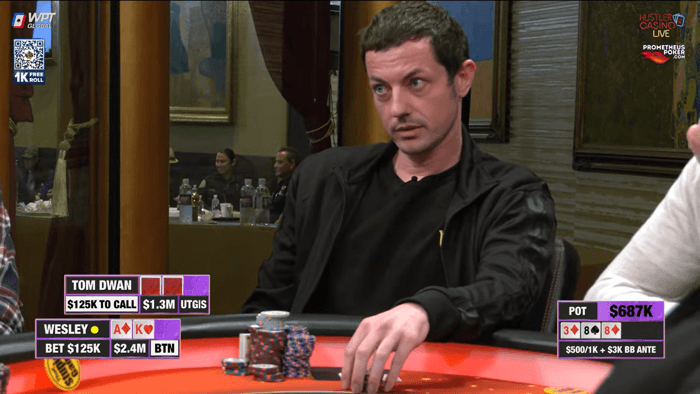
It was Hustler Casino Live's "Million Dollar Game" in June 2023. Wesley Fei three-bet, Dwan four-bet pocket queens from the straddle, Wesley five-bet to $275,000, Dwan called, and the chips went in on the flop.
Dwan called it off with his queens. Wesley tabled ace-king. Ace-high, and the queens held to drag a pot of roughly $3.1 million. It was the largest in televised or streamed poker history.
Now, pocket queens is a genuinely strong hand, so this is the biggest hero call by money, not the lightest by holding. However calling off a monster five-bet for a record-breaking pot, while knowing the whole poker world is watching? And, one wrong read costs you seven figures. This takes a kind of nerve most players will never be tested for.
It's here for the staggering scale.
From the biggest to about the lightest a winning hero call can get. It was a $25/$50 ante game on Hustler Casino Live. A player known at the table only as "Jack" looked down at jack-six of diamonds. He faced a huge river bet, and called with nothing but jack-high.
He was right. The pot was $146,500, and it was potentially one of the lightest calls possible.
There's no clever cards-based justification here. Only a fantastic read. Jack-high is a hand you fold on the river almost every time it faces a big bet. So this is exactly what makes calling with it, correctly, for six figures, so absurd.
It's a pure knack for the table, and when it works it's the kind of call people talk about for years.
Some players hate folding.
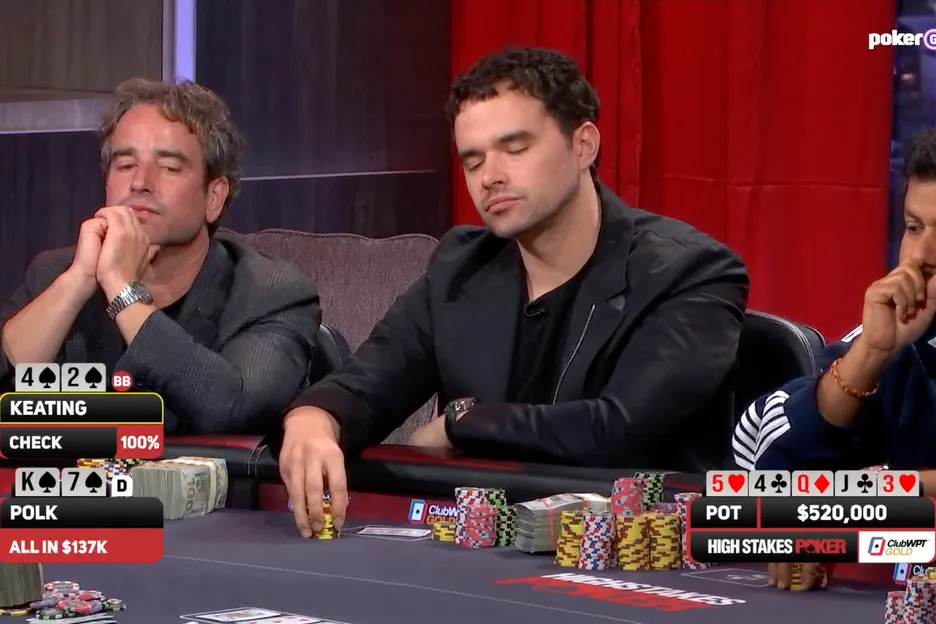
Alan Keating is one of them. In fact, he's built a reputation on it. In a 2025 episode of High Stakes Poker, he made one of the modern game's signature calls.
Doug Polk opened king-seven of spades, and Keating came along with four-deuce of spades. The board ran out queen-five-four, then a jack, then a three.
Keating had flopped bottom pair, a pair of fours, and called Polk's bets on the flop and turn. On the river, Polk moved all-in with king-high, a busted hand. Keating called with those fours to win $657,200.
Calling off a player's river shove with bottom pair is the stuff of nightmares for most players. Keating seemed to have little issue. And it's far from his only headline moment on the show. Keating is a fixture of the modern High Stakes Poker era, and has shown he's willing to call down a huge bet with a marginal hand.
He is, more than anyone in the current game, the man who doesn't believe you.
Before solvers, before streams, there was Allen Cunningham.
It was a 2006 final table, in the middle of the boom. The runaway chip leader and eventual champion Jamie Gold was firing at pot after pot. Cunningham, holding only ace-high, called a bet of around $2 million on a queen-high board.
He correctly sniffed out that Gold had nothing, and dragged a pot of more than $3 million. It remains one of the most replayed tournament calls ever made, the original "how did he know?"
For the top spot, you want everything a hero call can be. The tiny holding, a huge bet, a world-class opponent, and a title on the line. Patrik Antonius came with it all.
Three-handed at the final table of a $25,000 high roller at Triton Poker in Cyprus. The blinds at 200,000/400,000. Chip leader Fahredin Mustafov raised with ten-eight, and Antonius defended his big blind with jack-deuce of hearts.
The flop came seven-deuce-six, giving Antonius the worst possible pair. The bottom pair (a pair of twos) and he check-called. He checked again when a queen hit the turn and called another bet. Then an ace fell on the river, and Mustafov moved all in. It was enough to put Antonius's tournament life on the line.
Antonius sat in the tank for about six minutes. His entire championship rode on the decision.
Before calling off his remaining chips with that pair of deuces. Mustafov rolled over ten-high, a total bluff. Antonius had read it perfectly, doubled through the chip leader, and went on to win the event for his first Triton title and $825,000.
Bottom pair. For a championship. Against the biggest stack, with minutes on the clock and everything at stake.
It's hard to imagine a braver call, and it's our number one.
Not every legendary hero call ends in a call. And this one is famous for the opposite reason. In one of High Stakes Poker's most-replayed moments, Phil Ivey faced a big bet from Tom Dwan. He studied it, and announced, "This is going to be the sickest call of all time". He proceeded to fold.
The twist is what makes it legendary: Dwan had nothing, a stone-cold bluff, and Ivey had laid down the best hand. It shows the line between hero and fool cuts both ways. Even the greats get talked out of the winner.
For every call that makes a legend, there's a fold that haunts one.
In the modern game, a big river bet is, if anything, more likely to be the real thing than it used to be. Most players, especially outside the top, don't bluff enough on the river. When the population under-bluffs, the maths says fold your bluff-catchers more, not less.
It makes a call like Keating's or "Jack's" gutsy. We're in an era that has taught everyone to distrust that instinct.
A hero call is about the person across the table. Reading, in a single held breath, that they don't have it. When you're right, there's nothing else in the game quite like it.








 Customer Dispute Resolution Page
 Help Center
 Affiliate Program