










 Customer Dispute Resolution Page
 Help Center
 Affiliate Program
In this article
Welcome to WPT Global
Welcome to WPT Global, the online home of the World Poker Tour®. Let us guide you through setting up your account and get you to the tables in no time.Social Media


How To Play
World Leading Tournaments
A huge player pool and everything from freerolls to high rollers – plus regular special events!Ambassadors
Get to know our ambassadors - world-class players from across the globe who embody the spirit of the game. Discover their stories and become part of the community.Your Hub for News
Explore stories, tips, and updates from the world of poker and casino. Learn from pros, discover new trends, and stay in the loop with everything happening at WPTGlobal.What are you looking for?
Close




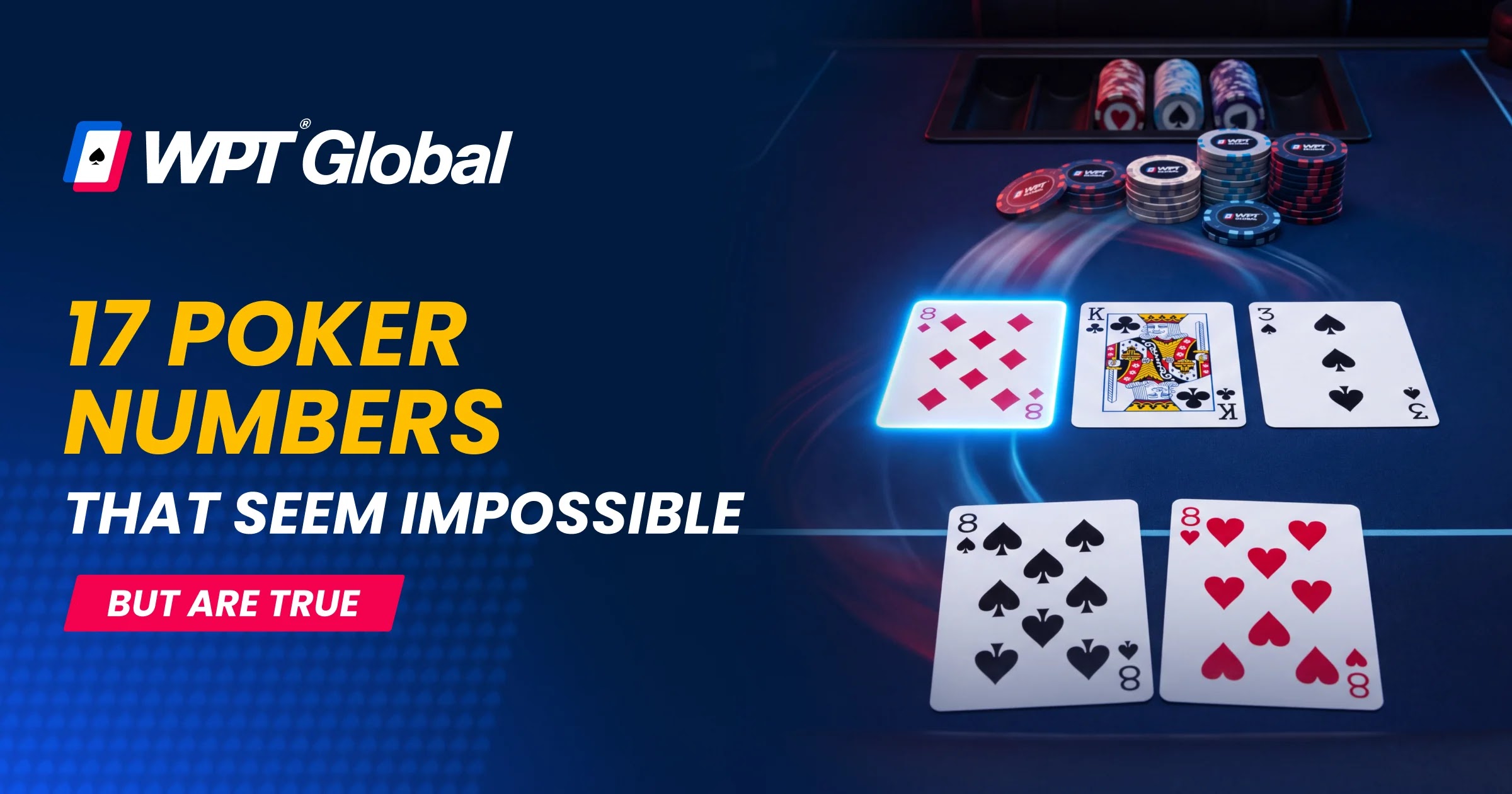
17 Poker Numbers That Seem Impossible (But Are True)
Share




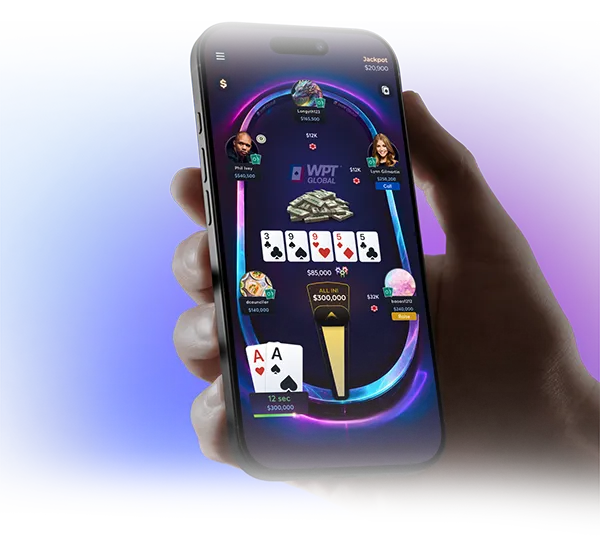

Underneath the felt, poker is pure improbability. It's a game that comes with a pile of numbers so large, so long, or so lopsided they sound invented.
Here are 17 of them, each one crazier than the last. (The money and field records are current as of 2026. And, being records, they’re always one big tournament from changing.)
Odds
1 in 649,740 - The odds of flopping a royal flush. By pure coincidence, it's the same as the odds of being dealt a complete royal in five-card poker.
1 in 30,940 - the odds of making any royal flush by the river in Hold'em. The wild part: that makes making a royal about 21 times more likely than flopping one.
2,598,960 - the number of distinct five-card poker hands in a 52-card deck. Exactly four of them are royal flushes. Four.
1 in 221 - how often you're dealt pocket aces (0.45%). On average you'll wait 221 hands for them. Funnily enough, you can still lose with them more often than you'd think.
11.8% - the chance of flopping a set when you hold a pocket pair, a little better than 1 in 8.5. It feels rare because it's the hand you want, but it's pretty common.
0.8% - the chance of flopping a flush when you hold two suited cards (about 1 in 118). That "suited" glow you feel looking at your hand is doing far less work than you'd guess.
82% - roughly how often aces beat kings when the money goes in preflop, about 4.5-to-1. The classic cooler that draws groans around the table isn't nearly as close as it sounds.
1,326 - the number of possible two-card starting hands you can be dealt. Strip out the suits that don't matter and only 169 of them are strategically distinct.
1 in 595 - the odds of making four of a kind by the river in Hold'em (about 0.17%). Quads feel like a once-a-year gift because, more or less, they are.
1 in 270,725 - the odds of two specific players both getting pocket aces in the same hand. It seems impossible. Yet, it happens on livestreams often enough to feel common.
19,600 - the number of different flops you could see once you're holding your two cards. Every hand, one of nearly twenty thousand futures lands face-up.
The records that sound made up
$90 million+ - the all-time live tournament cashes of Bryn Kenney. In 2026 he became the first player in history to cross $90 million. No one else has ever reached $80 million.
$20,563,324 - the biggest single payday in poker history, won by Kenney as the runner-up at the 2019 Triton Million in London. He finished second and still banked the largest cheque the game has ever produced.
$3.1 million - the largest pot in televised or streamed poker history, dragged by Tom Dwan against Wesley Fei on Hustler Casino Live in 2023. More than most earn in a decade, in one pot.
10,112 entries / $94,041,600 - the largest field and prize pool in WSOP Main Event history, set in 2024. That prize pool is the richest any live tournament has ever assembled, and it has held the record since.
$86 → $2.5 million - the online satellite buy-in that Chris Moneymaker turned into the 2003 WSOP Main Event title. An accountant with no live tournament experience turned pocket change into a championship. It was the spark that started the modern poker boom. The "Moneymaker Effect" that built the game we know today.
And the one that breaks your brain
Roughly 8 × 10⁶⁷ - the number of ways a single deck of 52 cards can be ordered (that's 52 factorial, about 8.07 × 10⁶⁷ — an 8 followed by 67 more digits).
The number is unfathomably large. For example, when you shuffle a deck properly, you have almost certainly created an ordering of those cards that has never existed before in the history of the world. And, never will again.
Every real shuffle is, quite literally, a first.
That's the strange magic of this game.
Promotions
Tournaments
For Customers
Safety & Security
Stay Connected
Follow us on social media to stay updated with the latest news, updates, and exclusive offers!



Promotions
Tournaments
For Customers
Safety & Security
Stay Connected
Follow us on social media to stay updated with the latest news, updates, and exclusive offers!
 Local Payment Methods
 Cards
Cards Crypto
 E-Wallets
 Apple Pay
 Google Pay
 Instant Bank Payments
*
Some methods may not be available in your region. Please contact support if you experience any issues.
This website is operated by Everstronglink Limited a company incorporated under the laws of Costa Rica having its registered address at Province 01 San Jose, Canton 02 Escazu, San Rafael, On La Ceiba Street, House No. 400, Costa Rica, and is licensed by the Tobique Gaming Commission under License Number 0000005. Kashxa Limited, a Cyprus company with registration number 427606, having its registered office at Strovolou, 12 Aigyptou, Nicosia, 1097, Cyprus, is acting as a payment agent on behalf of the license holder entity Everstronglink Limited.
Gambling can be addictive. Play responsibly. Everstronglink Limited only accepts customers over 18 years of age.
Copyright © 2026 WPT Global. All rights reserved