











 Customer Dispute Resolution Page
 Help Center
 Affiliate Program
In this article
Welcome to WPT Global
Welcome to WPT Global, the online home of the World Poker Tour®. Let us guide you through setting up your account and get you to the tables in no time.Social Media


How To Play
World Leading Tournaments
A huge player pool and everything from freerolls to high rollers – plus regular special events!Ambassadors
Get to know our ambassadors - world-class players from across the globe who embody the spirit of the game. Discover their stories and become part of the community.Your Hub for News
Explore stories, tips, and updates from the world of poker and casino. Learn from pros, discover new trends, and stay in the loop with everything happening at WPTGlobal.What are you looking for?
Close




“I Call”… “I Didn’t Call”: The Angle-Shoot That Blew Up Poker
Share





A single river decision on a Texas livestream has become a major source of online debate this week.
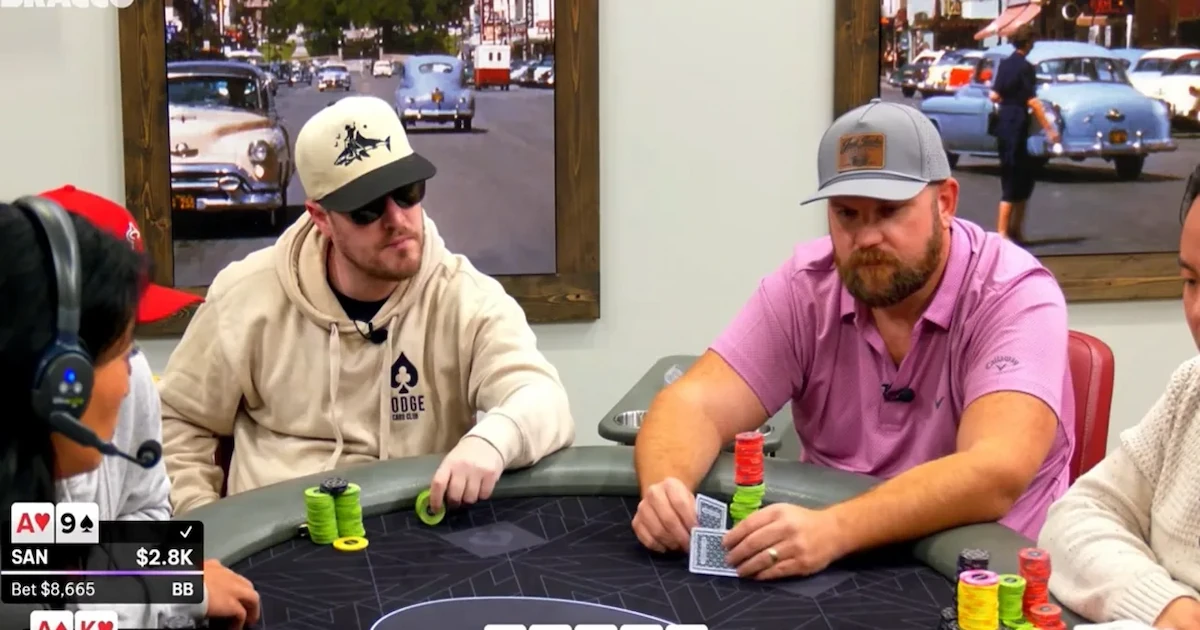
It was on a November 5 cash-game broadcast from The Lodge Card Club in Austin. An amateur player known on the stream as "Justin" appeared to announce a call and push his chips forward. He then pulled them back and insisted he never called the moment his opponent moved to show his hand.
The floor ruled it a binding call, and the hand chopped. Understandably, the clip rocketed past a million views. The poker world split between "blatant angle" and "honest mistake." However, mostly blatant angle.
Here's exactly what happened, the ruling, both sides of the argument, and the rule that every player should take away from it.
The hand, card by card
The board ran out 8♠ 10♠ 10♦ 8♣ 6♣. It was a two-pair showing for everyone to share, tens and eights. San Kim held A♥9♠; Justin held A♦K♥. Let's have a look at those two hands. We have the board already making two pair, both players were playing the same hand. It's the board plus an ace.
Barring a fold, it's highly likely this was going to get chopped.
Kim didn't know that, and on the river he moved all-in for $8,700, putting Justin to a decision for his stack. Justin tanked, talked through it out loud. "I don't know if I can beat you… I've got ace-high". Afterward, by the stream's audio, he said, "I call," and pushed chips forward.
The moment it turned
As Kim started to turn his cards face-up, Justin drew his chips back toward him and claimed he hadn't called. A table-mate immediately pushed back, telling him he'd clearly said it. Justin doubled down, insisting he'd only said, "I've gotta go anyway." He then asked the table whether he'd actually called.
A floor manager came and reviewed the situation. He ruled that between the verbal declaration and the chips' forward motion, Justin committed. Both hands were tabled, and, exactly as the cards dictated, the pot was chopped.
He appeared to try to wriggle out of a call in a hand he was going to split anyway. If the move was deliberate, it risked his reputation for a pot he was never going to lose.
Angle or honest mistake?
Lodge commentator Skull Mike shared the clip, and it spread fast. The reaction was overwhelmingly harsh. There were calls to ban him from the room. There were accusations that it was "not even an angle, just attempted cheating,". Many called for him to "take some accountability."
The Lodge itself reposted the hand and put the question to its audience: angle, or honest mistake?
There was a defense. Skull Mike spoke up for the player, describing him as a genuinely good man caught in the moment. It was a reaction to Kim, who reacted quickly and honestly forgot he'd verbalized a call. It's worth remembering that "Justin" is a recreational player, not a professional or a public figure. The internet may have an instinct to convict a named amateur on a five-second clip. But it also begs the question: would a pro get better or worse treatment?
Whether this was a cynical angle or a brain-fade under pressure is something only he truly knows. The footage is up to anyone's interpretation.
The rule everyone should take from it
Unlike the player's action, the ruling is not controversial at all. It's the standard across virtually every poker room in the US.
A verbal declaration is binding. If you say "call" (or "raise," or "fold") in turn, you are held to it. Words are action.
Motion counts too. Pushing chips past the betting line generally commits you to the bet. This is why the dealers watch the line.
Put the two together. A spoken "call" and chips moving forward. There's no ambiguity here. The floor's job was simply to apply it, and it did. That's also why the "standup game" style disputes and string-bet arguments keep ending the same way. Rules are rules, and a player can't say something, see a reaction, and then un-say it.
On a livestream with clear audio and many angles, there is nowhere to hide. Sure, the cameras make for great entertainment, but they also reveal any sneaky moves. Angle-shooting has been a recurring point in the live game. Often, the answer is the footage.
What an angle-shoot actually is
A quick explanation for newer players. An angle-shoot is a deliberately deceptive maneuver that tries to gain an edge or induce an opponent's mistake while staying technically within the rules. It can be hesitating to fake weakness, ambiguous chip motions, or misstating a hand.
Often, it sits in the grey zone next to cheating. Cases like this one are exactly why the community is up in arms. As a player, act clearly, declare your action out loud when it matters, and let the dealer and the line do their jobs.

FAQ
What happened in the Lodge angle-shoot hand?

On November 5, 2026, during a Lodge Card Club livestream, an amateur called "Justin" appeared to say "I call" and push chips forward facing an $8,700 river all-in, then pulled the chips back and denied calling. The floor ruled it a binding call. Both players held the same effective hand (ace-high on a two-pair board), so the pot was chopped.
Why was it ruled a call?
Across US cardrooms, a verbal declaration of "call" is binding, and pushing chips forward past the line generally constitutes the bet. With both present, the floor held him to the call.
Was it cheating or a mistake?
The community largely branded it an angle-shoot; Lodge commentator Skull Mike defended the player as a good guy who forgot he'd verbalized a call. Only the player knows for sure — and he is a recreational player, not a public figure.
Was this a WPT® event?
No. It was The Lodge's own cash-game stream. The Lodge separately hosts the WPT® Prime Lodge Championship, but that's a different, WPT®-run event.
Promotions
Tournaments
For Customers
Safety & Security
Stay Connected
Follow us on social media to stay updated with the latest news, updates, and exclusive offers!


Promotions
Tournaments
For Customers
Safety & Security
Stay Connected
Follow us on social media to stay updated with the latest news, updates, and exclusive offers!
 Local Payment Methods
 Cards
 Crypto
 E-Wallets
 Apple Pay
 Google Pay
 Instant Bank Payments
*
Some methods may not be available in your region. Please contact support if you experience any issues.
This website is operated by Everstronglink Limited a company incorporated under the laws of Costa Rica having its registered address at Province 01 San Jose, Canton 02 Escazu, San Rafael, On La Ceiba Street, House No. 400, Costa Rica, and is licensed by the Tobique Gaming Commission under License Number 0000005. Kashxa Limited, a Cyprus company with registration number 427606, having its registered office at Strovolou, 12 Aigyptou, Nicosia, 1097, Cyprus, is acting as a payment agent on behalf of the license holder entity Everstronglink Limited.
Gambling can be addictive. Play responsibly. Everstronglink Limited only accepts customers over 18 years of age.
Copyright © 2026 WPT Global. All rights reserved