
















 Customer Dispute Resolution Page
 Help Center
 Affiliate Program
In this article
Welcome to WPT Global
Welcome to WPT Global, the online home of the World Poker Tour®. Let us guide you through setting up your account and get you to the tables in no time.Social Media


How To Play
World Leading Tournaments
A huge player pool and everything from freerolls to high rollers – plus regular special events!Ambassadors
Get to know our ambassadors - world-class players from across the globe who embody the spirit of the game. Discover their stories and become part of the community.Your Hub for News
Explore stories, tips, and updates from the world of poker and casino. Learn from pros, discover new trends, and stay in the loop with everything happening at WPTGlobal.What are you looking for?
Close




The Luckiest Loser: A Straight Flush Lost at Rivers Casino and Won $330,000

Share






It sounds crazy, but sometimes losing can be the best thing that happens to you at the poker table. I know what you're thinking, but hear me out.
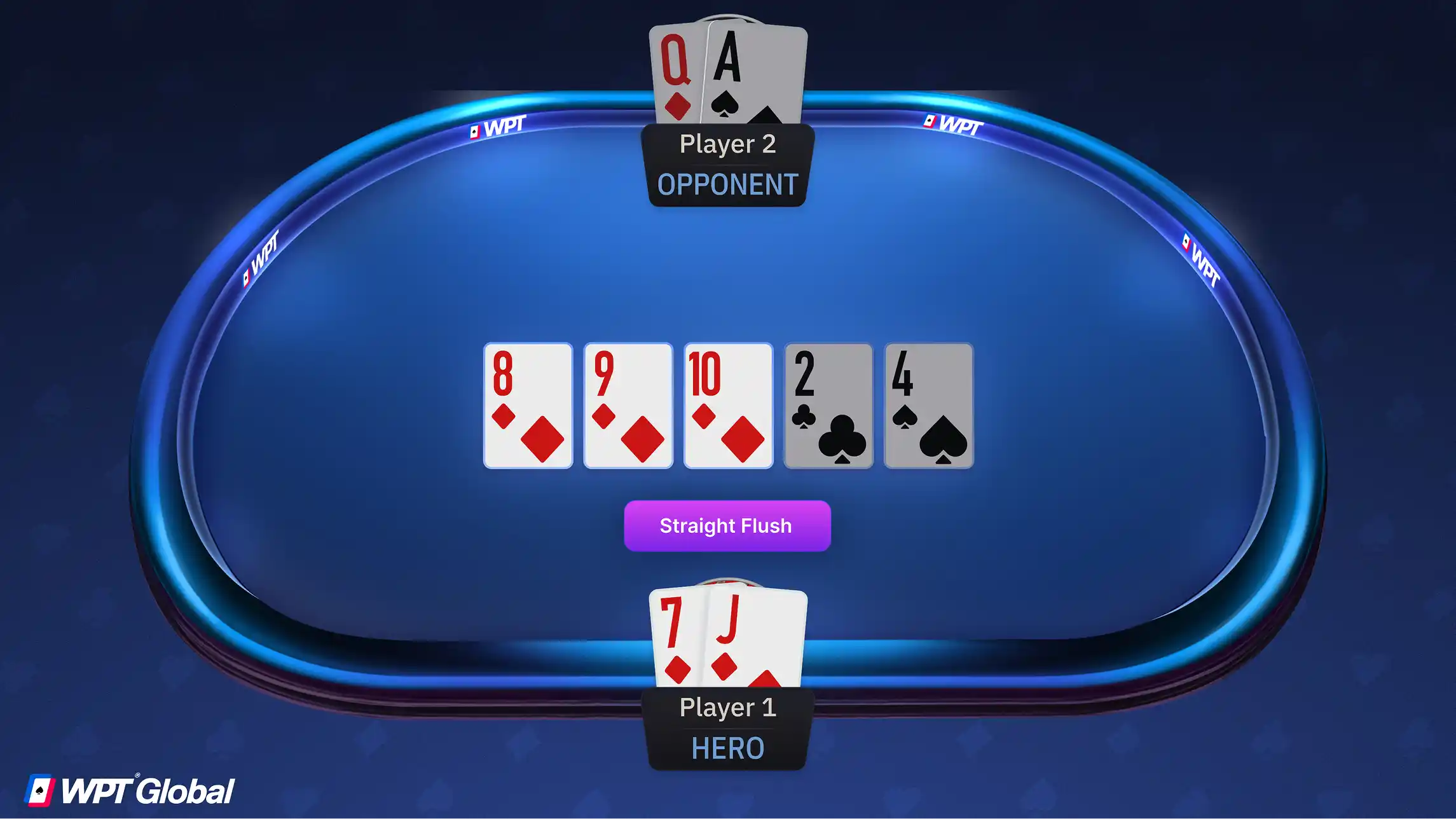
Last week at Rivers Casino in Des Plaines, Illinois, a player made a straight flush. We all know it's one of the rarest hands in poker. But he lost. By chance, the player across the table had a bigger one. That beat triggered a bad beat jackpot worth $659,941.70, and the "loser" walked away with the biggest share of all: $329,974.
It's truly a once in a career moment. It can also be argued this is why cash players keep coming back. So, let's have a look at both the twist and the maths, because it is an insane hand.
The hand and the $659,941.70 jackpot
It happened in a high-stakes no-limit hold'em cash game. A straight flush was beaten by a higher straight flush. It's rare. So rare that most players go a lifetime without seeing it once.
And, because Rivers runs a bad beat jackpot, the table split a near-$660,000 prize pool. On top of the freak rare occurence, the jackpot rewards the person on the wrong end of the beat.
Who | Share | Payout |
|---|---|---|
The "losing" hand (bad beat) | 50% | $329,974 |
The winning hand | 25% | $164,985 |
The other six players at the table | 25% split | ≈ $27,497 each |
So the player who lost the pot collected roughly twice what the player who won it did. Yes you read that right. Six others picked up almost $27,500 apiece for the good fortune of simply being dealt into the hand.
After the payout, Rivers' jackpot reset and began building again from $250,683.60.
How a bad beat jackpot works
A bad beat jackpot is a cash-game promotion funded by the players themselves.
The room drops a small amount (usually a dollar) from qualifying pots into a progressive pool that grows. This can go for months, until a hand meets the trigger. At Rivers, the rule is that a mighty hand has to lose: you need to be beaten while holding four tens or better.
When that finally happens, the pool pays out. Plus, the losing hand takes the lion's share, the winner takes a slice, and everyone else at the table shares the rest.
This turns a bad beat from feeling (well, bad) into a jackpot. The worse the hand you lose with, the more likely it clears the bar. For being coolered, you'll get a bigger reward.
How rare is it?
Straight flush over straight flush sits near the top of poker's rarity list. CardPlayer put the odds of a single player making a hand of this calibre at around 1 in 3,200. Not something you see every day (and that's for one such hand). For two players to make straight flushes in the same deal, the number goes astronomical.
So why is it so rare?
A straight flush over straight flush needs the board to lay down several connected cards of one suit. After that we need two different players to be holding the right suited connectors to complete straight flushes. The odds are slim. Especially all that lining up at the same table, the same hand.
It's why these jackpots build for so long before one finally hits.
How it ranks
A near-$660,000 bad beat jackpot is a big one however you look at it, but it isn't a US record.
That mark belongs to a sister property, Rivers Casino in Pittsburgh. This casino paid out a cool $1,226,000 in August 2022. It's the largest live bad beat jackpot in American poker history.
North of the border, Canada's Playground Poker Club in Quebec has been the genre's heavyweight. Here we see payouts running past CAD $2.5 million, and several of them to boot.
Back to the US, numbers are generally smaller. For example, the Lodge Card Club in Texas, home of the WPT® Prime Lodge, set the Texas record at $289,376 in early 2025. And another straight-flush-over-straight-flush hand at Hustler Casino in Los Angeles delivered a $100,000 jackpot.
When we look at these hands, Rivers' $660,000 is one of the larger US hits in recent times.
Promotions
Tournaments
For Customers
Safety & Security
Stay Connected
Follow us on social media to stay updated with the latest news, updates, and exclusive offers!



Promotions
Tournaments
For Customers
Safety & Security
Stay Connected
Follow us on social media to stay updated with the latest news, updates, and exclusive offers!
 Local Payment Methods
 Cards
 Crypto
 E-Wallets
 Apple Pay
 Google Pay
 Instant Bank Payments
*
Some methods may not be available in your region. Please contact support if you experience any issues.
This website is operated by Everstronglink Limited a company incorporated under the laws of Costa Rica having its registered address at Province 01 San Jose, Canton 02 Escazu, San Rafael, On La Ceiba Street, House No. 400, Costa Rica, and is licensed by the Tobique Gaming Commission under License Number 0000005. Kashxa Limited, a Cyprus company with registration number 427606, having its registered office at Strovolou, 12 Aigyptou, Nicosia, 1097, Cyprus, is acting as a payment agent on behalf of the license holder entity Everstronglink Limited.
Gambling can be addictive. Play responsibly. Everstronglink Limited only accepts customers over 18 years of age.
Copyright © 2026 WPT Global. All rights reserved