







 Customer Dispute Resolution Page
 Help Center
 Affiliate Program
In this article
Welcome to WPT Global
Welcome to WPT Global, the online home of the World Poker Tour®. Let us guide you through setting up your account and get you to the tables in no time.Social Media


How To Play
World Leading Tournaments
A huge player pool and everything from freerolls to high rollers – plus regular special events!Ambassadors
Get to know our ambassadors - world-class players from across the globe who embody the spirit of the game. Discover their stories and become part of the community.Your Hub for News
Explore stories, tips, and updates from the world of poker and casino. Learn from pros, discover new trends, and stay in the loop with everything happening at WPTGlobal.What are you looking for?
Close




How to Distribute Poker Chips

Share




Key Takeaways
Poker chip distribution must match the format: tournament or cash game.
Tournament chips are built around blind progression and equal starting stacks.
Cash game chips must reflect real monetary value and allow smooth betting.
40–60 chips per player is ideal for most home tournaments.
Removing smaller denominations as blinds increase keeps stacks clean and professional.
Poker chip distribution is not about stacking colors neatly in front of players. It is about structure. The way you set up poker chips determines how easily blinds are posted, how efficiently bets are made, and how clearly stacks can be read across the table.
When the chip setup is poorly planned, the game slows down. Players constantly make change or the blind increases become awkward. Stacks look bigger than they actually are. Good distribution prevents all of that.
Professional structures used in major poker tournaments follow strict denomination logic. Home games should apply the same thinking, just scaled down.
Recommended Tournament Chip Counts by Player Number
The number of chips each player receives should scale with the number of players and the desired tournament depth. The following table shows a practical distribution that keeps stacks readable while maintaining smooth blind progression.
Players | Starting Stack | Chips Per Player | Recommended Denominations |
|---|---|---|---|
6 | 10,000 | 40–50 | 25 / 100 / 500 / 1,000 |
8 | 10,000 | 50–60 | 25 / 100 / 500 / 1,000 |
10 | 15,000 | 50–60 | 100 / 500 / 1,000 / 5,000 |
This prevents over-distribution and keeps stacks readable.
Poker Tournament Chip Distribution
Tournament chip distribution is designed around blind progression. Every player begins with the same stack, and denominations must support early precision while preparing for later blind increases.
In structured poker events, smaller denomination chips are used early for accurate betting. As blinds rise, those chips are removed to simplify stacks and maintain clarity.
Example: 8 Players, 10,000 Starting Stack
Chip Value | Number of Chips | Total Value |
|---|---|---|
25 | 8 | 200 |
100 | 8 | 800 |
500 | 4 | 2,000 |
1,000 | 5 | 5,000 |
Total | 25 chips | 8,000 |
This balanced structure provides early precision and smooth blind progression.
Why this works:
25 chips support early levels like 25/50 and 50/100
100 chips become the core betting unit
500 and 1,000 chips reduce clutter as blinds increase
This structure transitions cleanly into the following without the need for constant chip exchanges:
200/400
300/600
400/800
How to Divide Poker Chips for 8 People
For most home tournaments:
Aim for 50–60 chips per player
Keep total denominations limited to 4 or 5 types
Avoid giving players excessive small chips
Too many physical chips slow down counting and dealing.
How to Distribute Poker Chips to 6 Players
With a smaller field:
40–50 chips per player is sufficient
You may reduce one denomination if running a turbo structure
Expect the tournament to conclude faster due to fewer eliminations required
When to Remove Denominations
As blinds increase:
Remove 25 chips once they are no longer needed
Color up into the next highest denomination
Keep stacks visually clean
This mirrors structured tournament progression and prevents late-stage clutter. The objective is always the same: smooth escalation without friction.
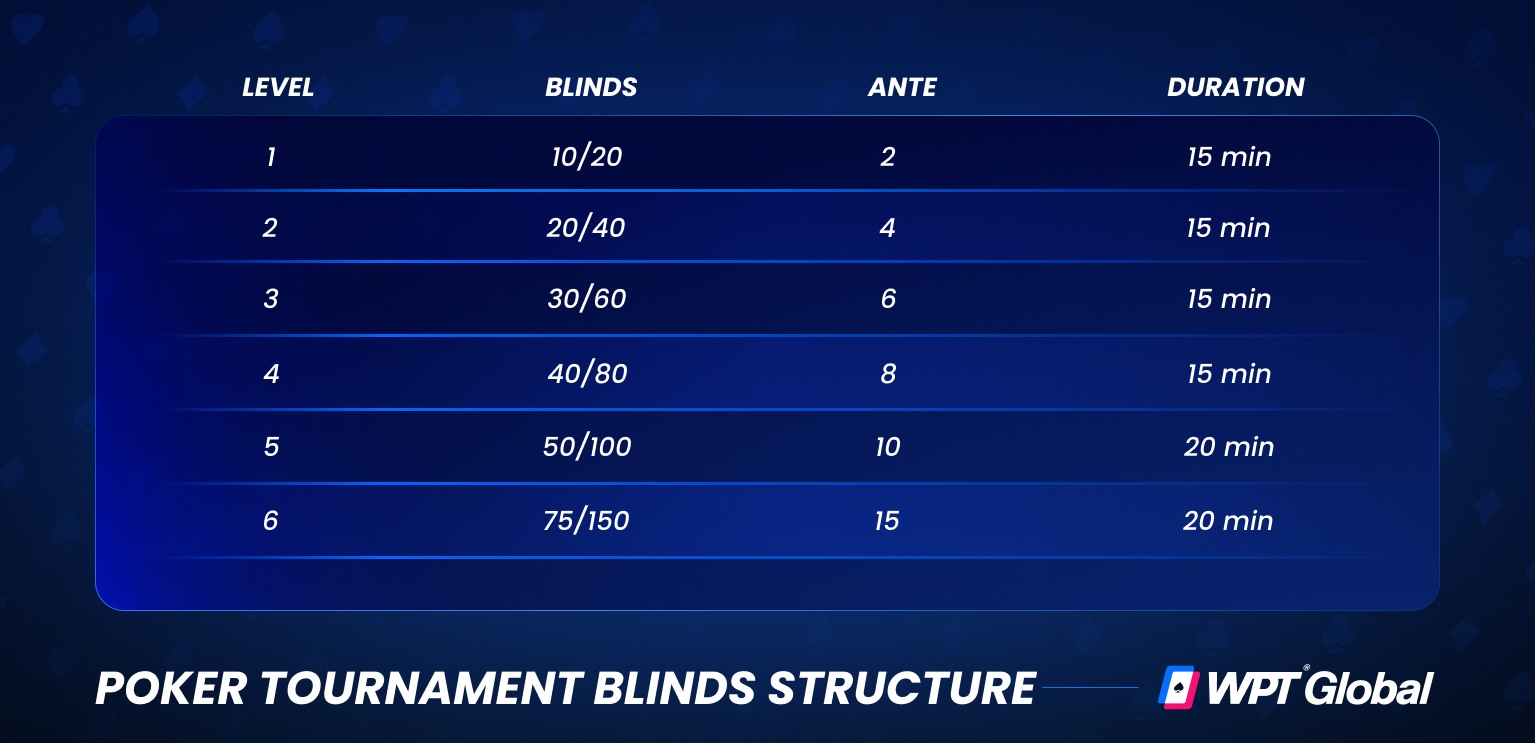
Blind Level Progression Example (10,000 Stack)
Level | Blinds | Average Stack (BBs) |
|---|---|---|
1 | 25/50 | 200 BB |
2 | 50/100 | 100 BB |
3 | 100/200 | 50 BB |
4 | 200/400 | 25 BB |
5 | 300/600 | 16 BB |
This demonstrates how chip structure directly impacts tournament length.
Cash Game Distribution
Cash game poker chip setup is simpler because chips represent real money. There is no blind escalation. Liquidity matters more than layering.
If you are running a $1/$1 game with a 100 big blind buy-in ($100), your chip setup should allow clean blind posting and flexible bet sizing.
Practical $1/$1 Distribution Per Player
Chip Value | Number of Chips | Total Value |
|---|---|---|
$1 | 20 | $20 |
$5 | 16 | $80 |
$25 | 4 | $100 |
Total | 40 chips | $200 |
This setup:
Ensures small blinds are easy to post
Allows standard $6–$15 raises without change
Supports larger river bets efficiently
Key Principles for Cash Game Distribution
Always have plenty of small-denomination chips in circulation
Do not overload the table with large chips early
Design for common bet sizes, not visual symmetry
When players ask how to split poker chips in a cash game, the answer starts with stake level and buy-in. Calculate the money first, then allocate denominations logically.
Cash Game Chip Distribution Comparison
Stakes | Typical Buy-In | Small Denom Focus | Large Denom Usage |
|---|---|---|---|
$0.50/$1 | $100 | High | Minimal early |
$1/$2 | $200 | Moderate | Gradual |
$2/$5 | $500 | Lower | Frequent |
Cash games prioritize liquidity over visual stack height.
Home Tournaments
Home tournaments require a balance between structure and simplicity. They should feel organized without becoming over-engineered. For a $20 buy-in tournament with 10 players and 15,000 starting stacks.
If Blinds Start at 100/200 You might use:
Chip Value | Number of Chips | Total Value |
|---|---|---|
100 | 10 | 1,000 |
500 | 6 | 3,000 |
1,000 | 5 | 5,000 |
5,000 | 2 | 10,000 |
Total | 23 chips | 19,000 |
Notice that 25 chips are unnecessary in this structure. Your denominations should match your opening blind level.
General Home Tournament Guidelines
Keep starting stacks between 100–150 big blinds
Use 4 denominations maximum
Plan color-ups in advance
Avoid giving players more than 60 physical chips
Remember, stack clarity matters more than stack height.
Running the Tournament
Good chip distribution only works if it is managed correctly. So always remember the following tips during the tournament:
Display blind levels clearly
Use a timer for consistency
Announce level increases
Remove obsolete denominations on schedule
Structure builds credibility. Even in a home setting, disciplined blind progression keeps the game feeling professional.
Players interested in deeper structured formats can explore official poker tournaments to see how professional blind and chip systems scale at higher levels.
Online Tournaments and Cash Games
Online poker removes physical chips, but the structural logic remains identical in online poker games:
Tournament stacks represent survival and blind depth
Cash game stacks represent real currency
Denominations adjust automatically
Live vs Online Chip Distribution
Format | Physical Chips | Denomination Management | Stack Clarity |
|---|---|---|---|
Live Tournament | Yes | Manual color-ups | Visual |
Online Tournament | No | Automatic | Digital display |
Live Cash Game | Yes | Based on buy-in | Physical count |
Online Cash Game | No | Automatic | Numeric balance |
Understanding live chip structure improves online decision-making and understanding physical chip distribution improves awareness of stack-to-blind ratios and bet sizing decisions in digital environments.
Home Cash Games
Home cash games prioritize comfort and efficiency, so use the following if hosting 8 players in a $0.50/$1 game:
Ensure at least 150–200 small denomination chips are in play
Introduce larger chips only when stacks deepen
Keep chip colors limited
When deciding how to set up poker chips for a home cash session:
Determine stake level
Set standard buy-in
Allocate small denominations first
Add larger denominations to support realistic betting
Remember, the smoother the chip flow, the better the game feels for all players.
Final Thoughts
Poker chip distribution is not complicated, but it must be deliberate. Tournament chip setup supports blind progression and stack clarity. Cash game chip setup supports liquidity and efficient betting.
When denominations match the structure, the game runs cleanly. When they do not, small logistical issues begin to dominate attention. Plan the chips correctly, and the poker can take center stage for you and your friends.


Promotions
Tournaments
For Customers
Safety & Security
Stay Connected
Follow us on social media to stay updated with the latest news, updates, and exclusive offers!


Promotions
Tournaments
For Customers
Safety & Security
Stay Connected
Follow us on social media to stay updated with the latest news, updates, and exclusive offers!
 Local Payment Methods
 Cards
 Crypto
 E-Wallets
 Apple Pay
 Google Pay
 Instant Bank Payments
*
Some methods may not be available in your region. Please contact support if you experience any issues.
This website is operated by Everstronglink Limited a company incorporated under the laws of Costa Rica having its registered address at Province 01 San Jose, Canton 02 Escazu, San Rafael, On La Ceiba Street, House No. 400, Costa Rica, and is licensed by the Tobique Gaming Commission under License Number 0000005. Kashxa Limited, a Cyprus company with registration number 427606, having its registered office at Strovolou, 12 Aigyptou, Nicosia, 1097, Cyprus, is acting as a payment agent on behalf of the license holder entity Everstronglink Limited.
Gambling can be addictive. Play responsibly. Everstronglink Limited only accepts customers over 18 years of age.
Copyright © 2026 WPT Global. All rights reserved