Poker strategies, at their core, are based on poker patterns. Players who can spot patterns and decode them faster than others are often the most successful. Recognizing repetitive behaviours gives you a major edge, especially in games where players aren't adjusting their strategy.
Whether you're playing poker tournaments or just a game with friends, in this article we'll show you common patterns and how to spot them. From limping with premium pairs to checking-raising with draws, we'll cover popular betting patterns and more. These common poker patterns show up at every level of play, and so knowing how to exploit them can boost your win rate overnight.
If that's not enough, we'll also give you tips from our pros on how to avoid falling into exploitable patterns. By the end of this guide, you'll not only be better at spotting poker patterns but avoiding common mistakes novices make.
Before we get into specifics, let's define what we mean by poker patterns. In the context of poker, patterns are consistent habits or routines.
These habits and routines apply to the way someone bets as well as their physical actions. Even online, players fall into repetitive timing and sizing patterns that can often be exploited once recognized. We can break down these patterns further by looking at one-the-felt and off-the-felt behaviours:
On-the-felt poker patterns are your opponent's actions. They're behaviours you can exploit, without breaking any poker rules, to gain an advantage and give yourself a better chance of winning pots.
Off-the-felt patterns relate more to your habits away from the poker table. It's the things you do to become a more skilled player, such as studying hand histories, learning from past mistakes, and preparing yourself emotionally for the next game.
Here are the most common on-the-felt poker patterns you can look for in your opponents and use to your advantage:
What does limping suggest? Limping is regarded as a passive move, so players who limp a lot are typically inexperienced, timid, or trying to trap someone. For the purposes of this discussion, we'll assume you're not facing a skilled player who limps with strong hands as a way to trap people.
A typical limping range in Texas Hold'em = small pairs, suited connectors, and suited aces, K-X hands.
How to adjust: Passive players limp a lot, so we can assume they're either inexperienced or not very good. In these situations, bluff more often and make thin value bets. For example, if you're playing Texas Hold'em and have middle pair, don't be afraid to bet against passive players who limp and call a lot. These players only look at their cards and rarely consider other hands. Therefore, they're more likely to go to a showdown with a weak hand, such as bottom pair.
You can always try to isolate limpers with position and force them into difficult post-flop spots by playing aggressively with a wider range.
What do betting patterns suggest? Betting patterns are sequences people use for specific types of hands. For example, someone who flops a flush draw might use the check-raise sequence. Conversely, someone who flops a set might use the bet-check sequence.
How to spot betting patterns: Review hand histories at the table or away from it. Focus on big pots that go to a showdown and note down the sequence of play.
How to use betting patterns: Use hand history data to generate a profile on someone, but don't hyper-focus on specific sequences. Instead, think about what each sequence suggests.
For example, if someone always checks at least two streets with strong hands, you can assume they like to trap. So, when you see them using sequences that include two or more checks, such as check-call on the flop and turn or check-check-raise, you can add more trapping hands to their range.
Also note how players size their bets. Some use small sizes when bluffing and go big only when strong. These patterns are gold for you to pick up on.
What does it suggest when someone looks at their cards early? Someone who looks at their cards before the action gets to them in a live poker game is probably a novice. Looking at your cards early gives other people more time to get a read on your body language. That's why experienced players wait until it's their turn to act.
How to spot early lookers: The easiest way to exploit these players is not to be one yourself. Watch everyone as the cards are being dealt, and only look at your hand when it's time for you to act.
How to exploit people who look at the cards too soon: Early lookers are often eager to play their cards, regardless of what they are. Therefore, you can assume they've got a wide range. When someone has a wide range, they're likely to have more weak hands in their range. This means, in general, you can afford to bluff more often and make thin value bets.
Players who peek early often act early too, often tipping their hand strength before the action reaches them.
What does showing poker hands early suggest? Players in a live game who show their hands too early or when they aren't required to are probably beginners. Therefore, you can assume they're not very skilled. People who show their hands early may also be excited because they have a strong hand.
Common hands people show early: Most inexperienced players show strong hands and weak hands too quickly. People don't usually show bluffs too early because they're embarrassed.
How to exploit this pattern: There are two ways to exploit this trait. If someone shows their cards early or unnecessarily more than once, they're a novice. In this situation, play your strong hands aggressively because they're unlikely to fold if they make any sort of hand.
If someone shows their hand early and they've got a monster, it's because they're excited. In this situation, replay the hand in your mind and try to recall the betting sequence. This will give you a good insight into whether they play strong hands passively or aggressively.
Always make sure to study the hands opponents voluntarily reveal. This gives clues about how honest or deceptive their overall strategy might be.
What do verbal and nonverbal cues suggest? Verbal cues (such as someone commenting on a hand) and nonverbal cues (such as someone slapping their forehead) provide insight into someone's emotional state.
Common verbal/nonverbal cues and what they might mean:
Talking during a hand/looking disinterested = someone has a weak hand.
Staring at a single spot/not moving or talking = someone has a strong hand and doesn't want to give it away.
Talking after a pot/slamming the table = someone folded the best hand or made a mistake and is annoyed. This player is probably on tilt (annoyed) and, therefore, more likely to play aggressively/bluff in the future.
A talkative player suddenly goes quiet = they probably have a strong hand.
A quiet player suddenly talks a lot = they probably have a weak hand and want to create a distraction so you don't call.
Someone is leaning back in their chair/acting casually = they probably have a strong hand but want to make it look like they don't care.
Tells and reverse tells: All of the possible reasons for someone acting a certain way can be reversed. For example, a skilled player might bang the table after losing a hand.
They know people will assume they're on tilt and, therefore, likely to be bluffing. The skilled player can exploit this assumption by betting aggressively with strong hands, thus fooling people. This is how a reverse tell works.
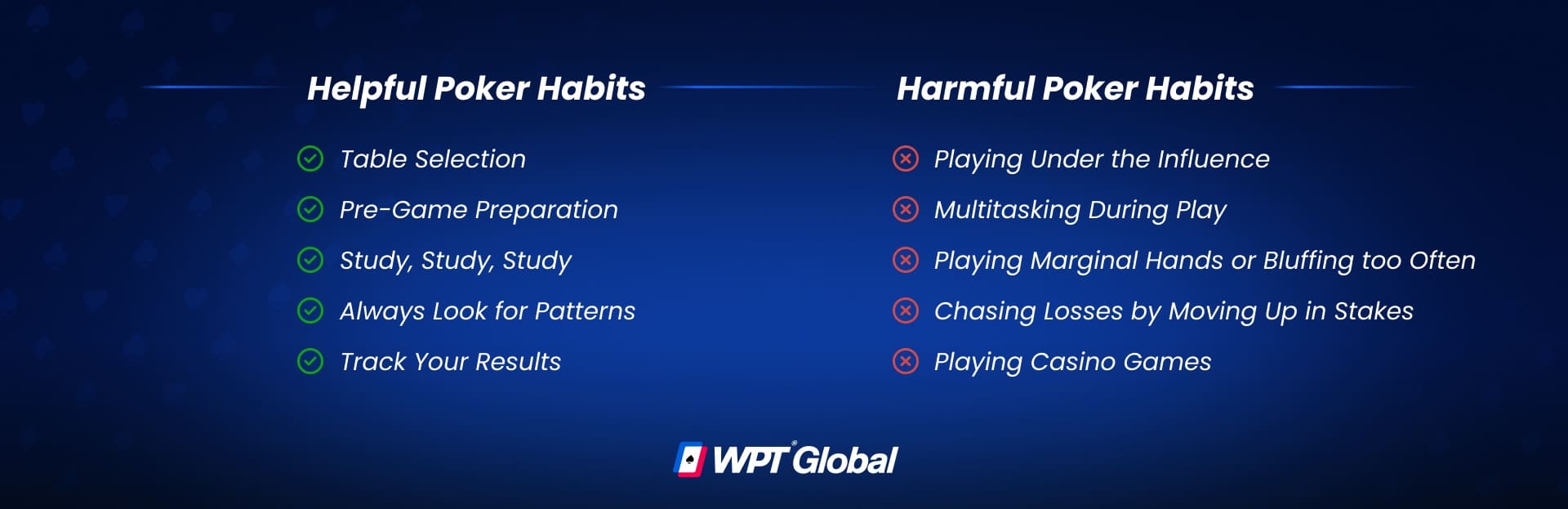
What happens away from the table often matters more than what happens on it, especially when it comes to long-term improvement. So now we've covered some of the common patterns players display at the poker table, let's go through the things you can do to be less exploitable. The following list of routines and practices will help you become a much stronger player in all aspects of the game:
Table Selection: Assess the dynamics of a table before you ante up. The best games to play are ones with a lot of weak players. You can spot these players because they limp a lot and don't bet/raise very much.
Pre-Game Preparation: Devise a routine that calms your mind before a game. The worst thing you can do is start a session emotionally charged, angry, tired, or unfocused. Spend a few minutes relaxing, thinking about your strategy, and preparing yourself for what could be a long session.
Study, Study, Study: Getting into a routine of studying old hand histories at the start of your poker career is vital. Aside from creating a good habit, it allows you to spot common mistakes in your own play and fix them before they cost you too much money. Try categorizing your mistakes into technical (math, odds) and strategic (timing, position) to refine your focus areas.
Always Look for Patterns: Never stop watching other players and looking for patterns. A lot of novice poker players make the mistake of only watching the action when they're involved in a hand. Avoid this mistake and you'll be a much better player.
Track Your Results: It's easy to think you're a winning player if you don't track your results. Make use of poker tracking software, so you can see whether you've got a positive or negative return on investment (ROI). You can also track exactly which games and types of hands you're winning/losing money with. Look at your win rate by position and by hand type, and also by session length. Patterns emerge fast when you’re logging consistently.

Before we send you off into your favourite live and online poker games, we need to shine a light on some common mistakes people make. Avoid these harmful patterns, and you'll give yourself an even better chance of success:
Don't play under the influence of drugs or alcohol because you'll make mistakes. Approach the game seriously and play like a pro.
Don't do other things while you're playing. Multitasking will cause you to lose focus and make suboptimal decisions. When you're online, you also risk timing out and losing pots with the best hand. In live games, you'll irritate other players and miss vital information.
Don't play marginal hands or bluff very often. Stick to the fundamentals and stay in your lane.
Don't chase losses by going up in stakes. Aside from the fact that you'll be playing poker against better players, you're likely to be emotional when you're chasing losses. This increases the risk of losing your bankroll when you're playing for higher stakes.
Avoid casino games. Smart poker players only put their money at risk when they feel like they've got an edge. You don't have an edge in casino games, so it's best to avoid them.
We've given you some of the most common patterns in poker, but it's not a complete list. In fact, even if we had time to cover every pattern, it's an almost impossible task.
Very few situations are the same in poker, which is why you can't rely on fixed ideas and strategies. That's why we've given you ways to think about poker hands and patterns, alongside common tells.
You can build on this knowledge by honing your pattern recognition skills. The best way to do that is to build these habits into your routine:
Take note of significant moments in a game and how your opponents acted.
Use poker HUDs (if you're playing online) or take notes (if you're in a live game).
Review past hands with a focus on patterns, not just results. Try to understand why a player made certain moves.
Always be on the lookout for timing tells, showdowns that reveal something about a player's range, and behaviour that suggests someone is on tilt.
Do these things on a consistent basis, and opponents will have a hard time playing against you and over time, you’ll start predicting your opponents’ next move. Not by luck, but because you’ve seen the same patterns before.
Poker is as much a game of patterns as it is a game of cards. That's why you have to focus on everything that's happening. Every bet, every gesture, and every showdown reveals something about a particular player and their hand strength.
Learning to spot these tells will make you better at exploiting weaknesses in other players. It will also make it harder for players to exploit your tendencies.





 Customer Dispute Resolution Page
 Help Center
 Affiliate Program