











 Customer Dispute Resolution Page
 Help Center
 Affiliate Program


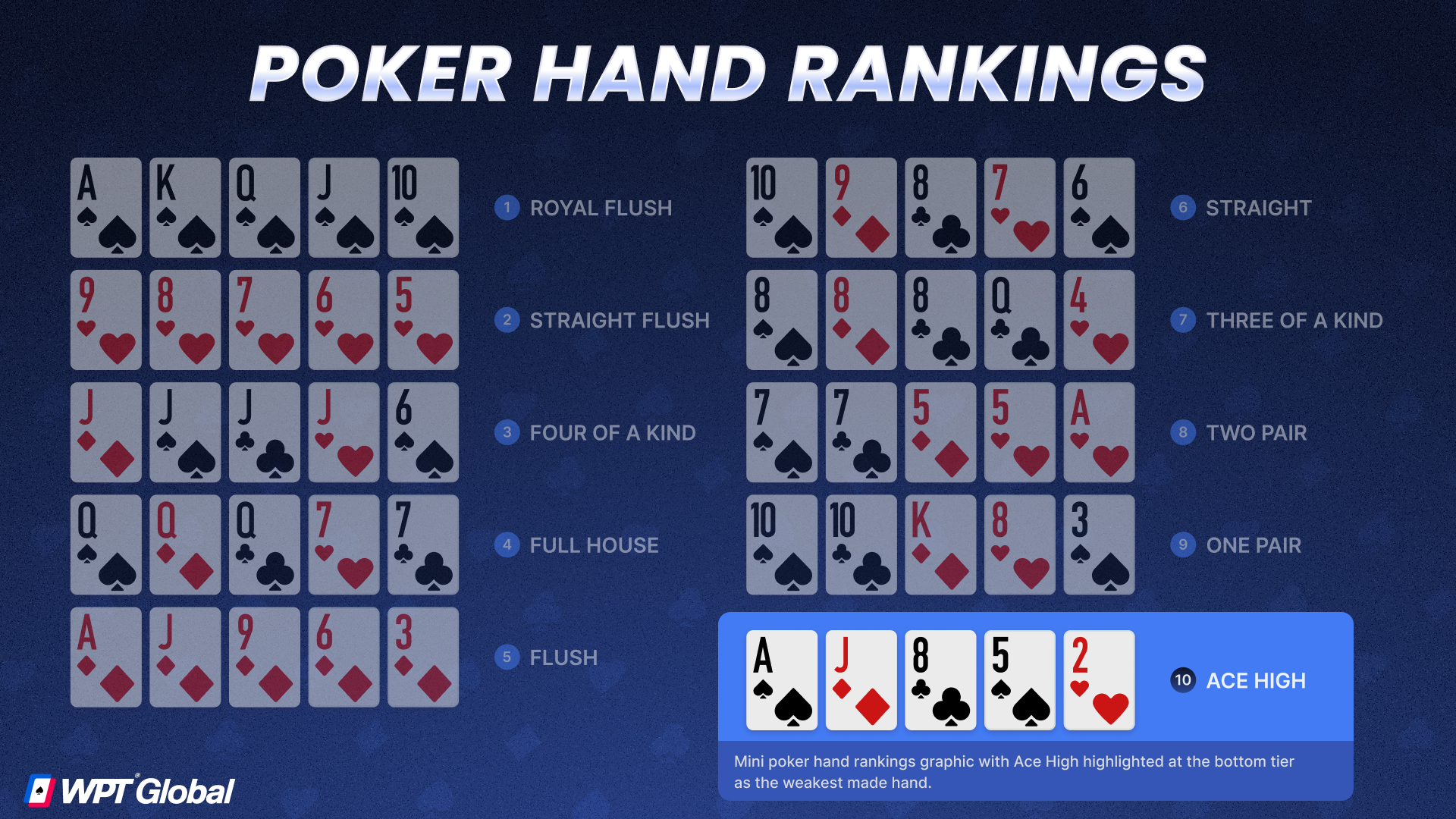
Ace High Explained: What It Means and When It Wins
Let’s start by breaking down exactly what Ace High is and why it sometimes sneaks into winning showdowns as the defining factor.
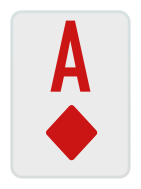
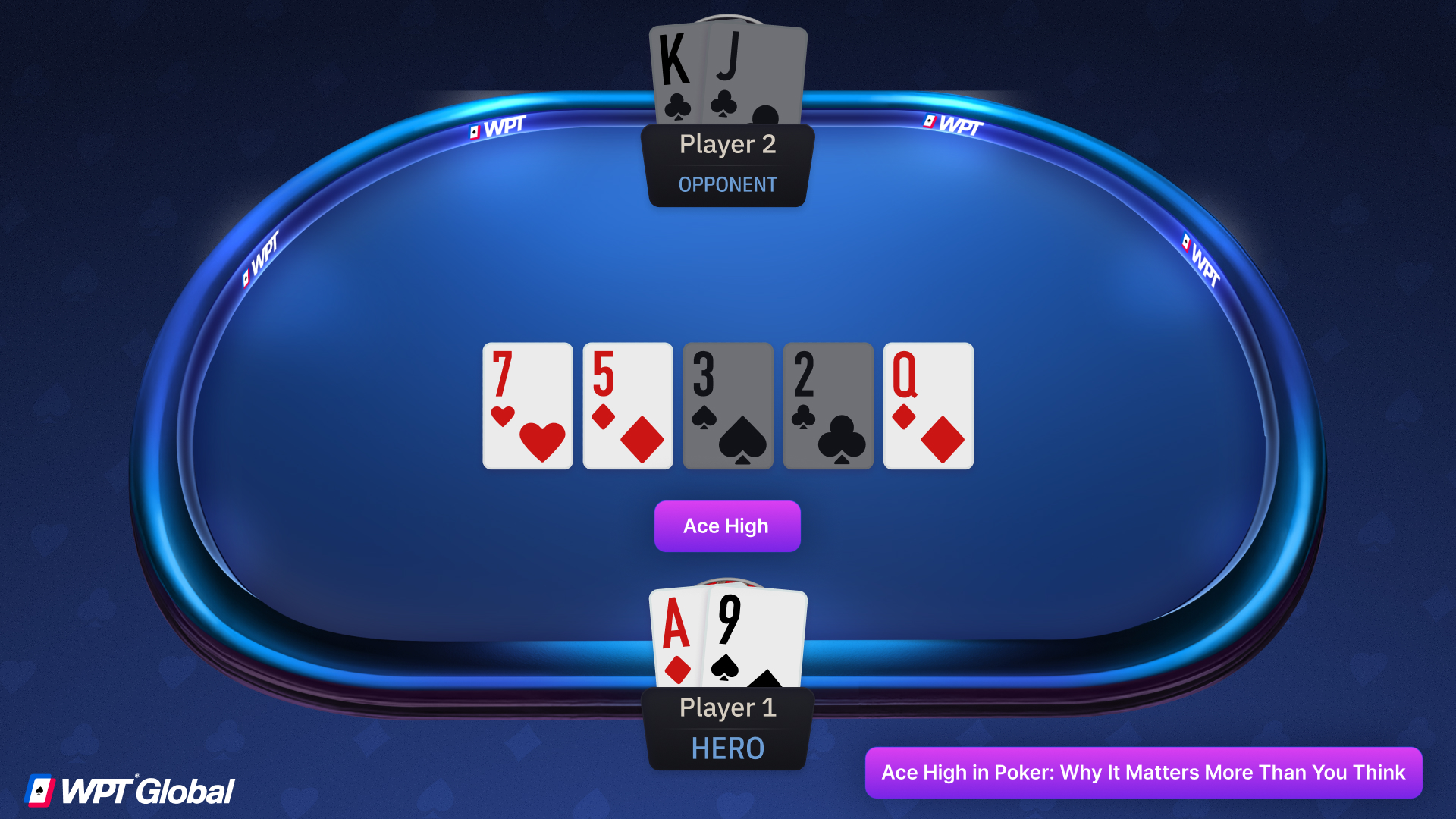
Ace High comes into play when your best five-card combination doesn’t form a made hand according to the poker hand hierarchy. For example:
- Your hand:
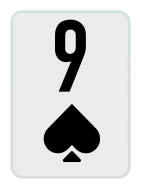
- Opponent’s hand:
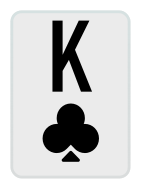
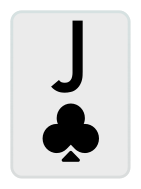
- Board:

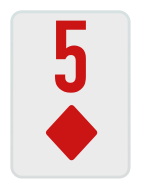
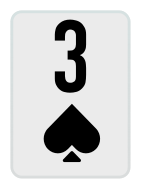
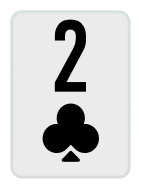
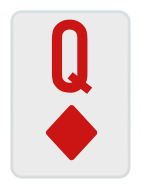
Here, you can see neither player has a pair or anything better. Your ace outranks your opponent’s king, so you win with Ace High.
Now that you know what it means and when it is active, let’s look at the scenarios where Ace High actually matters at the table.
When Ace High Can Make or Break Your Poker Hands
Ace High isn’t always glamorous, but sometimes it’s all you need to take down a pot! Here are some scenarios when it’s strong and some when it’s weak.
- Default Strength: The ace ensures you always have the best possible “high card” when nothing else hits on the table.
- Heads-Up Play: Against just a single opponent, Ace High can often win in a showdown, but is still considered quite a weak hand.
- Weak in Multiway Pots: The more players in the hand, the less likely it is that Ace High will be good enough to win a hand.
So when Ace High does show up as your best option (and it can), the real key becomes how you decide to play it strategically.
How to Play Ace High Like a Pro
Even the weakest-seeming hands can be played well if you know when to push and when to fold, and Ace High is no exception to that rule:
Bluff Catching:
Ace High is a hand you can often use to call when you believe that your opponent is bluffing.
For example, the board is Q♠ 7♦ 4♣ 2♥ 9♦ and you hold A♥ 8♠. If your opponent then fires off a big river bet after checking earlier streets, their line wouldn’t represent many strong hands.
Calling with Ace High can beat missed draws or any pure bluffs from your opponent.
Board Awareness:
Ace High can change value depending on the texture of the board. On a dry board such as K♣ 7♠ 2♦ for example, there are very few strong hands or draws possible. With A♠ J♥, you may often reach showdown profitably.
On a wet board such as J♠ 10♠ 8♦, Ace High loses much of its value, not because pairs are more likely to be dealt, but because your opponents’ ranges connect far more often. These boards interact heavily with common preflop holdings, producing pairs, strong draws, and made hands that will continue betting. As a result, a hand such as A♦ 5♣ should usually be folded, considering that far fewer bluffs reach later streets and Ace High is rarely good at showdown.
Kicker Importance:
Your kicker decides whether your Ace High beats another Ace High. For instance, if you hold A♣ Q♦ against an opponent with A♠ 9♠ on a board such as K♣ 6♦ 5♥ 2♣ 3♦, you would win because your queen kicker is higher than their kicker.
If you hold A♦ 4♣ against someone with A♥ J♦ on an unpaired board, you would always lose since their kicker outranks yours.
Strategy is nothing without getting the critical decisions correct. So let’s learn when to stick around with Ace High, and when to let it go.
When to Call vs. When to Fold with Ace High
The toughest decision in poker is often knowing whether to hang on to your hand and when to throw it away. Here’s how Ace High fits into that judgment:
When to Call
Heads-up vs an aggressive opponent:
If the board is Q♣ 7♦ 3♠ 2♥ 9♣ and you hold A♠ 5♦, an aggressive opponent’s river bet could often represent missed draws. Ace High could be good enough to call.
On dry boards:
On K♦ 8♣ 2♠, there are few strong hands available. Holding A♥ J♦, you could profitably call small bets because opponents rarely connect with this board texture.
When blocking the nut flush:
On Q♠ 6♠ 3♥, holding A♠ 9♦ means opponents are far less likely to have the nut flush draw. Your Ace High gains value in this case because you block their strongest bluffs.
When to Fold
In multiway pots:
If four players see a flop such as J♦ 10♣ 7♦, Ace High, such as A♣ 4♠ is almost never good. You should fold immediately.
On coordinated boards:
On 9♠ 8♠ 6♣ 5♠ K♦, Ace High (e.g., A♥ Q♣) is crushed by straights and flushes. Fold without hesitation.
Against tight players:
If a tight opponent triple-barrels on K♣ 5♦ 3♣ 5♥ 2♠ and you hold A♦ 9♣, they almost always have a made hand. Fold every time.
Ace High: Example in a Sentence
“I called on the river with Ace High and won the hand.”
Quick Takeaways: What to Remember About Ace High
Before we wrap up, here are the main points to lock in whenever you’re holding Ace High:
- Ace High is the strongest unmade hand.
- It can be a bluff-catcher heads-up.
- In multiway pots, it’s rarely strong enough.