













 Customer Dispute Resolution Page
 Help Center
 Affiliate Program


Ace to 5 Low Rules
Ace-to-Five is one of the most common methods for ranking “low” hands in split-pot or lowball poker variants. Unlike traditional Texas Hold’em and other poker games, where aces are the strongest high card, here aces always count as the lowest card.
Key points about A-5 Low:
- The ace always plays low.
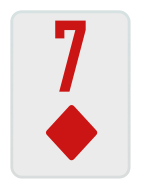
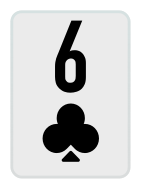
Example: If you hold, your hand is evaluated as 7-6-4-3-A, not as a high card ace. This can make ace-based combos extremely powerful in lowball formats.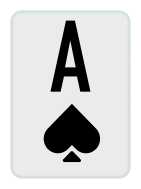
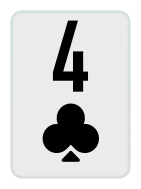
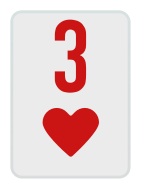
- Straights and flushes (even a royal flush) don’t affect the low hand’s value.
Example:is still the nuts (A-2-3-4-5) even though it forms a straight flush. Unlike Deuce-to-Seven, straights and flushes do not “break” your low.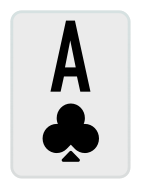
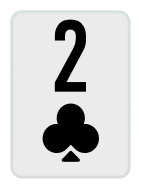
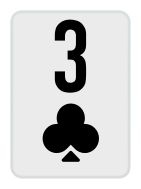
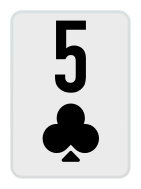
- Pairs are always bad for low hands.
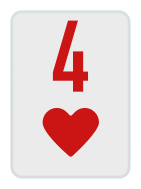
Example:is a pair of fours, which makes it worse than any unpaired low. Even a hand such as 8-7-5-4-3 beats it.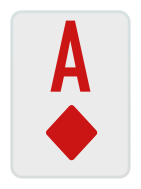
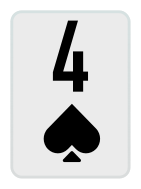
- The closer your five cards are to A-2-3-4-5, the stronger your hand.
Example: 6-4-3-2-A is extremely strong because the highest card is just a six.
By contrast, 9-7-5-3-A is much weaker because the nine significantly raises your low’s top card.
Now that we’ve covered these foundations for Ace-to-Five lowball poker, let’s take a look at how hands are actually ranked under Ace-to-Five rules.
Ace-to-Five Lowball Hand Rankings
Hand rankings are the heart of any poker format, and Ace-to-Five is no exception. You need to know exactly where you stand at all times, and as you progress as a player, you will begin to understand the probabilities of pot success based on the hand you have.
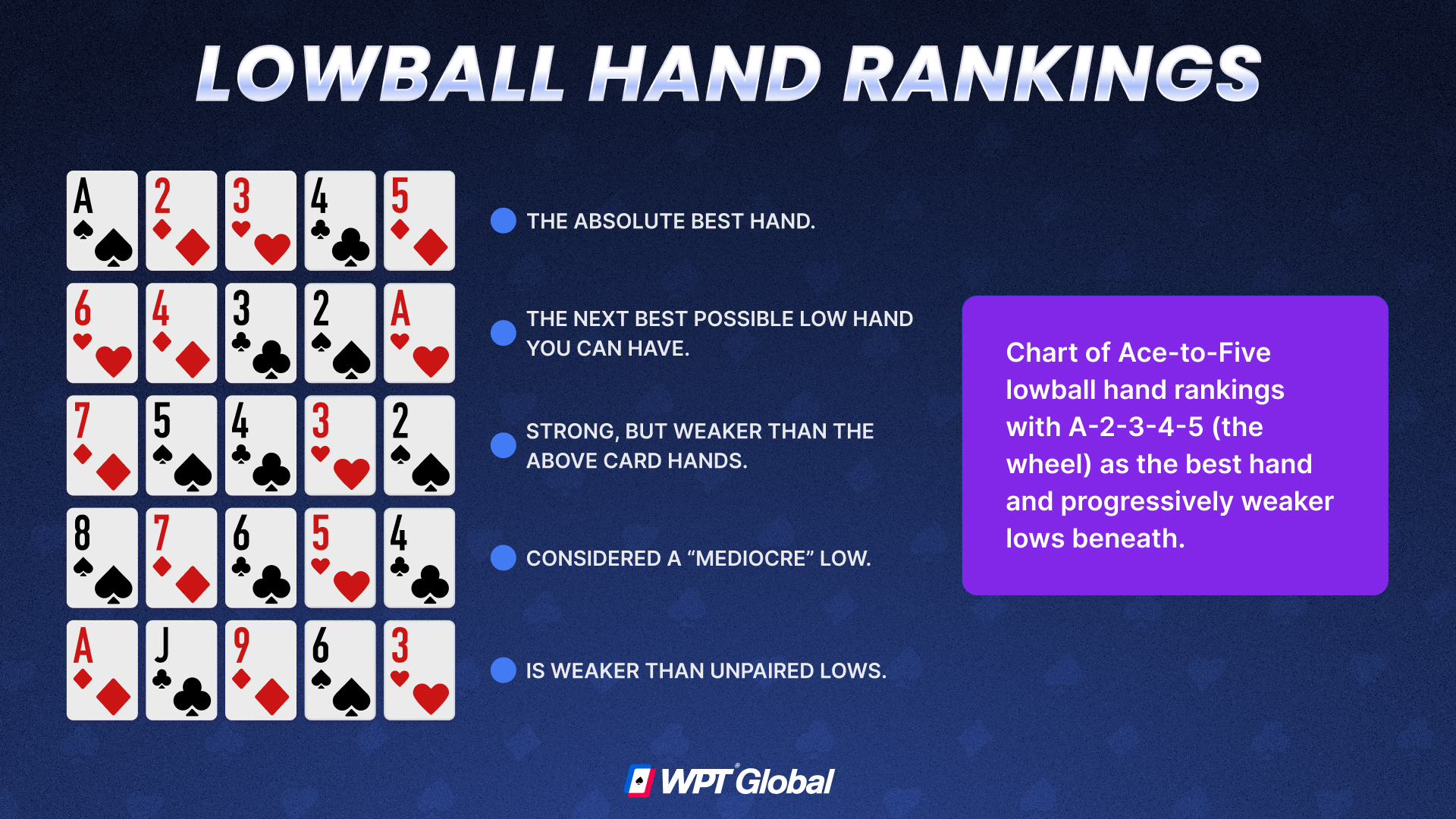
Here’s how hands rank under A-5 Low rules, from strongest to weakest:
- A-2-3-4-5 (“The Wheel Poker Hand”) – The absolute best hand.
- 6-4-3-2-A – The next best possible low hand you can have.
- 7-5-4-3-2 – Strong, but weaker than the above card hands.
- 8-7-6-5-4 – Considered a “mediocre” low.
- Anything with a pair or higher card is weaker than unpaired lows.
Comparing Two Ace-to-Five Low Hands
- Hand 1:→ 7-5 low
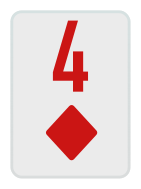
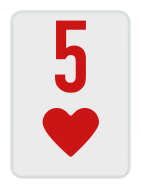
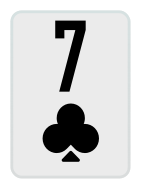
This hand contains five unpaired cards, and so because straights and flushes are ignored in Ace-to-Five Lowball, it is then evaluated purely from highest card downward. The highest card is a 7, followed by 5-4-3-A, making it a clean, strong 7-5 low. This is considered a solid low because all the cards are relatively small and unpaired. - Hand 2:→ 8-4 low
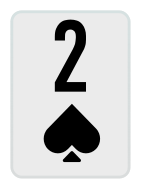
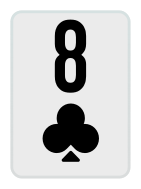
This hand also contains no pairs, and straights are ignored. The highest card is an 8, followed by 4-3-2-A, giving you an 8-4 low. While still playable in many lowball formats, it is considered significantly weaker because the top card (the “8”) ranks higher than the “7” in Hand 1. - Result: Hand 1 wins because 7-low always beats 8-low. In Ace-to-Five Lowball, the strength is determined entirely by the highest card, meaning even one rank can prove a difference.
So you’ve learnt the hand rankings, what’s next? Well, let’s understand how Ace-to-Five compares with other popular lowball systems so we can give this system some context.
Ace-to-Five vs. Ace-to-Six vs. Deuce-to-Seven: Key Differences Explained
Not all lowball systems are created equal, and knowing the difference can save you from costly mistakes. Let’s take a look at these other lowball systems and familiarize ourselves with the different rule sets.
To distinguish Ace-to-Five from other lowball systems, such as Ace-to-Six (6-4-3-2-A is best) or Deuce-to-Seven (7-5-4-3-2 is best, straights and flushes count against you), we need to know the following:
System | Best Possible Hand | Straights/Flushes Count? | Aces Play As | Notes |
|---|---|---|---|---|
Ace-to-Five | A-2-3-4-5 | No | Low only | Common in Hi-Lo games |
Ace-to-Six | 6-4-3-2-A | No | Low only | Sometimes called “6-low” |
Deuce-to-Seven | 7-5-4-3-2 | Yes | High only | “Kansas City Lowball” |
The difference between the lowball systems is subtle; just remember these key differences, and you will be ready to play Ace-to-Five, but where can you play it? What actual poker games use Ace-to-Five as their standard system?
Poker Variants That Use Ace-to-Five: Razz, Omaha Hi-Lo & More
Ace-to-Five is the standard low-hand ranking in several poker game formats, especially Hi-Lo split games:
- Omaha Hi-Lo (O8): Half of the pot goes to the best high hand, and the other half goes to the best Ace-to-Five low hand.
- Seven Card Stud Hi-Lo (Stud 8): A Similar split-pot game where the Ace-to-Five rankings determine the low side.
- Razz: Uses Ace-to-Five rankings exclusively, but without a high hand.
- Triple Draw Lowball (A-5): The Entire game is based around Ace-to-Five low hands, with multiple draw rounds.
Having the rules down is only half the battle; strategy is where you can really separate yourself from the competition! Let’s take a look at some of the most important tips.
Ace-to-Five Poker Strategy: How to Play with A-5 Low
- Chase the Wheel
The nuts in Ace-to-Five is always the wheel (A-2-3-4-5). Starting hands with multiple wheel cards (A-2-3, A-2-4) are always extremely valuable. - Avoid Pairs
Even a single pair makes your hand much weaker. For example, 2-2-3-4-5 counts as a pair of twos and not as a 5-low. - High Cards Hurt
Holding cards such as Q-J-10 adds no value to you. They only reduce your chances of making a strong low. - Suits Don’t Matter
Flushes don’t count against you, so don’t worry about suited cards unless the game is split-pot (which is where flushes can win the high side). - Position Is Key
In split-pot games such as Omaha Hi-Lo, players with strong lows can scoop both halves of the pot when their Ace-to-Five hand also makes a strong high.
With these tips in mind, let’s walk through an actual example hand to see Ace-to-Five in practice. Theory is one thing, but nothing beats the experience of seeing how a hand plays out on the felt.
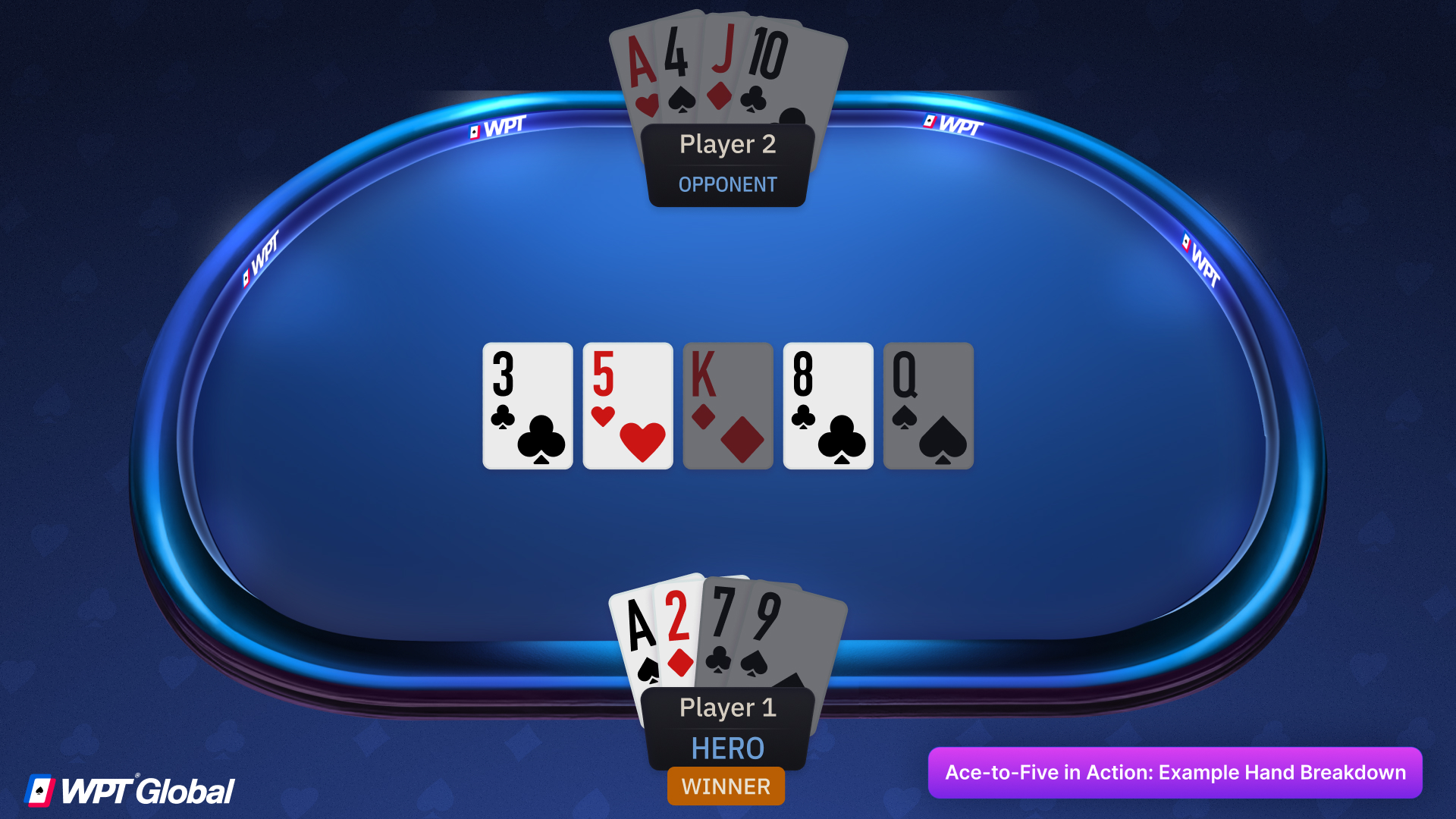
Ace-to-Five in Action: Example Hand Breakdown
Let’s walk through a hand of Ace-to-Five Lowball:
- Your hand:
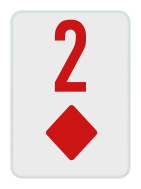
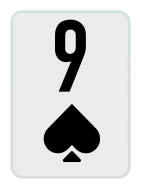
- Opponent’s hand:
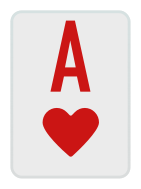

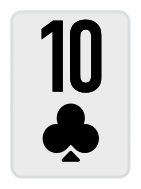
- Board:
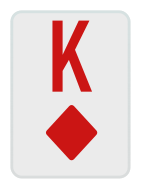
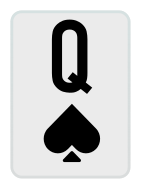
Result: Your low hand: A-2-3-5-8 beats your opponent’s low hand: A-3-4-5-8 because 4 is higher than 2. So you win the entire pot with a better Ace-to-Five low.