














 Customer Dispute Resolution Page
 Help Center
 Affiliate Program


Understanding Bottom End
When a straight is possible on the board, the bottom end represents the lowest sequence of that straight range. It’s the exact opposite of the top end, which is the highest possible straight.
- The bottom end uses the lowest possible connecting cards.
- It’s strong in isolation, but often second-best to higher straight combinations.
- It is common in hands with connected boards (e.g., 5-6-7-8-9 or 4-5-6-7-8).
- Risky when heavy straight or flush possibilities exist.
Understanding whether you’ve made the bottom, middle, or top end of a straight helps you evaluate how strong your hand really is in context compared to other players.

Examples of Bottom-End Straights
Here are a few quick examples that show what qualifies as the bottom end in poker:
- Board:→ You hold
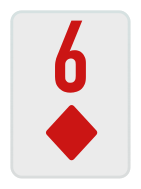
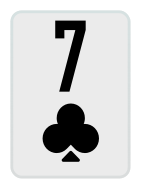
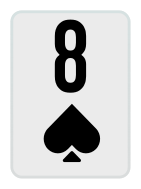 → Bottom end (5-high straight).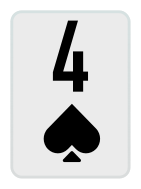
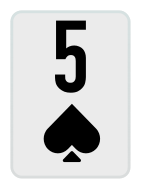
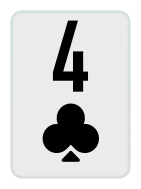
- Board:→ You hold
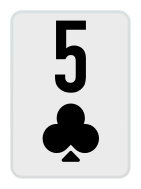
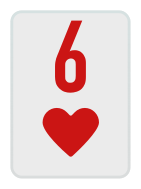
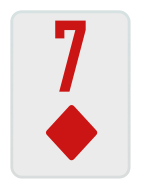 → Bottom end (7-high straight).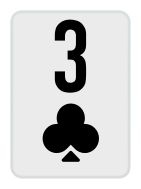
- Board:→ You hold
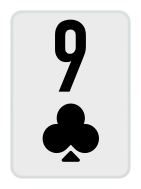
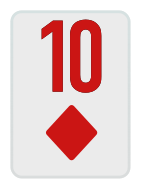
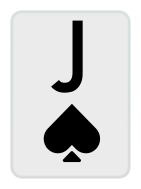 → Bottom end (Jack-high straight).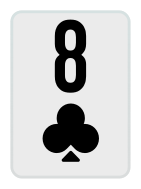
In each case, you do have a straight, but anyone holding higher connectors (like 8-9 or 10-Q) has a better one, making you vulnerable.

Tips for Playing the Bottom End
The bottom end can win solid pots, but it can also lose big ones if you’re not very cautious:
- Play cautiously when heavy straight or flush draws exist.
- Avoid slow-playing any bottom-end straights in multi-way pots.
- Be extra careful out of position, you’ll be acting before stronger hands.
- Value-bet thinly, only when you think the board texture is safe.
When in doubt, treat the bottom end as a good but very fragile hand, powerful against one opponent, but dangerous against many.