















 Customer Dispute Resolution Page
 Help Center
 Affiliate Program


Understanding Does Bottom
You will make bottom pair when one of your hole cards matches the lowest-ranked community card on the flop. For example:
- The flop comes, and you hold
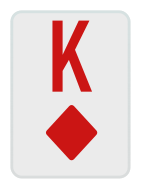
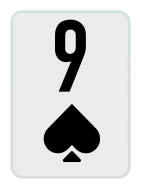
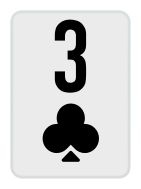 → you’ve made the bottom pair (pair of threes).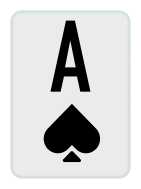
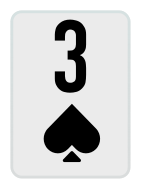
- It’s stronger than complete air, but weaker than middle or top pair.
- Bottom pair rarely wins at a showdown if it has no improvement in later streets.
Understanding that the bottom pair sits low in your hand hierarchy helps you avoid being vulnerable and overplaying it.

How to Play Bottom Pair Strategically
Bottom pair is playable in specific situations, but only when you clearly understand its limitations. Most of the time, it’s a marginal holding that should be used to control the pot rather than to build one. Your goal with bottom pair should be not to extract value, but to avoid losing unnecessary chips while staying alert to rare improvement opportunities:
- In position:
When you act after your opponent, bottom pair can sometimes justify calling one small bet, especially on dry boards. Being in position allows you to see how your opponent reacts on later streets and gives you control over the size of the pot. However, this is usually a one-street decision; if the pressure continues and your hand doesn’t improve, then folding is often the correct response. - Out of position:
Bottom pair plays very poorly without position. Betting usually doesn’t accomplish much, since worse hands rarely call and better hands will often raise you. Checking keeps the pot small and lets you reassess based on your opponent’s actions. When out of position, the bottom pair is best treated as a passive hand that you should be ready to give up if the situation turns unfavorable. - Against aggression:
Strong or repeated aggression can be a clear warning sign when you hold the bottom pair. Raises or large bets can typically indicate that your opponent’s range has moved beyond hands you that can realistically beat. Unless you have a strong read that your opponent is over-bluffing, folding bottom pair against serious pressure will most likely save you chips in the long run. - With backdoor draws:
Bottom pair becomes slightly more playable when paired with backdoor straight or flush potential. These extra equity paths give you a reason to continue cautiously, especially on the flop. But even then, your plan should be clear: you are continuing to improve your hand, not to win with bottom pair alone. If the draws don’t develop, then your discipline becomes essential.
Bottom pair should be treated as a bluff-catcher or a pot-control hand, not as a value hand. It can win small, uncontested pots or survive to showdown in low-pressure situations, but it is rarely strong enough to justify building a large pot. Knowing this distinction is what can separate controlled, profitable play from very expensive overconfidence.

How Strong Is Bottom Pair in Hold’em?
In Texas Hold’em, bottom pair is considered a very weak made hand. Because you only hold two hole cards, bottom pair often has limited ways to improve and is easily dominated by higher pairs, overpairs, or even strong drawing hands. In most cases, bottom pair in Hold’em is really only strong enough to continue in small pots, preferably heads-up and on dry boards.
Its real strength comes from having occasional showdown value when your opponent misses the board entirely. However, once the pot grows, or multiple betting streets are involved, then bottom pair in Hold’em quickly loses its value and should usually be folded unless you improve.
How Strong Is Bottom Pair in Omaha?
In Omaha, bottom pair is significantly weaker than it is in Hold’em. With four hole cards per player, opponents connect with the board far more often, making single-pair hands much less reliable.
Having the bottom pair in Omaha is rarely good enough to continue beyond the flop unless it’s paired with strong redraws, such as nut straight or nut flush possibilities.
Because Omaha hands are built around combination strength and nut potential, bottom pair without additional equity is usually close to worthless. In most Omaha situations, a bottom pair is a clear check-and-fold hand unless it improves dramatically for you.
What Is the Difference Between Bottom Pair and an Underpair?
Bottom pair is made using a community card, more specifically, the lowest card on the board. An underpair, on the other hand, is a pocket pair that ranks below all the community cards. For example, holding 5♦ 5♠ on a K♣ 9♥ 7♦ board is an underpair, and not bottom pair.
The key difference is how the hand interacts with the board. Bottom pair is exposed and vulnerable because it relies on the shared cards, while an underpair is hidden but still behind higher board pairs.
Strategically, both hands are pretty weak, but underpairs sometimes have slightly more flexibility due to their concealed nature.
What Is the Difference Between Bottom Pair and Low Pair?
Bottom pair is always the lowest possible pair formed using the board. But a low pair, however, is a broader term that refers to any small pair; it can come from the board or from your hole cards.
For example, pocket fours or a pair of fives on a high board would both be considered low pairs, but not necessarily the bottom pair.
The distinction matters because the bottom pair specifically signals that your hand strength is tied to the weakest board card. This makes it easier for opponents to have stronger pairs. Low pairs can sometimes be stronger than bottom pair, depending on how they interact with the board and your opponent’s range.
Top 3 Mistakes You Should Avoid With Bottom Pair
Do not overvalue your bottom pair because it feels like “something.” In reality, it’s a hand that regularly loses money when played too aggressively:
- Calling down on too many streets with no improvement.
Bottom pair almost never becomes strong enough to justify multiple calls. When an opponent keeps betting, they’re usually representing real strength, not just random pressure. Each additional street increases the odds of you being behind, and continuing without improvement often means paying off hands that were ahead from the start. Over time, this can turn curiosity into a costly habit. - Failing to recognize dangerous turn and river cards.
Certain cards should immediately set off alarm bells when you’re holding bottom pair. Overcards, flush cards, and straight completers are far more likely to help your opponent than you. If the board keeps getting worse and your hand stays the same, your chances of winning will drop fast. So ignoring those signals leads to sticking with a hand that no longer has a realistic path to winning. - Betting into stronger ranges on coordinated boards.
When the board is connected or suited, most of your opponents aren’t folding hands that already beat bottom pair. So betting in these spots doesn’t usually get called from worse hands, and actually often invites raises from better ones. Instead of protecting your hand, you end up inflating the pot against strength, which is exactly the opposite of what bottom pair needs.
Discipline is key; knowing when to fold bottom pair can save you more chips than trying to turn it into a hero hand.