















 Customer Dispute Resolution Page
 Help Center
 Affiliate Program


Understanding Bottom Set
A set occurs when you hold a pocket pair and one of those cards then appears on the board. A bottom set happens when your pocket pair matches the lowest-ranked community card.
- Example: You holdand the flop comes
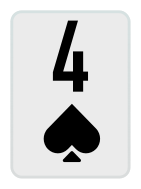
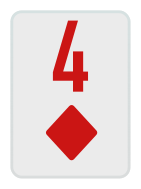 → you’ve made bottom set (three fours).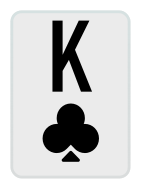

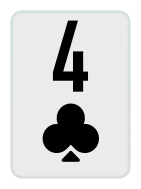
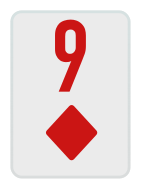
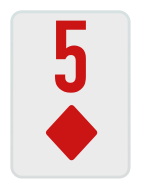
- Example: You holdon a flop of
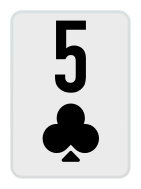
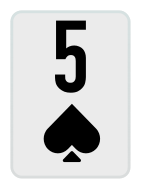 → bottom set (three fives).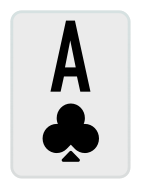
- It’s still very strong, but it can be vulnerable to higher sets or straights.
Bottom sets can win many pots, but can also lose massive ones if you overplay them against opponents who hold middle or top sets.

How to Play Bottom Set
Bottom sets can be very powerful because they’re well disguised. Opponents rarely put you on trips when the paired card is low, which can allow you to win sizable pots when you are truly ahead. The challenge is knowing when to press your advantage and when to shift into protection mode, because bottom set can very quickly go from dominant to vulnerable depending on the board texture and stack depth, and even your opponent's behavior.
- Fast play on dry boards:
On uncoordinated boards with few straight or flush possibilities, the bottom set is often close to the effective nuts. These boards limit your opponents’ ability to draw out, making it safer to bet and raise for value. Fast-playing in these situations helps you build the pot against the top pair or overpair hands that are very likely to call, but have limited equity to improve. - Caution on wet boards:
When the board is highly connected or suited, the bottom set loses some of its relative strength. Straights and flush draws, and even combo draws, all gain significant equity, and higher sets remain a threat. In these spots, slowing down can allow you to control the pot size and reassess on later streets, as opposed to committing large amounts of chips while the board is still unstable. - Stack depth matters:
With shallow stacks, the bottom set often plays itself because opponents have less room to apply pressure or represent narrow ranges. With deep stacks, however, the bottom set becomes much trickier to navigate. Larger effective stacks can increase the risk of running into higher sets or strong made hands, potentially turning some situations into expensive coolers if you’re not careful with bet sizing and commitment levels. - Pay attention to aggression:
Aggression should always be weighed against who is applying it. So when tight or disciplined players raise on boards where higher sets are possible, it’s often a sign of real strength rather than a bluff. In these cases, your bottom set should be played more cautiously, focusing on pot control and avoiding unnecessary escalation against ranges that are heavily weighted toward hands that beat you.
The key is reading the board and knowing whether your possible strong hand is really the best hand, or if it is a trap waiting to spring.

Common Mistakes With Bottom Sets
Bottom sets sometimes look unbeatable, but overconfidence is the quickest way to losing big pots:
- Overplaying bottom set on highly connected flops.
When the flop is coordinated with straight and flush possibilities, the bottom set is no longer the near-nut hand it appeared to be. Connected boards will allow your opponents to have strong combo draws or two pair, or even higher sets far more often. By piling money into the pot too quickly, you risk committing yourself against ranges that have significant equity or have already beaten you, turning a strong hand into basically a high-variance gamble. - Ignoring possible higher sets or straight draws.
Bottom set loses its strength when you fail to account for what hands your opponents can realistically hold. Middle and top sets are natural parts of many preflop calling ranges, especially in multiway pots. Straight draws and pair-plus-draw combinations also gain value on dynamic boards, meaning your three of a kind may not even be ahead. Recognizing these threats early can help you avoid building pots that only stronger hands want to play. - Calling or raising too aggressively against tight ranges.
Tight players rarely apply heavy pressure without having strong holdings. When a disciplined opponent shows that aggression on a board where higher sets or strong draws exist, then the bottom set should no longer be treated as automatic value. Raising or calling down large bets in these spots often isolates you against hands that dominate yours, therefore making pot control and selective folding critical to your long-term profitability.
Bottom set is strong enough to win a lot of hands, but not strong enough to ignore context on the board.