

















 Customer Dispute Resolution Page
 Help Center
 Affiliate Program


Understanding a Case Card in Poker
A case card is the last remaining card of a particular rank after the other three have already appeared.
For example:
- The flop comes
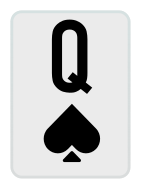


- You hold

- There is only one queen left in the deck
That final queen is the case queen.
If it appears on the turn or river, you make four of a kind. When players talk about a “poker card case,” they mean exactly this: the final available card of that rank.
You’ll see the term most often in games like Texas Hold’em and Omaha, both of which you can explore further in standard how-to-play guides for those formats.
Understanding the idea also links directly to how poker hands are ranked, especially when it comes to quads and how rare they are.
What Does it Mean to Draw to a Case Card in Poker?
To draw to a case card means you are hoping to hit the final remaining card of that rank to improve your hand.
In practice, that usually means you have exactly one out.
Imagine this situation:
- Board:
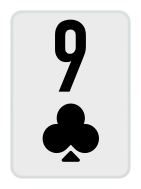
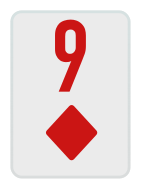
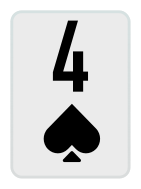

- You hold

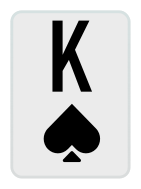
There is only one nine left in the deck. If it comes on the river, you make four of a kind.
You are drawing to the case nine.
Odds-wise, this is very thin. On the river, with 46 unseen cards after the turn, your chance is roughly 1 in 46, just over 2 percent.
Knowing that math matters. If you’re calling a large bet hoping to hit a case card, you need proper pot odds to justify it. This is where a solid grasp of poker odds and outs stops you from chasing long shots too often.
Will You Always Know if You Are Drawing to the Case Card?
No, and that’s where things get interesting strategically.
In some spots, it’s obvious. If three kings are face up and you hold the fourth, you clearly know you have the case king.
But many times, you won’t have perfect information.
For example:
- The board shows

- You hold

You know there’s only one king left in the deck.
However, you don’t know if another player is already holding that king. If they are, then technically you are drawing dead, even though from your point of view you still think that case king exists.
This shows an important point: a case card is defined by the deck, not by what you can see.
Strong players track visible cards carefully. If multiple players show down hands or prior betting narrows ranges, you may be able to guess whether the case card is realistically live.
This links straight into deeper poker strategy and combinatorics. When three cards of a rank are exposed, the number of possible combinations your opponent can hold drops sharply, and that shift affects bluff frequency, value betting, and river decisions.
What Does it Mean to ‘Catch the Case Ace’ in Poker?
“Catch the case ace” is just colourful poker language for hitting the fourth and final ace in the deck.
This phrase almost always comes up in high-emotion spots.
Picture this:
- You hold


- The flop comes

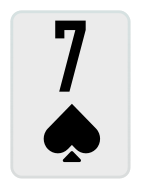
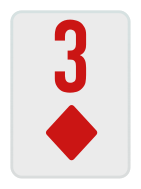
- Your opponent has
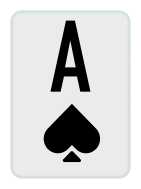
Right now, there is only one ace left, the case ace.
If it comes on the turn or river, your opponent makes four of a kind and wins the pot.
When that card hits, someone at the table will usually say, “He caught the case ace.”
The phrase captures both the rarity and the drama of the moment. From a technical angle, though, it simply means the last ace in the deck showed up.
If you care about long-term results, you can’t let that phrase get under your skin. Variance always includes rare events. They feel wild because they’re uncommon, not because the game is somehow rigged against you.
How Likely is it to Catch a Case Card?
The probability depends on which street you’re on and how many cards remain unseen.
Here’s a simple breakdown in a typical Hold’em hand when you are drawing to one specific card:
- On the flop, there are 47 unseen cards: If three of a rank are already visible, the chance of hitting the case card on the turn is 1 in 47, roughly 2.1 percent.
- If you miss the turn, there are 46 unseen cards left: The chance of hitting it on the river is 1 in 46, roughly 2.2 percent.
- Combined turn-and-river probability: Around 4.3 percent to hit that one remaining card by the river.
That’s why drawing to a case card is usually described as drawing to a one outer.
These percentages are small, but not zero. Over thousands of hands, especially in high-volume formats like multi-table tournaments or regular cash games, you will see case cards get there.
Understanding the real numbers helps you avoid common leaks:
- Calling large bets without the right pot odds
- Tilting after rare river outcomes
- Overrating how often opponents “get lucky”
Once you accept the math, the emotional spikes become easier to manage.
Why Case Cards Matter Strategically
At lower stakes, players often fixate on whether the case card hits or misses.
Stronger players care more about how the presence of a case card changes hand combinations.
If the board reads J♠ J♦ J♣ 6♥ and the river is J♥, there are now zero jacks left in the deck. That means no one can hold a jack in their private cards.
That single fact simplifies range analysis a lot.
Similarly, if three queens are already visible, the chance your opponent has pocket queens is exactly zero.
These small bits of card removal logic are part of advanced hand reading. Even if you’re still building the basics, learning how exposed cards reduce possible combinations will sharpen your decisions.
If you want to build a stronger terminology base alongside ideas like this, spending time with a complete poker terms guide can help link everything together.