10 Tips to Learn How to Be a Good Poker Player

10 Tips to Learn How to Be a Good Poker Player
Author
Harry Elliott
Reviewed by
Jeff Kimber
Updated Date
Nov 4, 2026
Read Time
8 Min Read

Key Takeaways

  • Play tight in early position: Enter pots with strong starting hands from early positions and widen your range in later positions to maximise positional advantage.

  • Position is power in poker: Acting last provides more information, improves pot control, and increases profitability through information-driven decisions.

  • Master pot odds and equity: Compare pot odds to your hand equity to ensure mathematically sound calls instead of instinct-based decisions.

  • Follow disciplined bankroll management: Risk no more than 5% of your total bankroll in a single game or buy-in to protect against variance.

  • Think in ranges, not individual hands: Analyse the full range of hands your opponent could hold based on betting patterns rather than guessing one specific holding. Bluff selectively and strategically: Target opponents who can fold and reduce bluff frequency against players who call too often.

  • Control tilt and emotions: Accept variance as part of poker and take breaks when necessary to maintain rational decision-making.

  • Review hands after every session: Analyse 5–10 key hands regularly to identify leaks and accelerate long-term improvement

  • Choose soft poker tables: Game selection strongly impacts win rate, and playing weaker opponents often increases profitability more than minor strategy tweaks.

  • Maintain strategic consistency: Apply structured decision-making frameworks, such as raise-or-fold preflop in many spots, to build repeatable long-term success.

Want to be a good poker player without spending years reinforcing the wrong habits? Many players struggle because they lack structure and rely on inconsistent decision-making. The key to real improvement is mastering fundamental poker principles that consistently winning players apply every day.

This guide focuses on practical poker strategy basics used in real games, not just theory. You will learn how disciplined, tight play compounds over time, why position is one of the strongest advantages at the table, and what separates long-term winners from players who repeatedly go broke. By the end, you will have a clear framework to strengthen your strategy and progress confidently at your current stakes.

How to be a good poker player: beginner mastering hand selection and position at poker table.

Play Fewer Hands, Play Them Stronger

This is one of the most common leaks among newer poker players. Long stretches of folding can feel frustrating, which often leads to entering pots with weak hands out of boredom. Limping with marginal holdings in hopes of “hitting something” frequently turns good intentions into avoidable losses.

In reality, playing fewer but higher-quality hands is one of the fastest ways to improve as a poker player. By folding marginal holdings, you enter pots with a stronger average range than many opponents. Over hundreds or thousands of hands, this disciplined approach compounds into measurable profit and establishes a solid strategic foundation.

As a general guideline, tighten your range in early position and expand it gradually in later positions. From early position, focus on approximately the top 15–20% of starting hands. In middle position, you can widen slightly, and from late position and the button, you can expand further due to positional advantage. These ranges may feel tight at first, but they create structural discipline and reduce costly marginal decisions.

Why do fewer hands create your edge?

If an opponent plays 50% of starting hands while you play 25%, your average hand strength will be significantly higher. When both players connect with the board, your range is more likely to contain stronger combinations. Additionally, a tighter preflop range strengthens your credibility when betting, making opponents more cautious against your aggression.

At the same time, you will be less vulnerable to bluffs because your holdings are generally stronger. Over time, this range advantage translates into improved expected value and win rate. Reviewing position-based hand charts and studying structured preflop ranges can further reinforce this edge.

Position Poker Determines Who Wins

Position poker is probably the biggest tactical advantage in every hand. Acting later in the betting order allows you to observe your opponents’ decisions before making your own. Acting early, by contrast, requires committing chips without knowing how other players will respond. The more information you have, the more accurate your decisions can be.

The button is the strongest position at the table because you act last on every postflop street. The cutoff also offers significant strategic value. Early positions, however, are the most challenging, as you must act with limited information and are more likely to face raises from players behind you.

This lack of positional advantage requires a tighter and more disciplined range.

As a foundational guideline, widen your opening range in late position and tighten it significantly in early position. From the button, when action folds to you, raising a broad but structured range can be profitable because you retain postflop control. In early position, however, limit your opens to stronger holdings, as you are more vulnerable to 3-bets and multi-way pots without positional advantage.

Position does not change the strength of your cards, but it dramatically changes their value. The same hand can be profitable in late position and unprofitable in early position due to differences in information and control. Consistently adjusting your strategy based on position leads to better decision-making and long-term profitability.

How Position Changes Your Decisions

Consider hands such as A-J, K-T, or Q-J. On the button, these holdings can often be raised profitably because you will act last postflop. In early position, those same hands may need to be folded or played more cautiously due to the increased likelihood of facing stronger ranges behind you. The relative value of a hand is highly dependent on position.

You should also adjust your blind strategy accordingly. Defend your big blind more selectively but with awareness that you will act after the small blind postflop. Conversely, play more cautiously from the small blind, as you will act first on future streets. Understanding these positional dynamics is essential for building a strong and consistent poker strategy.

Master Bankroll Management Before Playing Real Money

A difficult but essential reality is that even a winning poker player can go broke without proper bankroll management. Variance affects every player, regardless of skill level. You can make mathematically correct decisions and still experience short-term losses. If your entire bankroll is committed to one game or stake level, a downswing can eliminate your ability to continue playing.

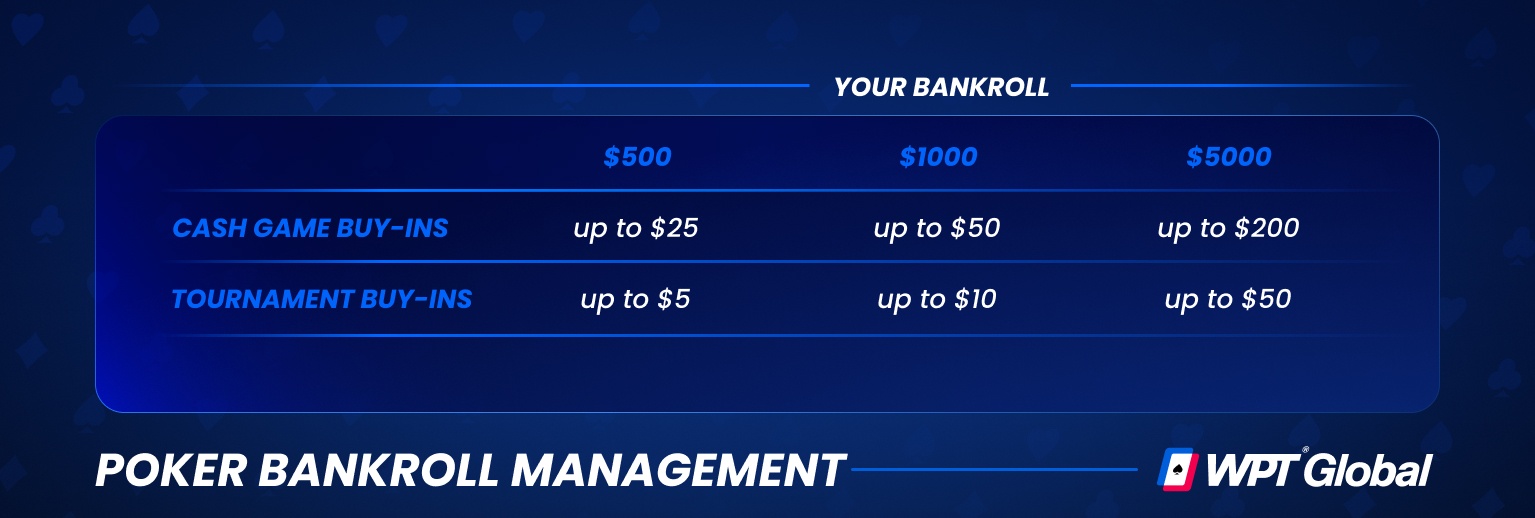
Bankroll management means maintaining sufficient reserves so that short-term or extended losing streaks cannot wipe you out. For cash games, a common guideline is to keep at least 30 full buy-ins for your chosen stake. For tournaments, where variance is higher, many players recommend maintaining 100 or more buy-ins.

For example, if you have $1,000 dedicated to poker, conservative cash game stakes might include $0.25/$0.50 with a typical $50 buy-in, giving you 20 buy-ins (below the ideal 30, so caution is required). For tournaments, $5–$10 buy-ins would provide a much safer cushion relative to variance. As your bankroll grows, you can gradually move up in stakes while maintaining appropriate buy-in multiples.

A structured system can help manage risk effectively. Consider moving up in stakes only after building at least 40 buy-ins for the next level, and moving down if your bankroll falls below 20–25 buy-ins. This disciplined approach protects your capital while allowing steady progression.

Why Bankroll Psychology Works

A properly managed bankroll reduces emotional pressure. When losses occur, they are viewed as part of normal variance rather than a financial crisis. This stability allows you to continue making rational, mathematically sound decisions. In contrast, playing underfunded creates fear-based decision-making, where avoiding loss becomes more important than maximizing expected value.

The psychological benefit of bankroll management directly impacts profitability. When you are not worried about going broke, you play with greater confidence and clarity. Better mental stability leads to better decisions, even if your technical skill level remains unchanged. Selecting stakes that align with your available poker funds is therefore both a financial and strategic decision.

Bankroll management poker progression: how to move up stakes safely while learning how to be a good poker player

Calculate Pot Odds on Every Call

Pot odds in poker are a core mathematical concept that separates structured decision-making from guesswork. The principle is straightforward: if the pot is offering better odds than your hand’s equity, calling is profitable in the long run; if not, folding is the correct decision.

The basic formula for calculating pot odds is:

Bet ÷ (Pot + Bet) = Minimum Equity Required

For example, if the pot is $100 and your opponent bets $30, the total pot becomes $130, and you must call $30 to win $130. Using the formula, $30 ÷ $130 = approximately 23% equity required. If you are holding a flush draw on the flop with nine outs, your chance of completing the flush by the river is roughly 35%. Since 35% is greater than 23%, calling would be profitable over the long term.

While this may seem complex at first, you do not need advanced mathematics to apply pot odds effectively. Memorizing a few key equity benchmarks can dramatically improve decision-making:

  • Flush draw (9 outs, two cards to come): ~35% equity

  • Open-ended straight draw (8 outs, two cards to come): ~31–32% equity

  • Pair vs. two overcards: roughly 55% vs. 45%, depending on kicker strength

  • Flush draw plus a pair: ~50–55% equity, depending on board texture

  • Two overcards vs. a made pair: ~24–27% equity

Once you understand these common scenarios, every call becomes a structured comparison: does your equity exceed the pot odds being offered? Consistently applying this principle transforms poker from instinct-based play into probability-driven strategy.

How Pot Odds Compound

Even a small mistake in pot odds calculation can have significant long-term consequences. If one incorrect call costs an average of $3–$5 per session, over 100 sessions that amounts to $300–$500 in preventable losses. Over the course of a year, a single recurring leak could cost $1,500–$2,500 or more, depending on volume.

Learning to calculate pot odds and compare them to your hand equity eliminates this type of systematic error. It is one of the fastest poker skills to develop and offers one of the highest returns on study time. By consistently applying basic probability principles, you can immediately improve decision quality and long-term profitability.

Hand Reading Separates Good Players From Great Ones

Have you ever tried to put an opponent on a specific hand? For example: "He has AK." This is what beginners do. Advanced players, however, think in ranges: "His range is AK, AQ, 99-JJ, and maybe AJs given how he plays."

This adjustment changes everything because poker decisions are based on probabilities, not certainty. Thinking in ranges allows you to evaluate how your hand performs against a spectrum of possible holdings rather than against one assumed combination.

Hand reading is fundamentally deductive logic. Consider a scenario where an opponent checks the flop, calls a turn bet, and then shoves on the river when a high card appears. Each action provides information. You should ask which hands logically follow that betting sequence and how those hands interact with the board texture.

By analyzing position, betting patterns, and board development, you progressively narrow your opponent’s likely range. You then evaluate whether your hand performs well against the bluff portion of that range or is dominated by stronger value hands. Your final decision, call or fold, should reflect that range-based assessment.

Developing this skill takes practice, but it has a direct impact on long-term profitability. Instead of asking, “What exact hand does my opponent have?” train yourself to ask, “What range of hands would take this action?” Consistently applying range thinking improves accuracy, reduces emotional guessing, and increases your overall win rate.

How to Learn Range Thinking

Practice range thinking in low-stakes games where mistakes are less costly. Begin by observing opponent tendencies and noting which hands reach showdown, how different holdings are played, and whether consistent betting patterns emerge. Focus on key variables such as position, preflop action, bet sizing, and board texture to understand how ranges are constructed in different scenarios.

After 50–100 hands against the same opponent, patterns often become clearer. A tight player may only 3-bet premium hands, while a loose opponent may call with a wide and inconsistent range. Through structured observation and repetition, your ability to assign accurate ranges will steadily improve. Over time, this disciplined approach enhances hand reading precision and overall decision-making.

Bluff Smart Opponents, Not Loose Fish

Many aggressive new players struggle with improper bluff selection. They bluff opponents who rarely fold, eliminating their fold equity, while failing to apply pressure against disciplined players who are capable of folding. Effective bluffing in poker depends on targeting the right opponent type.

A foundational bluffing strategy is to bluff players who demonstrate the ability to fold and avoid bluffing loose calling stations. Against opponents who call too frequently, focus primarily on value betting strong hands. Against tighter players who respect aggression and can lay down marginal holdings, selective bluffing becomes more profitable, particularly on scare cards or unfavorable board developments.

When bluffing, prioritize semi-bluffs whenever possible. A semi-bluff occurs when you bet with a drawing hand, such as a flush draw on the flop or a straight draw on the turn. Even if called, you retain equity through your outs. Pure bluffs, hands with little to no equity, should be used sparingly and primarily against disciplined opponents in situations where the board strongly favors your perceived range.

Balancing value bets and bluffs is essential. As a general guideline, maintain a healthy ratio of value hands to bluffs to avoid becoming predictable. For example, bluffing less frequently on the river than on earlier streets helps prevent overbluffing and protects your long-term profitability. Thoughtful bluff selection, rather than constant aggression, is what separates effective players from reckless ones.

Bluff Spots Worth Real Money

Try to bluff on dry boards (low cards, gapped textures with no draws possible) because opponents have fewer made hands. And when scare cards hit the river (especially Broadway cards when you've been aggressive), your bluffs work best.

If your opponent shows weakness through checks or small bets, then that's your signal to go ahead. A tight table image helps too because players will respect your aggression more. The key? Know the spot before you bet, not after!

Control Tilt Before It Destroys Everything

Tilt control in poker is one of the highest-return skills a player like you can develop. Emotional reactions to bad beats or coolers often lead to impulsive decisions, such as forcing marginal all-ins or deviating from sound strategy. These reactive plays can damage a bankroll more quickly than variance alone. Even strong starting hands lose value when decisions are driven by frustration rather than logic.

The solution is straightforward but requires discipline: step away when emotions begin to influence your thinking. Many experienced players credit structured breaks with protecting both their bankroll and long-term career. A single tilt session can result in significant, avoidable losses. Repeated emotional sessions each month can compound into substantial financial setbacks over time.

Keeping a tilt journal can help identify emotional triggers. Record what caused the reaction, such as a bad beat, a cooler, or a perceived mistake, and outline a specific response plan. By recognizing patterns in advance, you can implement a pre-committed strategy, such as taking a 10-minute break, to prevent emotional decisions before they escalate.

Tilt Cost Math

If one tilt session per week = $100 lost. 52 weeks × $100 = $5,200 per year gone. That's thousands you could keep just by walking away when frustrated. Your biggest profit leak might just be your emotions, not your skills…

Study Hands As Much As You Play Them

Playing alone does not guarantee improvement; consistent review is essential for long-term progress. Effective study involves analyzing hand histories, identifying decision-making leaks, and understanding why stronger players may have chosen different lines. After each session, review five to ten significant hands and ask structured questions: Where did I lose expected value? What range was my opponent representing? What would be the optimal decision in that situation? Spending 20–30 minutes on focused review can produce meaningful skill development over time.

A balanced improvement ratio often recommended by experienced players is approximately 70% play and 30% study. Many beginners invert this balance by playing extensively without structured analysis, limiting growth. A practical approach is to play a focused session and then dedicate time immediately afterward to reviewing that same session. Additionally, learning one specific concept, such as 3-bet defense or c-bet frequency, and applying it deliberately over several sessions helps reinforce skill acquisition.

As fundamentals strengthen, advanced tools such as poker solvers (e.g., GTO-based software) can further refine your understanding of optimal strategy. These tools illustrate equilibrium-based decisions in complex scenarios and can significantly accelerate learning when used responsibly. However, they are designed strictly for study purposes and must never be used during live or online play. Structured review combined with disciplined study habits is one of the most reliable paths to long-term improvement.

Study ROI

Studying for just 30 minutes per day can produce measurable improvements in your hourly win rate, depending on your current stakes and skill level. Even a modest increase of $30–$50 per month compounds into several hundred dollars per year, simply from consistent review and skill refinement. This incremental growth illustrates why professional poker players prioritize structured study routines. Over time, disciplined analysis and continuous improvement translate into sustained profitability and meaningful long-term gains.

Table Selection Wins More Money Than Skill Improvement

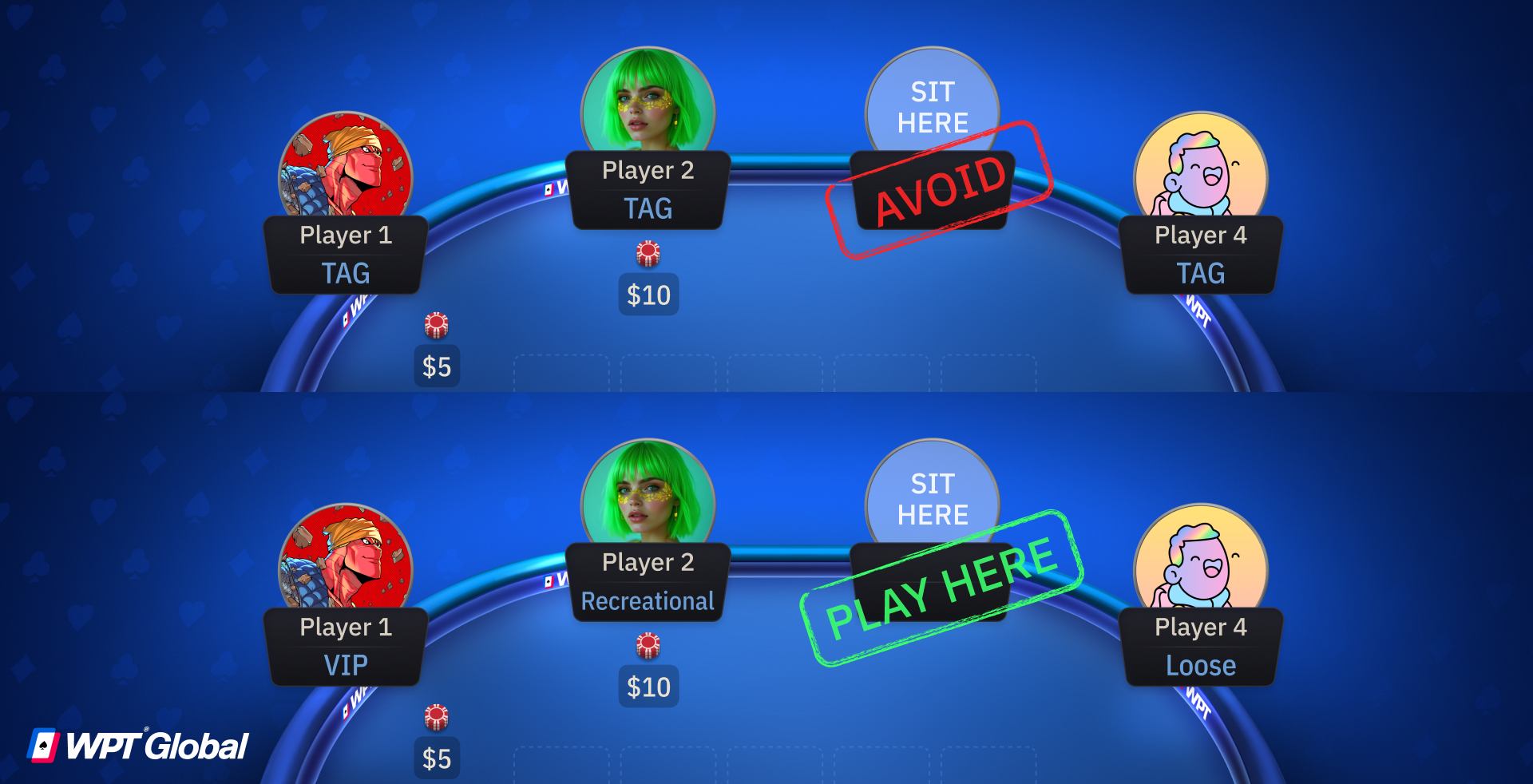
Table selection is one of the most underrated edges in poker. The overall skill level of your opponents often has a greater impact on profitability than marginal improvements in personal strategy. Playing in games with weaker opponents increases expected value and reduces variance. In online poker, you can use available statistics such as VPIP (Voluntarily Put Money in Pot) to identify looser tables; higher average VPIP percentages generally indicate more players entering pots with wider ranges. In live settings, observing a table for several minutes before sitting down can reveal useful information about playing styles, table dynamics, and overall competitiveness.

It is generally more profitable to avoid tight, highly aggressive lineups where edges are smaller and variance can increase. Instead, seek tables with looser, more passive players who tend to call too frequently and make larger postflop mistakes. Strong table selection can significantly improve your hourly win rate by placing you in situations where your strategic edge is clearer and easier to realize. Choosing the right game is often as important as playing the hands correctly once seated.

Spotting Soft Tables

When selecting online poker games, look for tables with higher average VPIP percentages (around 35% or more), as this often indicates looser player pools. A lower average aggression factor can also suggest more passive tendencies, which may create additional value-betting opportunities.

If win rate data is available, moderate profitability levels can signal balanced games that are not overly competitive. In live poker, table dynamics are easier to assess through observation. Frequent limping, multi-way pots, relaxed conversation, and recreational behavior often indicate a softer lineup. Identifying and choosing these favorable environments can significantly improve your long-term win rate.

Table selection poker: how to be a good poker player by finding soft games with weaker opponents.

Build Preflop Strategy & Execute It Every Hand

Many newer players improve rapidly at first but abandon their structured strategy when boredom or frustration sets in. This often leads to unnecessary experimentation, such as opening weak hands from early position without strategic justification. Deviating from disciplined preflop standards typically results in avoidable losses rather than meaningful balance.

Your preflop strategy should function as a consistent hand-selection framework. Maintain tighter opening ranges in early position, expand moderately in middle position, and widen further in late position, while incorporating appropriate defensive adjustments. Structured preflop discipline reduces marginal decisions and strengthens overall range integrity.

Even small preflop leaks can accumulate significant long-term costs. Minor negative expected value decisions repeated across hundreds of hands compound into measurable losses over time. Consistency in applying position-based ranges creates stability, improves decision quality, and contributes directly to long-term profitability. A disciplined, repeatable system may feel less exciting, but it provides a reliable foundation for sustained success.

Strategy Consistency

Strong poker players apply a disciplined preflop system consistently over thousands of hands. They do not adjust their ranges out of boredom or emotion, but rely on structured strategies that have proven effective over time. Consistent execution minimizes leaks and preserves expected value, while unnecessary deviation introduces avoidable mistakes. In the long run, disciplined consistency is what drives sustainable poker profit.

Practice These 10 Tips Over 4 Weeks

Don't try to master everything at once. Stack them gradually to build a strong foundation:

Week 1: Focus only on playing fewer hands. Count your folds. Get comfortable folding weak hands preflop.

Week 2: Add position awareness. Play tight early, loose late. Notice how button profits more than under-the-gun.

Week 3: Calculate pot odds on one hand per session.

Week 4: Review 5 hands after each session. Ask about opponent ranges. Find your leaks.

And by week 4, you'll notice a profit shift. By month 2? Your win rate difference becomes obvious. By month 3? You'll be crushing at your stakes!

Final Thoughts

Learning how to be a good poker player isn't some mysterious art; it is consistently making the right decisions. Play that tight preflop, exploit that position, manage your bankroll, study those hands, and pick soft tables. Execute these 10 poker tips for beginners for 90 days straight, and you'll beat the vast majority of players.

The gap between surviving and crushing isn't talent. It's discipline. Tight play beats loose play. Study beats winging it. Soft tables beat grinding tough spots. And bankroll management beats going broke on bad variance.

The easiest path to becoming a good poker player? Show up. Follow the system. Review yourself honestly, and trust the process. See you at the tables!

FAQS

Can I become a good poker player in 3 months?

Yes, if you play around 20+ hours weekly, plus study for 10 hours. Most newer players see a clear edge at micro-stakes within 6-8 weeks. Profitable play can take 2-3 months minimum with discipline. Consistency matters more than speed!

What's the single best poker tip for beginners?

Play fewer hands preflop. That one change, executed consistently, beats a large percentage of your competition immediately. Master it, then add positional awareness next.

Do I need expensive software to become good?

No. Free hand history software, such as PokerTracker and Holdem Manager basic versions, work, but keep in mind that this software is not allowed during online play. Learn the fundamentals first, add the tools later.

How much bankroll do I need to start?

$50 for freerolls ($0 entry, pure practice). $200-500 for micro-stakes ($0.01/$0.02 cash, $1-2 tournaments). $1,000+ for sustainable play. Start wherever you can, but build upward methodically.

Is bankroll management really that important?

Yes. You can be a winning player and still go broke with a short bankroll. A proper bankroll protects you through variance. One week of bad runs shouldn't end your career. Bankroll management means it won't.