





 Customer Dispute Resolution Page
 Help Center
 Affiliate Program
In this article
Welcome to WPT Global
Welcome to WPT Global, the online home of the World Poker Tour®. Let us guide you through setting up your account and get you to the tables in no time.Social Media


How To Play
World Leading Tournaments
A huge player pool and everything from freerolls to high rollers – plus regular special events!Ambassadors
Get to know our ambassadors - world-class players from across the globe who embody the spirit of the game. Discover their stories and become part of the community.Your Hub for News
Explore stories, tips, and updates from the world of poker and casino. Learn from pros, discover new trends, and stay in the loop with everything happening at WPTGlobal.What are you looking for?
Close




Poker Starting Hands Strategy Guide
Share




Winning pots in poker can be the difference between understanding the nature of starting hands and not. That's because the cards you play set the tone for everything that follows. Put simply, a winning poker strategy starts with starting hands…
This guide explores this concept in more detail by showing you which starting hands to play, and, more importantly, how to play them profitably. From hand rankings to position, stack sizes and suited connectors, you'll learn how to play each type of starting hand for maximum value.
What is a Starting Hand in Poker?
Starting hands are the cards you receive during the initial betting round. These cards are dealt once the antes or blinds have been posted. Depending on the game, all of your hole cards will either be hidden from others at the table or only some of them will be. Here's how hole cards are dealt in the three most popular poker variants:
Texas Hold 'em = each player receives two hole cards dealt face down once the small blind and big blind have been posted.
Omaha = each player receives four hole cards dealt face down once the small blind and big blind have been posted.
Seven-Card Stud = each player receives two hole cards dealt face down and one card face-up after everyone has posted their ante.
Getting your hole cards is the easy part of poker. Knowing what to do with them is a matter of position, timing, and stack sizes.
Before we explain how to master those skills and become a better poker player, let's take a look at the types of starting hands you can be dealt and how to rank them.
Types & Rankings of Poker Starting Hands
Here are the types of starting hands most players will bet, call, or raise with. We've given these starting hands ratings from strong to weak. These ratings are useful, but it's important to remember that strength is relative in poker.
For example, a pocket pair is generally strong. However, it might not be strong in every situation. Therefore, we'd advise you not to rely on the ratings. We'd used them as a way to distinguish the starting hands and give you a general idea of where they rank.
Pocket Pairs
Rating = Strong
Two cards of identical value in your hand are known as a pocket pair. In terms of strength, we categorize pairs like this:
Premium Pairs = AA–JJ
Medium Pairs = TT–77
Low Pairs = 66–22
Pocket pairs are strong hands to play from most positions. However, there are three things to consider before you bet, call, or raise:
Your position - as a general rule, the earlier you are to act, the strong your pocket pair needs to be. For example, if you're playing a 9-max Texas Hold 'em game, it's often best to fold all pocket pairs lower than sevens (77) when you're in early position.
Your stack - you can afford to play more pocket pairs when you've got a lot of chips. Conversely, you should only play premium pairs when you're short-stacked.
The variant - pocket pairs are strong hands in Texas Hold 'em because you only have two hole cards. Pairs aren't as strong in Omaha or Stud because everyone has more cards to work with. Therefore, it's easier to make hands stronger than a pair.
Broadway Cards
Rating = Strong
Broadway cards are Ace, King, Queen, Jack, 10. They're called Broadway cards because they're "big actors" in poker. When they combine to make a five-card hand, it's known as a Broadway straight.
The reason people play Broadway cards is because of their rank. For example, if you're dealt ace-king suited in Texas Hold 'em, you've got various ways to make a strong hand. You could make a pair of aces or a pair of kings, both of which can win a showdown.
You could also make two pair, a straight, a flush, or a royal flush. That's why Broadway cards make strong starting hands, providing you play them in the right position.
The main thing to consider when you're dealt a single Broadway card is the kicker. Let's say you're dealt a single ace, e.g., A-6. Do you really want to make a pair of aces? Possibly, but possibly not.
You might win the pot if someone makes a worse pair. However, what if it's a raised pot and your opponent keeps betting when there's an ace on the flop? Their actions suggest they might have an ace as well.
If that's the case, you might end up in a big pot because it's hard to fold a strong pair like aces. That's why your kicker card matters. The best way to avoid unnecessary losses is to play starting hands that contain two Broadway cards or, at the very least, a Broadway card with a strong kicker (such as a nine or a suited card).
Suited Hands
Rating = Moderately Strong
Suited cards give you the opportunity to make flushes, which is great. But, as it is with Broadway hands, you need both cards to work in unison. By that, we mean you want as many possible hand combinations (aka outs) as possible.
For example, if you call a raise with 10♠ 9♠, you could make a decent pair (tens), two pair, a straight, a flush, or a straight flush. Now, let's say you call a raise with 10♠ 3♠. This hand has far fewer outs. You could make a pair, two pair, or a flush.
However, your two pair won't be that strong, and you probably won't want to go all-in with your flush. So, again, we can see that harmony between your suited cards is necessary to create strong starting hands.
Suited hands also benefit from higher poker equity, especially when they have straight and flush potential.
The suited starting hands we recommend playing are:
Suited connectors, i.e., two suited cards that are next to each other in value, such as J♠ 10♠ or 7♠ 6♠.
Suited one-gappers, i.e., two suited cards that have one gap between their value, such as J♠ 9♠ or 7♠ 5♠.
Suited Aces, i.e., two suited cards, one of which is an ace (A♠ 2♠), so you've got the chance to make nut flushes (aka the best possible flush).
Connected Hands
Rating = Moderate
Closely connected to suited connectors are unsuited connectors. Starting hands such as 10♦ 9♣ give you the opportunity to make straights.
These cards generally have more value in community card games such as Hold 'em and Omaha because they allow you to make straight and two-pair hands that can be harder to spot. In Stud games, where almost all of your cards are on display, it's easier to see when someone has a possible straight.
The important rule to keep in mind when you're playing unsuited connectors is value. Specifically, you want the cards to have a high value. This makes it more likely you'll have the best end of a straight, rather than the worst.
For example, let's say you're playing Hold 'em and the board is 4♠ 5♣ 8h♥ 9♦ J♣, and you've got 6♥ 7♦. You've made a nine-high straight in this scenario (5c 6h 7d 8h 9d), which is a strong hand.
However, you could still lose to someone who's got Q-10 or 10-7 because they've made a better straight. That's why you should be more willing to play if you've got high-value connectors rather than low-value ones.
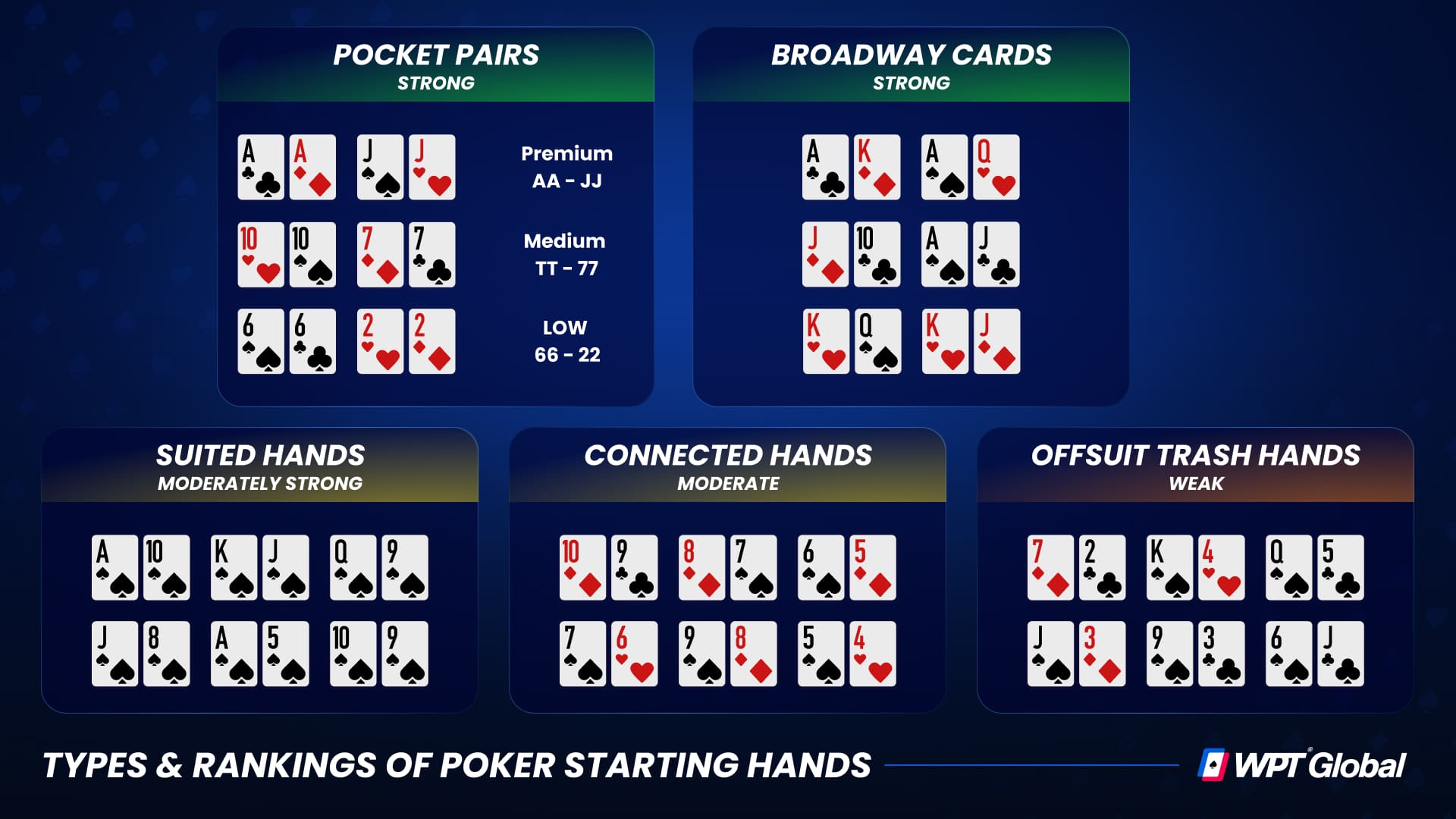
Offsuit Trash Hands
Rating = Weak
The final category worth talking about is trash hands. These are cards that aren't connected in any way, such as 9♣ 4♦ and the worst starting hand in Texas Hold 'em, 7♠ 2♥.
You should fold these hands in almost every situation. The only time we recommend playing trash hands is if you're in position and have a strong read on your opponents.
These reads should be accompanied by big stacks because it's much harder to bluff players when their only options post-flop are to fold or more all-in.
Hand Selection: Why Position, Timing, and Stack Sizes Matter
Now you've got a general understanding of the types of hands you can play in poker and what they're good for, let's talk skills.
We mentioned earlier that, other than the cards you're dealt, hand selection is based on three things: position, timing, and stack sizes. Here's how each of these variables affects the hands you play.
The Role of Position in Starting Hand Strategy
Starting hands aren't universal. It's fine to say that AK (big slick) is a strong starting hand, but in what context? Would you risk your entire stack with AK on the bubble of a major tournament if three people were all-in? Most players wouldn't.
So, even though AK is a great starting hand in Texas Hold 'em, that doesn't mean you should play it regardless of the situation. We can take this concept a step further by looking at position.
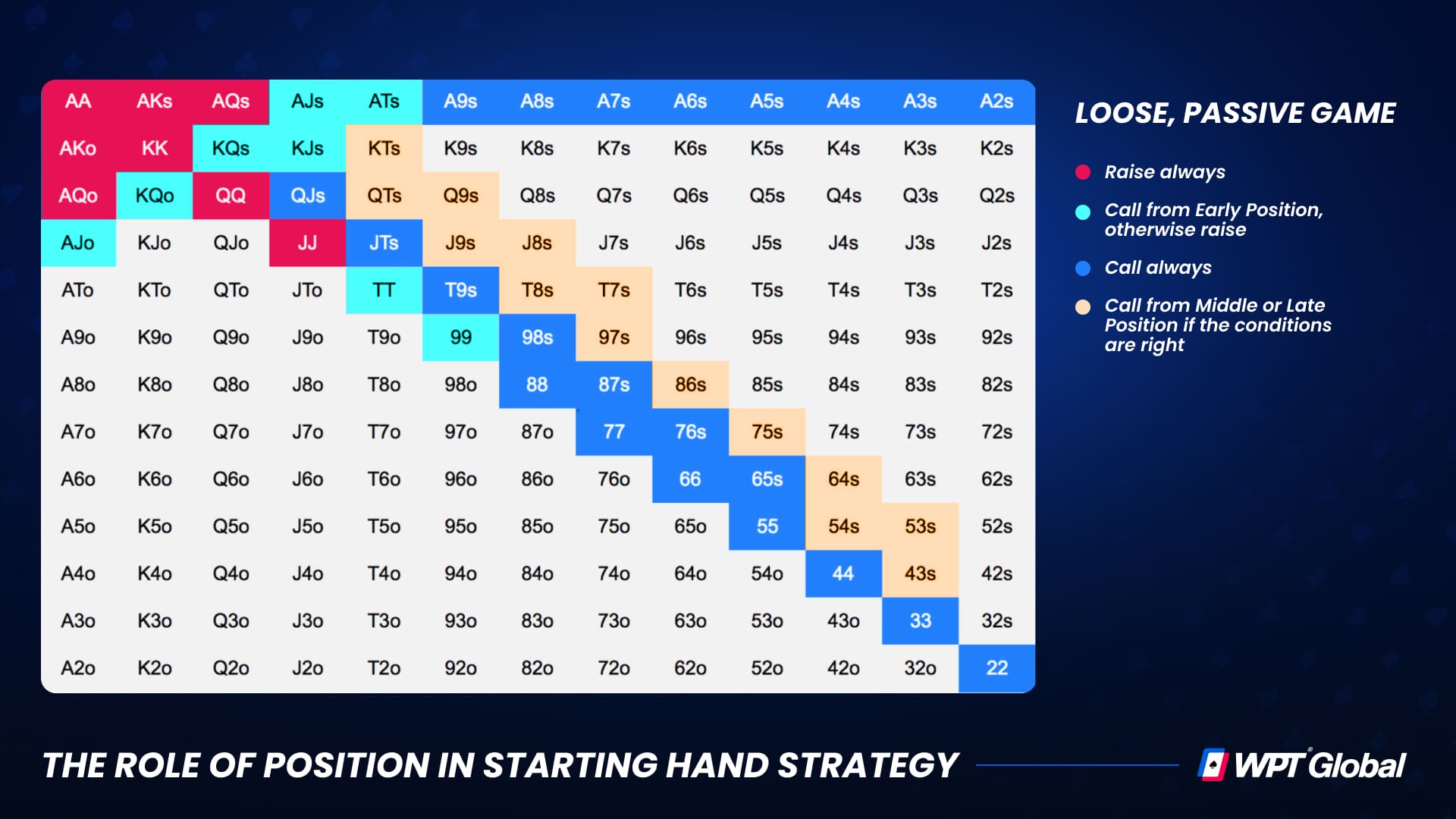
We said before that, in most full-ring games, you should fold small pairs in early position. We can apply the same logic to every starting hand. The earlier you are to act, the stricter your starting hand requirements should be. This concept is at the heart of solid preflop strategy in both cash games and tournaments.
That's because position equals information. The later you are to act, the more information you've got. More information allows you to get a better idea of how strong your hand might be compared to those around you.
For example, let's say you're in middle position with a pair of sevens. It's a strong hand and one you'd probably raise if everyone before you folds. However, the player in first position raises, and the person next to them re-raises. At this point, a pair of sevens goes from a playable hand to a fold.
The general rule when it comes to position and starting hands is this: have a tight range in early position and a wider range in late position.
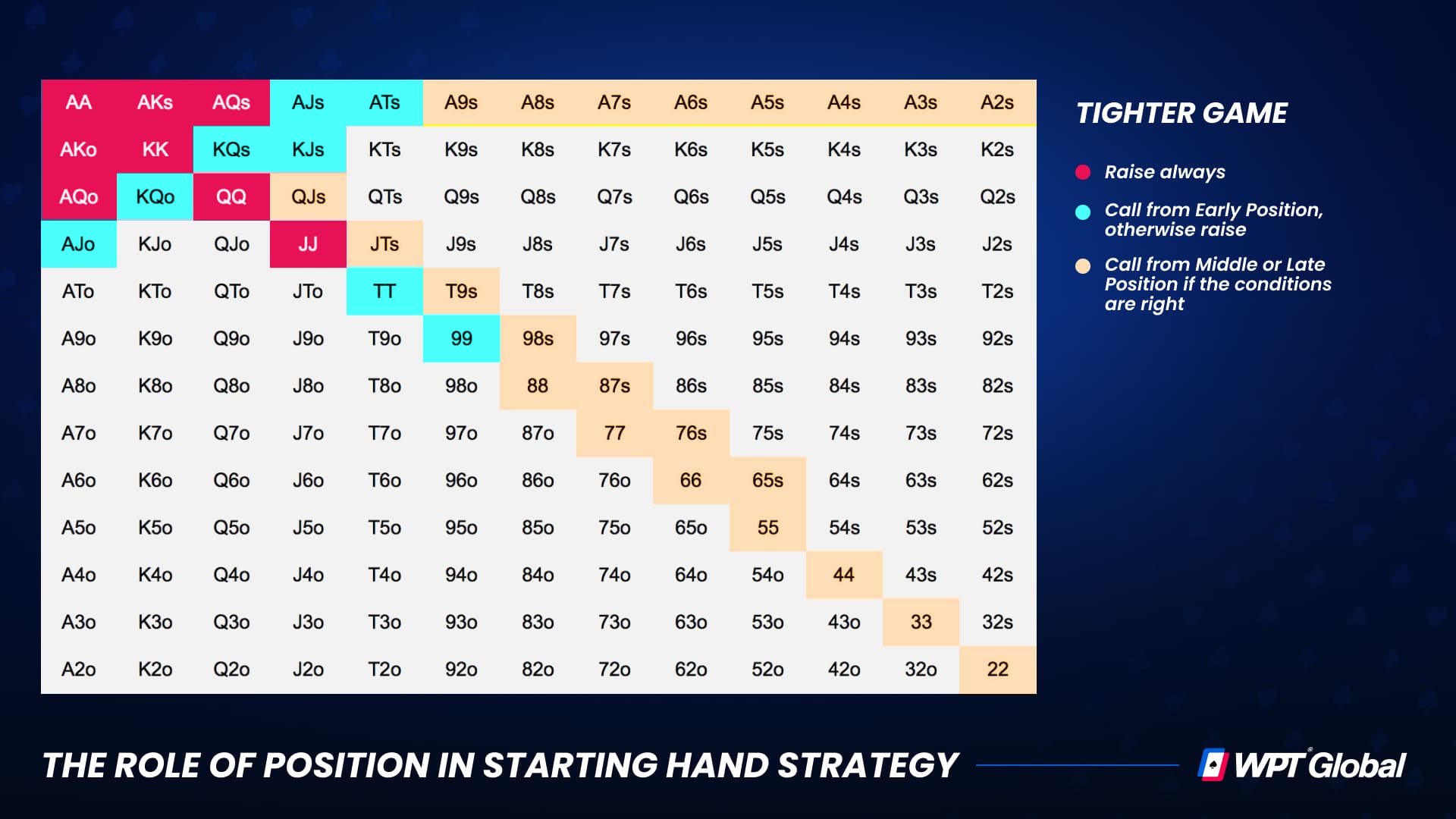
Timing
The second of our three variables is timing. Like position, timing can turn a playable hand into one you should fold and vice versa. Here's a scenario that demonstrates the importance of timing:
You're on the bubble of a Texas Hold 'em tournament. You have the biggest stack at the table, and you're in the big blind. Everyone folds to the player on the button who has a medium-sized stack. This player raises, and the small blind folds.
You look down at 8♠ 5♦. You would fold this hand in most situations because it's weak. However, you notice that there are three short stacks at the table who are a risk of going out on the bubble. Because of this, you move all-in.
The reason for moving all-in is that your opponent can only call with a monster hand. As it stands, they're not at risk of being eliminated. Therefore, while it's OK for them to raise on the button with a wide range of hands, they can't make a loose call.
You know this, which is why it's a good time to move all-in. The original raiser won't want to jeopardize their chances of making the money. So, unless they've got pocket queens or better, it's unlikely they'll call. That's how you can use timing to win pots with weak starting hands.
Stack Sizes and Hand Selection
The final variable to consider when you select starting hands is the amount of chips in play. You should be more risk-averse with a short stack and play more pots with a big stack.
We're not telling you to fold everything when you're short and be reckless when you've got a lot of chips. That being said, you can afford to play more hands when you've got a big stack.
With a short stack, things are relatively easy. You just need to wait for a spot where you've either got a strong hand or the people behind you are likely to fold. If either of these two conditions is met, you can move all in.
When short-stacked, you should use hands such as suited aces and small pairs to shove over loose raisers. These hands have decent equity and fold potential.
When you've got a big stack, it's all about your opponents and your intentions:
If your opponent also has a big stack, you want to get value from them (i.e., a lot of chips).
If your opponent has a medium-sized stack, you want to make them fold.
If your opponent has a short stack, you want to catch them with a stronger hand when they move all-in.
The hands you have in each scenario will be determined by the effective stack size (i.e., the most chips anyone can win based on both your stack sizes). Let's say you want to extract value from a fellow big stack.
Suited connectors are great in these spots because they can make strong but hard-to-spot hands, such as flushes and straights. Those hands are great for winning big pots against players who have premium hands such as big pairs and two pair.
This is how you need to think when you're playing poker games with beginners and intermediate players. Things get tougher in high-stakes games, but the underlying principle stands.
Conclusion
Knowing which hands you're going to play and how you're going to play them is the secret to winning in poker. Everyone can use a poker starting hands chart to get a general overview of the cards they should be playing. However, many new players assume that's enough.
The truth is that all starting hands are playable in certain situations. It's the players who understand this that do best. So, if you're looking to progress as a poker player, think about starting hands as situations rather than specific cards.
Studying and memorising poker starting hand charts is one of the fastest ways to improve your preflop strategy. You can practice this skill in play-money games and freerolls. Then, once you're ready, make the switch to real-money games and take on other players in a battle to see who can make the most correct pre-flop decisions.

FAQs
What are the best starting hands in poker overall?

The best starting hands in poker are high-value pairs, such as pocket aces and pocket kings. Pocket queens and AK suited (aka Big Slick) are also classed as premium hands in Texas Hold 'em. In other poker games, such as Omaha, suited connectors are also strong starting hands.
Do starting hand rankings change in Omaha vs Hold'em?
Yes, even though there is some crossover in terms of hand rankings, the starting requirements for Omaha are different from Hold 'em. The most important concept for Omaha starting hands is connectivity. Specifically, you want all four cards to be as connected as possible in terms of value and suits. This is less important in Hold 'em.
Why is position important when choosing starting hands?
Position can change a very strong hand to a weak one and vice versa because of information. Being in position means you've got more information, which, in turn, allows you to make better decisions with weak and strong starting hands. Therefore, the strength of your hand should be based as much on your position as on the cards. That’s why position is one of the most critical components in any winning poker strategy.



Promotions
Tournaments
For Customers
Safety & Security
Stay Connected
Follow us on social media to stay updated with the latest news, updates, and exclusive offers!


Promotions
Tournaments
For Customers
Safety & Security
Stay Connected
Follow us on social media to stay updated with the latest news, updates, and exclusive offers!
 Local Payment Methods
 Cards
Cards Crypto
 E-Wallets
 Apple Pay
 Google Pay
 Instant Bank Payments
*
Some methods may not be available in your region. Please contact support if you experience any issues.
This website is operated by Everstronglink Limited a company incorporated under the laws of Costa Rica having its registered address at Province 01 San Jose, Canton 02 Escazu, San Rafael, On La Ceiba Street, House No. 400, Costa Rica, and is licensed by the Tobique Gaming Commission under License Number 0000005. Kashxa Limited, a Cyprus company with registration number 427606, having its registered office at Strovolou, 12 Aigyptou, Nicosia, 1097, Cyprus, is acting as a payment agent on behalf of the license holder entity Everstronglink Limited.
Gambling can be addictive. Play responsibly. Everstronglink Limited only accepts customers over 18 years of age.
Copyright © 2026 WPT Global. All rights reserved