











 Customer Dispute Resolution Page
 Help Center
 Affiliate Program
Play Anytime, Anywhere
In this article









Dublin Poker Festival 2026 runs from 19 February to 1 March at the Bonnington Hotel Conference Centre.
Across eleven days, the schedule offers more than €400,000 in guarantees and a mix of flagships, side events, and nightlies aimed at European recreational players and mid-stakes regs.
Here’s the practical planning layer, including key events, flight rules, real fees, and logistics. You’ll find how the multi-flight format works, what comes off the top, and the basics of travel and life in Dublin during the festival.
Standard bounty
Your buy-in is split between the main prize pool and a fixed bounty pool. When you knock someone out, you win their bounty as a cash payout.
In a standard bounty, the bounty amount stays the same all event.
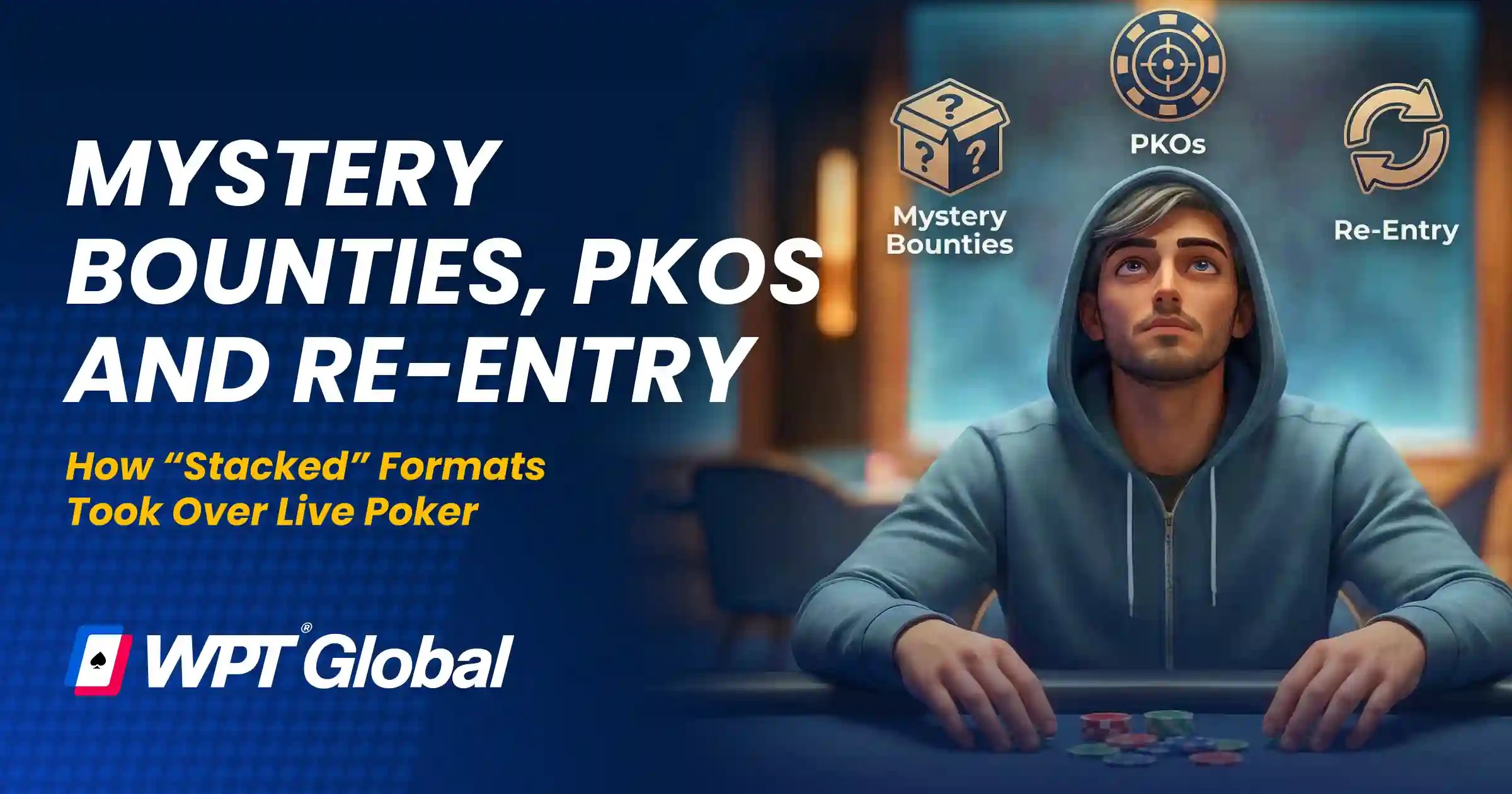
Mystery Bounty
When it comes to Mystery Bounties, you do not collect bounties from Hand 1.
Instead, every entry pays a bounty portion into a separate bounty pool. As a result, once the event reaches a set stage, usually Day 2, every knockout earns a random envelope or draw. Most envelopes are small. A few are huge jackpots.
At the top end of live poker, this format now carries serious weight:
A Mystery Bounty event in Las Vegas drew 18,409 entries in 2024. The 2025 edition grew to 19,654 entries, with two $1,000,000 bounties and a $1,000,000 top prize.
A high-stakes series in Monte Carlo added a $40,000 Mystery Bounty. It had 155 entries, 94 unique players, around $3.1M in the main prize pool plus a separate bounty pool, and a $400,000 jackpot bounty. So this is not something only reserved for side-events any more.
PKO (Progressive Knockout)
A PKO is two economies at once: chips and bounty equity. Everyone starts with a bounty.
When you bust someone, you usually get part of their bounty paid out immediately, and the rest gets added to your own bounty. The more you collect, the more expensive you are to play against.
Most live PKOs run close to a 50/50 split between the main prize pool and the bounty pool, but check the structure sheet. Re-entry is often allowed while late registration is open.
High-end festivals, including WPT® live tour stops, now schedule three and four-figure PKOs with real guarantees.
Re-entry and multi-flight
You bust, walk to the cage and then buy back in for a fresh starting stack along with a new random seat.
In practice, re-entry is usually paired with multi-flight events.
This is why they’re everywhere: entries, content moments, and scheduling.
Bigger headline numbers
Multi-flight and re-entry grow total entries, not just unique players. That pushes bigger prize pools and makes bigger guarantees easier to post and hit. It also gives tours clean headline numbers for recaps.
For example, a flagship Mystery Bounty in Las Vegas climbed from 18,409 entries to 19,654 in one year. A big European Mystery Bounty jumped straight to a €1,000,000 guarantee and beat it on the first run.
Big totals are easier to sell to media, partners, and players.
Sweat moments that sell the festival
Mystery formats give the series easy TV and social moments, some being:
A player peels a $1,000,000 envelope on camera.
Someone in Dublin draws a six-figure bounty in front of a packed rail.
A high-stakes regular in Monte Carlo sweats a $400,000 ticket on stream.
PKOs create their own drama. A player who builds a towering stack and a massive bounty on their head becomes a natural story for media coverage, as every pot against them matters more.
Better use of the schedule
Multi-entry formats let organisers run multiple Day 1 phases during the week, bring survivors back for a single big Sunday or Day 2, and build satellites and side events around one recurring headline event, like a Mystery Millions style banner.
So who gains most from Mystery Bounties, PKOs, and re-entry? Short answer: strong players with proper bankrolls, but recreational players get real upside if they accept the swings.
Mystery Bounties: high-variance by design
Mystery Bounties move a big chunk of EV into spikes:
You can bust early on Day 2 yet hit one envelope and book a huge win, while you can run deep in the regular payouts and miss all the big bounties, then finish with a smaller result than a standard ladder would give.
For the professionals, the long-term ROI can be very healthy if they adjust well, and variance is higher than a freezeout with the same buy-in and guarantee. Bankroll swings are wider, so they need a clear festival budget.
For recreational players, one knockout can change the entire trip, as typically, you don’t need a final table to have a story.
PKOs: early aggression has more value
PKOs reward knockouts, not just survival, as bounty value grows on your head. A few points:
Winning pots early matters more than in a pure ladder.
Calls against short stacks turn correct earlier once you include bounty equity.
Big stacks gain more than their raw chip share. Every bust they score is worth premium value.
Players who price bounties into shove and call decisions can gain a clear edge. On the other hand, those who treat a PKO like a regular freezeout can often pass on profitable spots or punt in bad ones.
Re-entry: edge vs bankroll
Re-entry changes the environment in two ways:
Prize pools and guarantees grow, or the field shifts toward bullet culture.
In capped formats, with one or two re-entries per flight, the effect is controlled. In unlimited re-entry events, the edge leans toward pros and backed players who can fire several times without wrecking their bankroll plan.
For serious recreational players, the key is discipline. Aim to decide your maximum number of bullets before you sit down, and treat that total as your real buy-in when you think about bankroll.
Re-entry gives you a second chance. It also makes it easier to overspend if you do not set a clear line from the get go.
Stacked formats work only if floors and players stay on the same page.
Multiple stacks and best stack forward
Standard practice:
You cannot play two live stacks in the same event at the same time. If you want to re-enter in the same flight, you usually must forfeit your current stack first. Some events may let you bag multiple stacks in different flights but only take your biggest stack to Day 2.
Misreading best stack forward rules is one of the quickest ways to waste a bag.
When do bounties start?
Here is a common Mystery Bounty pattern:
Day 1 plays like a normal tournament.
Day 2 starts once players reach the money or a fixed point.
From that stage, every knockout comes with a draw.
Each series sets its own trigger. Some start the draw at the money, while others wait for a level or player count. Do not assume. Check the structure sheet every time.
Operational and streaming pressure
Large bounties can add extra work for staff. For example, security must control crowds around the draw area, and floors and payouts staff must track every knockout, envelope, and payment with zero errors.
Streams need tight camera work and instant graphics so viewers know which jackpots are left. In the past, we’ve seen top live tours across Las Vegas, Europe, and the high-roller circuit show that big Mystery events can run smoothly.
More than anything, it takes careful planning and attention from the staff.
This looks like a structural shift, not a one-season gimmick. To take a look:
Large-field Mystery Bounty flagships have run every year since 2022 and keep posting massive entry counts.
European festivals have locked in seven-figure Mystery Bounties with multiple Day 1s.
High-roller series now include Mystery Bounties alongside their main NLHE events. PKOs and re-entry sit on the schedule as standard, not as a novelty.
We have seen this before, when Late registration followed the same path a decade ago. At first it felt controversial, now it is part of championship poker everywhere.
Mystery Bounties, PKOs, and re-entry may very well be on the same track. They often sit in every major schedule tier, from regional stops to world championship series.
Before you sit down in a stacked-format event, run through a quick checklist.
1. Read the structure sheet
Answer these:
When do bounties start?
How is the buy-in split between main prize pool and bounty pool?
Is re-entry capped per flight or unlimited?
Can you bag multiple stacks, and what happens to the smaller ones?
Small details change strategy in a big way.
2. Set a bullet cap
Decide your maximum number of entries in advance. Base it on:
Your normal buy-in.
Your real bankroll.
Your plans for the rest of the series.
Treat that total spend as your true buy-in for variance planning.
3. Adjust your strategy to the format
In Mystery Bounties, tighten up before bounties go live if they only start on Day 2. Once draws begin, you can widen ranges when bounty equity justifies it.
In PKOs, widen your calling and shoving ranges when the bounty makes the pot worth playing for. The right call in a PKO often looks loose in a regular event.
Treat bounty equity as real money, because it is.
4. Know why you are in the event
Be honest with yourself:
Are you chasing a life-changing bounty sweat?
Grinding leaderboard points or a full festival schedule?
Taking a one-off shot because you like the format?
Your reason should match your spend and your bullet cap.
5. Respect variance
These formats can pay huge. They can also brick for a while. Day 2 with no envelope and no cash happens. Plan for it.
The formats are not a cheat code. They are normal tournaments with extra layers on top.
If you understand the rules, plan your bullets, and adjust your strategy, stacked formats move from confusing hype to clear, playable opportunities.



 Local Payment Methods
 Cards
Cards Crypto
 E-Wallets
 Apple Pay
 Google Pay
 Instant Bank Payments
Some methods may not be available in your region. Please contact support if you experience any issues.