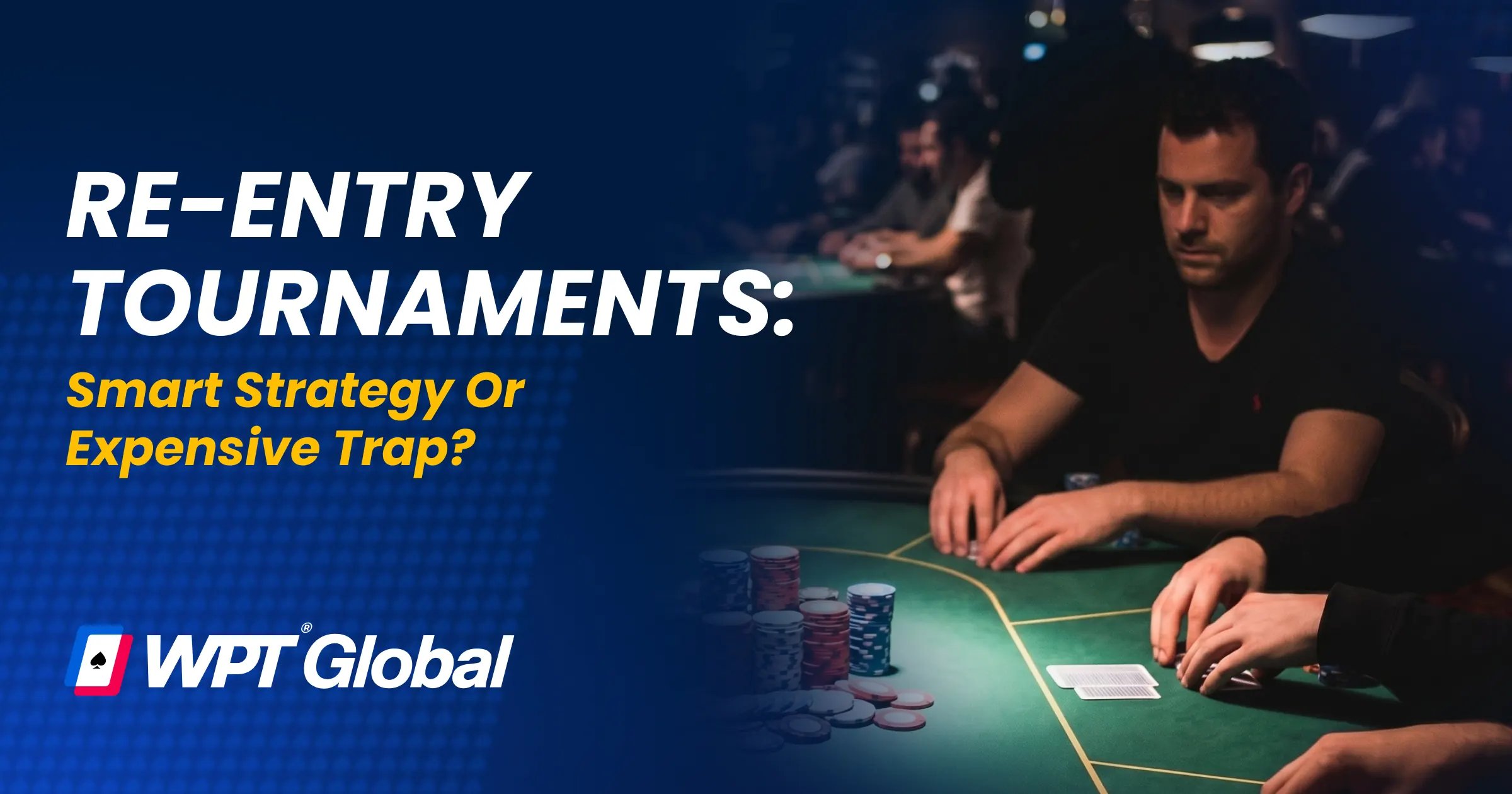
Re-entry tournaments are not automatically smart, and they are not always a trap. They are only rational when the next bullet still has real value.
That is the whole debate. A second entry can make sense if you still have an edge. But consider if the structure is still worth buying into, and whether your bankroll can absorb another full buy-in. If Bullet 2 is about frustration, ego, or fear of “wasting the trip,” then re-entry repeats the same costly mistake.
That is why the right question is not whether re-entry is fair or unfair in the abstract. The real question is much simpler: should you buy into this tournament again right now?
A re-entry tournament is not the same as a rebuy.
In a re-entry event, you must first bust, then buy back in as a new entry with a fresh starting stack and a new seat.
In practice, that usually means paying the full price again, including rake. A rebuy is different. In a rebuy format, extra chips can often be purchased while you are still alive.
That difference is important. Re-entry feels cleaner than rebuy tournaments. However, re-entry still changes a tournament's economics. A $1,100 event is not a $1,100 event if you are treating it as a likely two-bullet tournament.
Re-entry is becoming more common in modern poker, and upcoming 2026 schedules reflect this.
The Irish Open features different re-entry models during the festival. The Main Event allows a single re-entry for each flight. In contrast, the Mini Irish Open and the Super High Roller offer unlimited re-entries.
WPT® Rolling Thunder Championship allows unlimited re-entries until the end of the first break on Day 2. The $3,500 WPT® Seminole Hard Rock Poker Showdown Championship schedule includes the $3,500 WPT® Championship as a re-entry event. Re-entry is also featured in many other parts of the festival.
Some brands keep the Main Event as a freezeout. However, their broader series mixes freezeouts with events that allow one, two, or more re-entries based on the structure.
It appears the industry has not settled on one philosophy, but is using many.
The business case is obvious.
Re-entry boosts field size, helps events hit or beat guarantees, and gives festivals more headline numbers to market. A clear example from this year is Seminole’s $400 Deep Stack No-Limit Hold’em (Re-Entry) opener. It attracted 4,783 entries and built a prize pool of $1,578,390, with $201,030 for first place.
That is exactly why operators like the format. Re-entry can turn a big event into a very big event.
And for players traveling to a stop, the pitch is also easy to understand. If flights and hotel are already paid for, a second shot can feel practical instead of reckless.
But that is where discipline starts to matter. What is good for prize-pool headlines is not always good for the average player’s bankroll.
The best pro-re-entry case is not “why not fire again?” It is expected value.
Jonathan Little’s framework is a helpful guide. Each re-entry should be seen as entering a new tournament. It has the same buy-in but a worse structure. That point matters because later bullets are often not identical to the first one. Blinds are up, average stacks vary, and your relative edge might have shifted.
Therefore, if re-entering this event still offers positive expected value, then re-entering can be smart. If it does not, it's better to stop and wait for the next opportunity.
That is the grown-up version of the debate. Not “Do I want another chance?” but “Is this still a good investment?”
A second bullet is not emotionally neutral.
Ari Engel shared a key insight: players often lose focus after they bust and re-enter, especially after doing it many times. That is easy to believe because live tournaments are emotional even when players pretend otherwise.
It's no secret that busting hurts.
And, firing again often happens while the player is still irritated, disappointed, embarrassed, or trying to rescue the day.
That is why a second entry can look logical on paper but still be bad in practice. It might still be profitable. However, you might not be in the right state to realize that edge.
This is the part many players ignore. Bullet 2 is not a bankroll decision. It is a mental-state decision.
This is where re-entry formats can damage decision quality.
The format itself is not always the problem. The bigger leak is that some players start treating Bullet 1 like a warm-up. That changes behavior before they even bust. They pick thinner spots, bluff too often, defend too loosely, or think one punt doesn’t matter since they can always reload.
That mindset is exactly how a format turns from flexible into expensive.
Greg Raymer’s framing helps here. Re-entry does not turn a bad decision into a good one. It only gives you another chance to make a good decision later. If the first bullet becomes mentally disposable, the format is already costing more than the buy-in suggests.
Too many players talk about “re-entry tournaments” as if they are one product. They are not.
A freezeout is still the cleanest and fairest format for many recreational players because everyone gets one shot. The official first-timer guide points out that many casual players view the freezeout format as a benefit. This is because wealthier pros can't simply keep buying back in.
Single re-entry is a compromise. It gives players one second chance, but still puts a limit on how much one player can flood the field.
Unlimited re-entry is different again. It may work fine in high rollers, where bankroll assumptions and player expectations are very different. But in marquee Main Events, this is where the criticism gets loud. A 2018 pro panel said unlimited re-entry can work. However, they believe big Main Events are better as freezeouts or with limited re-entries. Unlimited entries can put off recreational players.
That distinction matters because “re-entry” is not really one debate. It is three.
The honest answer is obvious. Re-entry favors players with deeper bankrolls, stronger backing, or both.
That does not automatically make the format bad. But it does change the ecology of the event. Recreational players know they face opponents who can easily manage two, three, or more full buy-ins. That can make marquee events feel less level, even when everyone technically has the same rules.
This is the strongest anti-reentry argument, and it is not really about nostalgia. It is about the player ecosystem. Unlimited re-entry can make a tournament seem stronger on paper. However, it can also leave some players feeling outmatched.
That is why many players still prefer freezeouts or single re-entry formats in flagship events. They feel cleaner, more disciplined, and less tilted toward bankroll depth.
A second bullet can be smart when three things are true.
First, you still have a real edge.
Second, the structure is still good enough to justify the buy-in.
Third, your bankroll and mental state can handle it.
A strong player who travelled for a major stop and busted early is still facing a solid tournament structure. If they came with a pre-set bullet budget, re-entering could be a smart choice.
The key phrase there is a pre-set bullet budget. Smart players decide their exposure before they sit down, not after they bust.
When the smartest move is leaving
Many players hate this part because it feels passive, yet it is often the most disciplined option.
If the structure has worsened a lot, your emotions are off, or the second point would push your bankroll too much, the best strategy is to stay out.
For many players, the smartest response to a bustout is not “one more shot.” It is saving the money for a better structure, a better event, or another day when they are sharper.
That is especially true for under-rolled players and traveling recs who mistake sunk costs for poker logic. Flights and hotels may already be paid for, but that does not make the next entry good value.
So is re-entry smart strategy or an expensive trap?
It can be either.
Re-entering makes sense if the next bullet is still a solid investment. The player must also discipline themselves to view it this way. It becomes a trap when the decision is driven by tilt, ego, sunk-cost thinking, or fantasy bankroll logic.
So, re-entry is not always a leak. But for a lot of players, it becomes one because they budget emotionally instead of with reason.
So the real takeaway is simple: treat every bullet like a fresh investment, not a rescue mission. If Bullet 2 still makes sense, fire again. If it does not, leave.















 Customer Dispute Resolution Page
 Help Center
 Affiliate Program